
Best GEOs to Promote iGaming Offers: Tier 1 vs Tier 2/3
You can pour the same budget into two campaigns, run the same creative, push the same offer, and watch one bleed money while the other prints FTDs. The difference is rarely the funnel. It's the GEO.
I've watched advertisers burn through a quarter's media spend chasing the "premium" markets everyone names first, then quietly make their numbers back in countries their competitors ignored. So before you lock a single dollar to a campaign, the tier question deserves a real answer: where does iGaming traffic actually convert, and what does a first-time deposit cost you once the dust settles?
This isn't a "Tier 1 good, Tier 3 cheap" listicle. The tiers behave differently at every stage of the funnel, and the right mix depends on your offer, your payment rails, and how patient your bankroll is.
What "Tier" Actually Means for iGaming Advertisers
Tier labels come from affiliate and ad-network shorthand, not from any official body. They cluster countries by purchasing power, traffic price, and competition density. Rough version:
- Tier 1 – US, UK, Canada, Australia, Germany, the Nordics, New Zealand. High ARPU, mature regulation, expensive clicks.
- Tier 2 – much of Latin America, Eastern Europe, parts of Southern Europe, and a big slice of Asia including several Southeast Asian markets. Mid-cost traffic, fast-growing deposits.
- Tier 3 – large-population, lower-income markets across South Asia, Africa, and parts of SEA. Cheap traffic, thinner deposits, volume play.
The thing most decks get wrong: tiers describe the economics of a market, not its quality. A Tier 2 GEO with strong local payments and a real gambling culture can out-earn a Tier 1 GEO where you're the fourth identical casino offer a user has seen this week.
For an iGaming advertiser, the metric that matters isn't CPM or even CPC. It's cost-per-FTD – what you pay to acquire one player who funds an account – and the downstream value that player carries. Hold that lens through everything below.
Tier 1: Premium Players, Premium Prices
Tier 1 is where the lifetime value lives. A funded UK or Australian player often deposits more, plays longer, and tolerates higher minimums than someone in an emerging market. If your offer is built for high rollers or sports-betting whales, this is your pool.
The catch is the auction. Every regulated Tier 1 market is crowded with operators bidding for the same impressions, and several layer on compliance costs that push CPMs up further.
Where Tier 1 makes sense:
- High-LTV verticals (live casino, high-stakes sports) where one funded player covers a lot of expensive clicks.
- Brands with strong recall that can convert on a single touch instead of paying to re-warm cold traffic.
- Markets where you already hold the right licensing and can run compliant, easy-to-approve creative.
Where it bites:
- CPA-FTD targets in mature Tier 1 markets frequently run several multiples of Tier 2 costs. You're not buying a worse player – you're buying scarcity.
- Approval friction is real. Regulated markets demand tight ad copy, age-gating, and responsible-gambling messaging, which narrows what you can run.
- Saturation. When a user has seen ten near-identical bonus offers this month, your creative fatigues fast and CPMs climb to compensate.
Tier 1 isn't a trap. It's a margin business. The advertisers who win there have either a genuine LTV edge or a brand moat – and usually both.
Tier 2/3: Where the Math Often Tilts in Your Favor
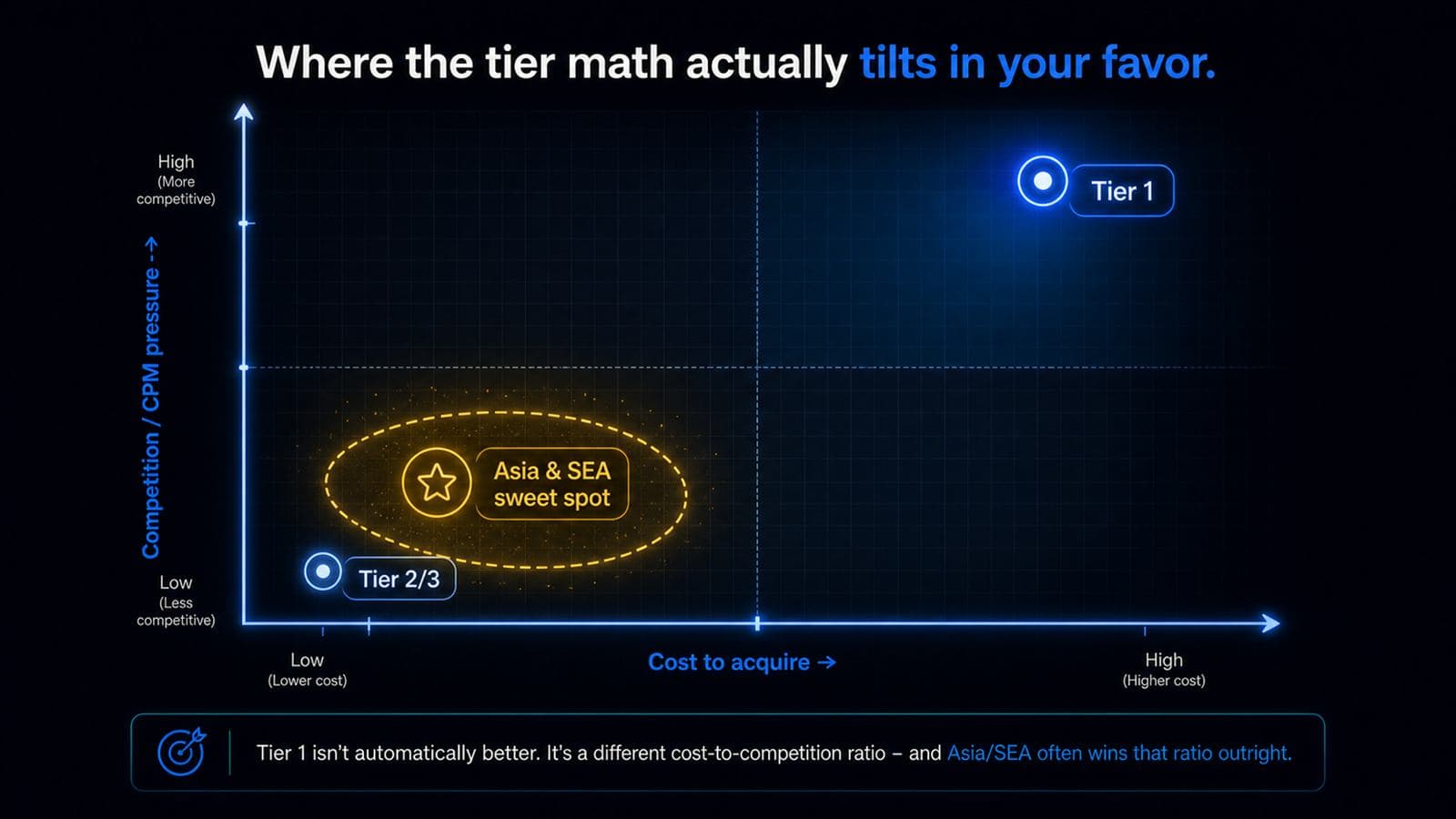
Here's the shift most advertisers underestimate. In many Tier 2 and emerging markets, traffic costs a fraction of Tier 1, deposit culture is accelerating, and a smaller average deposit is offset by far more funded accounts per dollar spent.
The trade-offs are honest:
- Lower average deposit per player. Your LTV model has to assume volume, not whales.
- Payment friction. Card penetration can be low; you'll lean on local wallets, bank transfers, and regional rails. Offers that support local payment methods convert dramatically better than ones that don't.
- Localization matters more, not less. Language, currency display, and culturally-tuned creative move conversion rates in these GEOs in ways a translated Tier 1 ad never will.
When the mechanics line up – local payments, native-language creative, the right format – Tier 2/3 can deliver a blended cost-per-FTD well below what the same offer costs in Tier 1, at volume Tier 1 simply can't supply.
A quick comparison
| Factor | Tier 1 | Tier 2 | Tier 3 |
|---|---|---|---|
| Traffic cost (CPM/CPC) | High | Medium | Low |
| Average deposit / LTV | High | Medium | Lower |
| Competition density | Very high | Moderate | Light |
| Volume ceiling | Capped | Large | Very large |
| Localization weight | Moderate | High | Critical |
| Typical cost-per-FTD | Highest | Mid–low | Low (volume) |
Read the table as tendencies, not laws. A well-run Tier 2 SEA campaign can beat a sloppy Tier 1 one on every column that pays the bills.
Asia and Southeast Asia: The Leverage Point
This is where we live, and where the standard tier playbook gets most interesting.
Southeast Asia is one of the fastest-moving regions for online gaming demand, and the GEOs inside it don't behave like a single block. The same offer that flops in one market converts in the one next door because of payment rails, device mix, and how locals actually engage with promotions. That granularity is the edge – and it's invisible if you treat "SEA" as one line in a spreadsheet.
A few patterns we see consistently across the region:
- Mobile-first, push-friendly. A large share of traffic is on Android, on cheaper data plans, reachable through push and in-page push at low CPMs. Formats that respect that – lightweight, fast-loading, push-led – outperform desktop-heavy banner buys.
- Local payments decide everything. The campaigns that win route through the wallets and bank transfers people actually use, not generic card flows. This single factor separates a 2% deposit rate from a 6% one.
- Per-GEO nuance beats regional averages. Bidding, creative angle, and best-performing format shift market to market. The advertisers who tune at the country level, not the regional level, are the ones quietly clearing their FTD targets.
This is where Taroviser's focus is built in. We're specialised in Asia and Southeast Asia and among the top networks for the region, and the value isn't just reach – it's the local market intelligence that tells you which SEA GEO to lean into, at what bid, with which format, before you've spent the test budget finding out the hard way.
Building a smart tier mix
You don't have to pick a tier. The strongest iGaming media plans blend them:
- Anchor in Tier 2 SEA for efficient, scalable FTD volume at a low blended cost.
- Layer Tier 1 selectively where your LTV or brand justifies the premium, not as a default.
- Use Tier 3 for top-of-funnel volume and learning, then reallocate toward whatever GEO and format actually convert.
Then let the data and an optimization layer push spend toward the cost-per-FTD that works, instead of toward the tier label that looks impressive in a pitch.
How Taroviser Optimizes Across Tiers
Picking the right GEO is the start. Holding performance once you're live is the harder part, and it's where the platform earns its keep.
- Cost-per-FTD optimization. Our AI layer combines advertiser data to push spend toward the GEOs, formats, and placements that produce funded players – not just clicks. CPM/CPC/CPA-FTD pricing models supported.
- Asia & SEA market intelligence. Local insight on which of 200+ available GEOs to scale, with the per-market nuance that regional averages hide.
- Five formats, fully covered. Push, in-page push, popunder, native, and interstitial – so you can match the format to how each GEO actually consumes ads.
- S2S postback tracking. Server-to-server attribution so your FTD and deposit events flow back cleanly and the optimization runs on real outcomes.
- No platform fee, no minimum. Test a Tier 3 GEO on a small budget without a floor working against you, and scale what converts.
- Easy approvals + human-analyst anti-fraud. Get compliant campaigns live fast, with human review on the traffic quality side rather than automated guesswork alone.
- 24/7 support, self-serve or managed. Run it yourself or let our team manage the tier mix and bidding for you.
Compared with broad self-serve networks, the difference is the regional specialization: many platforms can sell you 200 GEOs, far fewer can tell you which SEA market will actually return your FTD target this quarter. On price, Taroviser typically runs 30–50% below comparable networks, which changes what a Tier 3 volume test or a Tier 1 scale-up can afford.
A Note on Compliant Markets
Tier strategy only works inside the law. Promote iGaming offers only where the activity is permitted, target only the geos where your operator holds the right licensing, and gate by age everywhere. Responsible-gambling messaging isn't a compliance checkbox you bolt on – in regulated Tier 1 markets it's often what gets your creative approved at all, and it protects the brand you're spending to build. Frame every campaign around legal, permitted markets first; the GEO math is only worth running on traffic you're allowed to acquire.
FAQ
Which tier has the lowest cost-per-FTD for iGaming?
Usually Tier 2 and well-run Tier 3 markets, because traffic is cheaper and competition is lighter. The caveat is average deposit size – Tier 1 players are worth more individually, so the right answer depends on whether your model rewards volume or LTV. Blended, many advertisers see their best cost-per-FTD in Tier 2 SEA.
Are Tier 1 GEOs worth the higher price?
For high-LTV verticals and brands with strong recall, yes. One funded UK or Australian player can carry a lot of expensive clicks. For volume-driven offers or newer brands without a margin edge, Tier 1 often underperforms a smart Tier 2 mix on cost-per-FTD.
Why are Asia and Southeast Asia singled out for iGaming?
Demand is growing fast, traffic prices are still efficient, and the markets are highly mobile- and push-friendly. The real edge is per-GEO nuance: local payments and creative angles vary sharply between neighboring SEA markets, so country-level tuning beats regional averages.
How important is localization in Tier 2/3 markets?
Decisive. Native-language creative, local currency display, and – above all – local payment methods can move deposit rates by several multiples versus a translated Tier 1 ad with card-only checkout. In emerging GEOs, localization is the campaign, not a finishing touch.
Can I test a Tier 3 GEO on a small budget?
Yes. With no platform fee and no minimum, you can run a small Tier 3 volume test, read the S2S postback data, and reallocate toward whatever actually converts before committing real spend.
Which ad formats work best across tiers?
Push and in-page push tend to win in mobile-first Tier 2/3 SEA markets at low CPMs. Native and interstitial can suit higher-intent Tier 1 placements, and popunder works as a volume layer. Matching format to GEO behavior matters more than picking one "best" format.
Start With the Right GEO Mix
Stop letting the tier label pick your budget. Map your offer to the markets where it actually converts, anchor in the Asia/SEA GEOs where the cost-per-FTD math works in your favor, and scale on real FTD data instead of impressions.
Taroviser gives you the local market intelligence, the 200+ GEOs, the five formats, and the cost-per-FTD optimization to do exactly that – with no platform fee, no minimum, and a team on hand 24/7. Launch a self-serve test or talk to a managed-campaign analyst, and let the FTD numbers decide your tier mix.
Related on Taroviser
Related guides
- iGaming Traffic in Indonesia: A Compliance-First Advertiser's Guide
- iGaming Traffic in Malaysia: Advertiser Guide to a Restrictive Market
- iGaming Traffic in Singapore: Advertiser Guide to a High-Value Market
- iGaming Traffic in Cambodia: Advertiser Guide to a Complex Market
- iGaming Traffic in Myanmar: Advertiser Guide to an Emerging Market
- Do Fullpage Interstitial Ads Increase iGaming Conversions? What It Does
Traffic & ad formats
Ready to launch?
Put these tactics to work with premium iGaming traffic on Taroviser.
Start advertising