
How Much Does It Cost to Advertise an Online Casino? 2026 Pricing Guide
There is no single price tag for advertising an online casino — your real cost is set by four drivers: the GEO you target, the ad format you run, how much competition is bidding on the same inventory, and the quality of your creative and funnel. You pay in one of three pricing models (CPM, CPC or CPA), but the number that actually decides profitability is your cost per first-time deposit. This guide breaks down each driver, when to use each pricing model, and how to bring the cost down.
The four things that decide your cost
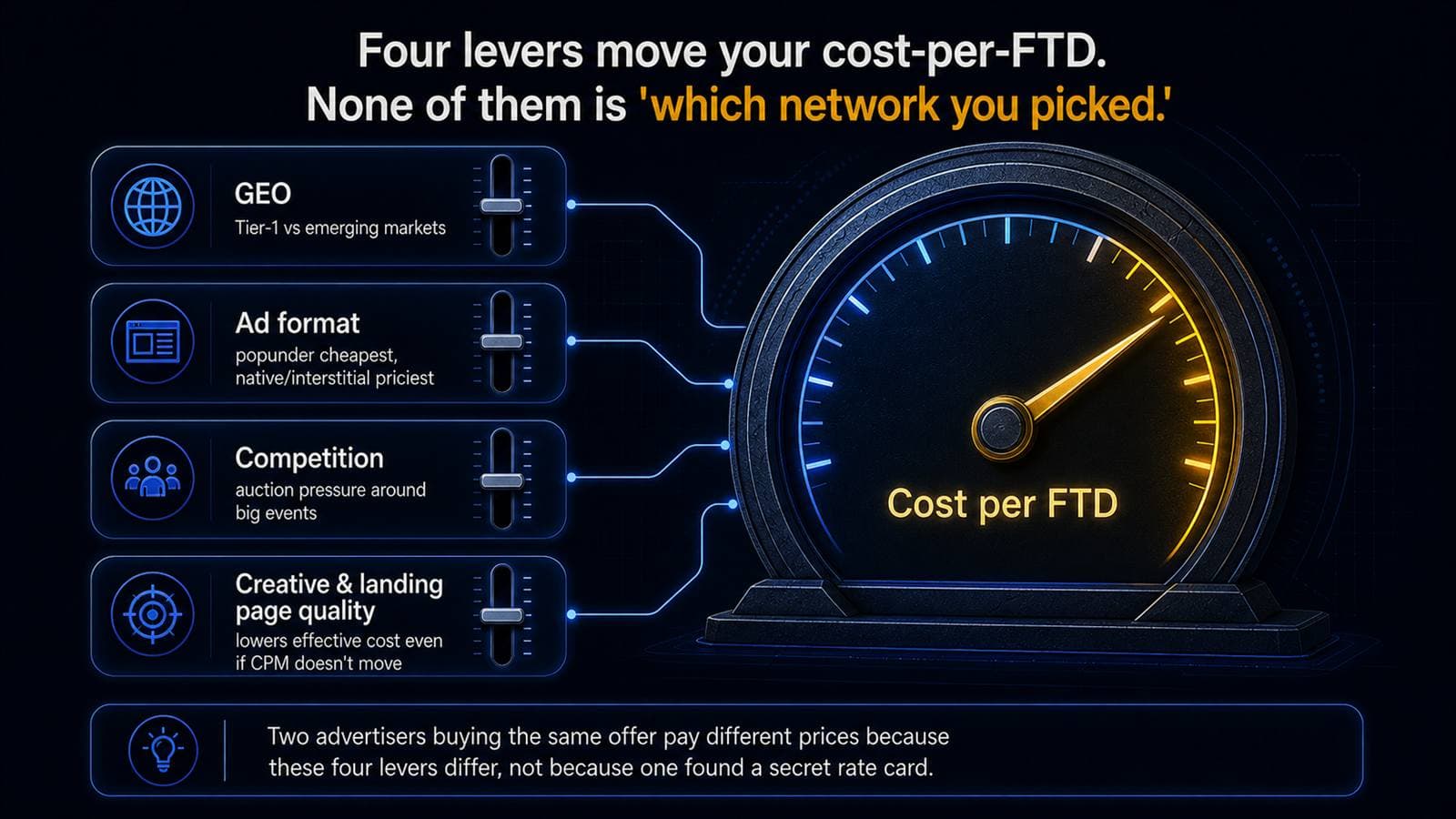
Before you compare any rate card, understand what moves it. These four levers explain almost every difference in what two advertisers pay for the same offer.
- GEO. Tier-1 markets have higher player value and deeper pockets bidding against you, so impressions and clicks cost more. Emerging markets and much of Asia and Southeast Asia offer cheaper traffic and fast-growing demand. Start where your offer is licensed and your payment rails work.
- Ad format. High-volume formats such as popunder are priced for reach and cost the least per unit. Push notifications and in-page push sit in the middle. Native ads and interstitial placements command more because they buy attention and engagement, not just volume.
- Competition. Inventory is auctioned. When more advertisers chase the same GEO, device and time slot — around a big fixture for sports betting, for example — clearing prices rise. Auction-based SmartCPM and SmartCPC bidding help you win efficiently without overpaying.
- Quality. Your own creative and landing page quietly set your cost. A stronger click-through and conversion rate lowers your effective cost per click and per deposit even when the raw CPM never changes.
The three pricing models, and when each fits
You choose the model that matches your goal and your appetite for risk. The Taroviser Network supports all of them — CPM, SmartCPM, CPC, SmartCPC and CPA — in a single account.
| Model | You pay for | Who carries risk | Best for |
|---|---|---|---|
| CPM / SmartCPM | Every 1,000 impressions | You | High-volume reach, early GEO and creative testing |
| CPC / SmartCPC | Each click to your page | Shared | Paying only for engaged users on push and native |
| CPA | A defined action (registration or deposit) | The network | Scaling segments that already have conversion data |
The reliable sequence is to discover, then scale. Test on CPM or CPC across two or three GEOs to learn which countries, devices and creatives convert. Cut the losers ruthlessly. Then move proven segments to CPA so spend follows depositors automatically. A CPA goal only performs once optimisation has learned who converts, which is why the CPM-or-CPC test comes first — and why CPA is a scaling tool, not a starting point.
Why cost-per-FTD is the number that matters
CPM and CPC are input costs. They tell you what you pay for impressions and clicks, but neither tells you what you pay for a depositing player. Two campaigns with an identical CPC can produce wildly different cost per FTD once their conversion rates diverge. A campaign that looks cheap on CPC can be your most expensive on the only metric that touches revenue.
To see that number, connect S2S postback tracking so registration and first-deposit events flow back from your platform in real time. That does two jobs: it lets you measure net cost per deposit instead of surface metrics like CTR, and it feeds the continuous AI optimisation that steers delivery toward depositing users. That optimisation needs your conversion data via postback to work — it cannot know who deposited unless you tell it.
How to control and lower your cost
Once you know the drivers, lowering cost is a matter of working each one deliberately.
- Pick your battles by GEO. Begin in lower-competition markets where you are licensed, prove the funnel, then expand into pricier Tier-1 GEOs with a model that already works.
- Ladder your formats. Test cheap, high-volume popunder and in-page push first; graduate winners into premium native and interstitial once the economics are proven.
- Improve quality relentlessly. Better creative and pre-landers raise conversion rate, which lowers your effective cost per deposit without touching your bid.
- Cut waste with delivery controls. Use frequency capping, dayparting and zone whitelists and blacklists to stop paying for impressions that never convert.
- Let clean traffic protect your budget. Human-analyst anti-fraud — IVT filtering, bot detection and zone scoring — screens out invalid traffic so you are not paying for clicks that could never deposit.
What it costs to start with Taroviser
Structure matters as much as media rates. Taroviser charges no platform fee and has no monthly minimum, so your budget goes to inventory rather than overhead. The minimum deposit is just 50 USD, campaign approval is typically completed in under two hours, and you can run self-serve or work with a managed team. As a specialised iGaming network with deep Asia and Southeast Asia reach across 200+ GEOs, the Taroviser Network is built to run roughly 30 to 50 percent more cost-efficiently than comparable generalist sources — a positioning you can confirm in your own controlled test rather than take on faith.
The takeaway: stop shopping for a headline CPM. Model the four cost drivers, discover on CPM or CPC, scale winners on CPA, and judge everything by cost-per-FTD. That discipline is what separates profitable casino buying from guesswork. When you are ready to buy casino traffic and put the math to the test, start small, measure the deposit, and scale what pays.
Related on Taroviser
Related guides
- iGaming Traffic Provider: How to Buy Traffic That Actually Converts
- Telegram Ads for iGaming: How to Advertise on Telegram (Cost, Formats, Setup)
- iGaming Ad Network Vietnam: Buy Casino & Betting Traffic That Converts
- iGaming Ad Network Thailand: Buy Casino & Betting Traffic That Converts
- iGaming Ad Network Philippines: Buy Casino & Betting Traffic That Converts
- Casino Advertising in 2026: How to Advertise an Online Casino
Traffic & ad formats
Frequently asked questions
How much does it cost to advertise an online casino?
There is no single sticker price. Your real cost is set by four drivers: the GEO you target, the ad format you run, how much competition is bidding on the same inventory, and the quality of your creative and landing page. High-value Tier-1 markets cost more per impression and click than emerging markets; high-volume formats like popunder are cheaper per unit than premium native placements. Rather than chase a headline CPM, model your cost-per-first-time-deposit, because that is the number that decides whether a campaign is profitable. With Taroviser you can start with a 50 USD minimum deposit, with no platform fee and no monthly minimum, so you can test cheaply before scaling.
Should I buy casino traffic on CPM, CPC or CPA?
Match the model to the stage. Use CPM or SmartCPM for high-volume reach and early GEO or creative testing, where you carry the learning risk but keep the upside. Use CPC or SmartCPC when you want to pay only for engaged clicks. Move a segment to CPA once it has produced enough conversion data for optimisation to learn who deposits. The reliable path is to discover on CPM or CPC, then scale winners on CPA. Taroviser supports CPM, SmartCPM, CPC, SmartCPC and CPA in one account.
Why is cost-per-FTD more important than CPM or CPC?
CPM and CPC tell you what you pay for impressions and clicks, but neither tells you what you pay for a depositing player. Two campaigns with an identical CPC can have very different cost-per-first-time-deposit once conversion rates differ. Cost-per-FTD is the metric that ties spend directly to revenue, so it is the number you should optimise toward. To measure it accurately, connect S2S postback tracking so registration and first-deposit events flow back from your platform in real time.
Are there any platform fees or monthly minimums?
No. Taroviser charges no platform fee and has no monthly minimum, so your budget goes to media rather than overhead. The minimum deposit to start is 50 USD. You can run self-serve or work with a managed team, and campaign approval is typically completed in under two hours.
How can I lower my casino advertising costs?
Control the four cost drivers. Start in lower-competition GEOs where your offer is licensed, test cheaper high-volume formats before premium ones, and improve creative and landing-page quality so your effective cost per click and per deposit falls. Feed conversion data back via postback so optimisation can steer spend toward depositing users, and use frequency capping, dayparting and zone whitelists to cut waste. The Taroviser Network is also built to run more cost-efficiently than comparable generalist sources, which you can confirm in your own test.
Ready to launch?
Put these tactics to work with premium iGaming traffic on Taroviser.
Start advertising