
A/B Testing iGaming Ad Campaigns: Test Creatives, Geos and Bids
To A/B test an iGaming campaign properly, change one variable at a time, give each variant enough traffic and enough days to produce real conversions, and decide the winner on cost per first-time deposit measured through S2S postback, not on click-through rate. Test in a sensible order (creative, then geo, then pre-lander, then format, then bid model), hold everything else constant, and only roll a winner into scale once the deposit data confirms it. Everything below is how to run that loop without fooling yourself.
A quick note before we start. This is written for advertisers, affiliates and media buyers who buy traffic to acquire depositing users. It is not player-facing, and nothing here is advice on how to gamble. Run every test inside the rules: respect age-gating, geo-restrictions and responsible gambling requirements in each market you touch.
Why most iGaming tests prove nothing
The two ways a test dies quietly are both common. The first is measuring the wrong thing. A buyer swaps a creative, watches the click-through rate jump, declares a winner, and never notices that the flashier creative pulled in curious clickers who never deposit. The second is changing too much at once. New creative, new geo mix and a shift from CPC to CPA, all in the same week, and when the results move there is no way to know which change did it.
Good testing fixes both. You pick a single variable, you measure all the way down to the first-time deposit, and you wait for enough volume that the difference between variants is signal rather than luck. Get those three things right and the rest is bookkeeping.
What to test, and in what order
Not every variable deserves the same attention, and the order you test in matters because each test should sit on a foundation you already trust.
- Creative – the cheapest thing to change and usually the biggest lever. For push notifications and in-page push, that means the icon, the title and the short line of copy. For native ads, the thumbnail and headline. Test angle, not just wording: a bonus-led hook behaves very differently from a live-event hook.
- Geo – the same offer converts nothing alike across markets. A tier-3 Southeast Asian geo and a tier-1 market are different economies, not the same test at different sizes. Split them and judge each on its own cost per FTD.
- Pre-lander – the page between the ad and the operator. A well-matched pre-lander warms the click and lifts registration-to-deposit conversion; a mismatched one leaks qualified users. This is often where a campaign is quietly won or lost.
- Format – popunder, interstitial, push, in-page push and native each convert with their own personality. Format is a real test, but change it on its own, not tangled up with creative.
- Bid model – CPM, SmartCPM, CPC, SmartCPC and CPA answer different questions. Moving from a CPC buy to a CPA buy changes the risk profile of the campaign, so treat the switch as its own experiment once your creative and geo are settled.
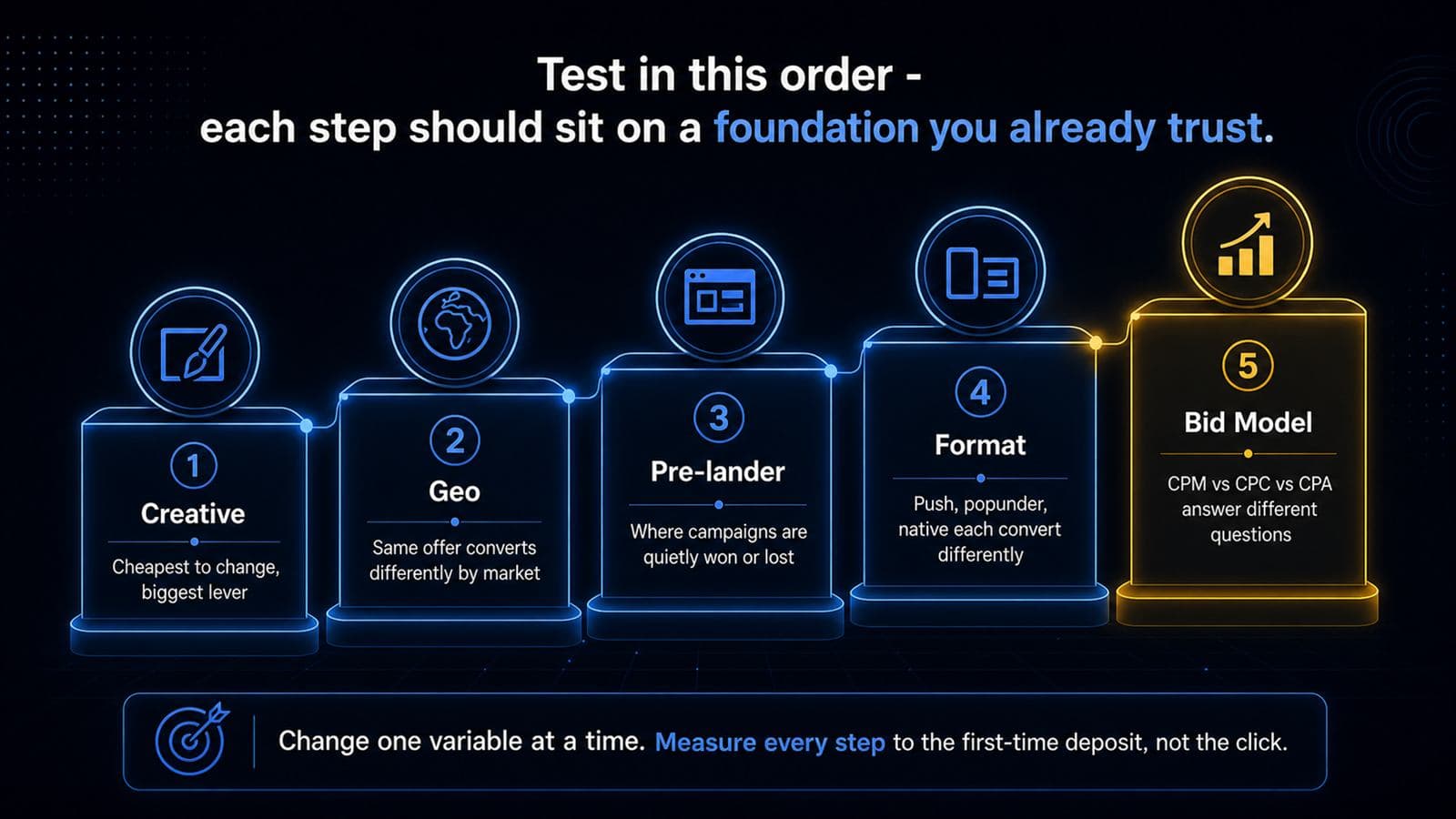
Working top to bottom means your format and bid tests run on a creative and geo you have already validated, instead of every variable drifting at once.
Control your variables
The whole point of an A/B test is a clean comparison, and that only works if the two variants differ in exactly one way. If you are testing two creatives, run them into the same geo, the same device and OS targeting, the same frequency cap, the same pre-lander and the same bid. If you are testing two geos, run the same creative into both. Anything else and you are measuring a fog.
Two practical habits protect the comparison. First, split by traffic zone deliberately rather than letting variants fight over the same inventory, so one does not starve the other. Second, keep frequency capping and dayparting identical across variants during the test window, because a creative that only ran in peak evening hours will flatter itself against one that ran all day.
Give the test enough volume and time
This is where iGaming testing diverges hardest from ordinary display. Registrations arrive quickly; deposits lag. A user who signs up today may deposit four days later. Judge the test at 24 hours and you will undercount FTDs and kill variants that were about to turn profitable.
So define, before you start, how many conversions each variant needs before you will call it, and roughly how many days that will take given your deposit lag. A handful of FTDs is not a result; it is noise wearing a costume. A low-volume variant can post a wild cost per FTD off two lucky deposits, and if you scale on that you are scaling luck. Wait for enough volume per variant that the gap between them is unlikely to be chance, and only then decide.
Patience has to be paired with cleanliness. Early wins can be invalid traffic that has not been caught yet, which is why our anti-fraud layer matters mid-test as much as after it. A zone that posts a great early cost per FTD on bot-driven or fraudulent deposits is not a winner; it is a trap that surfaces later as clawbacks. Filtering that out during the test is what keeps the comparison honest.
Measure to the FTD, not the click
Every decision above depends on seeing the real conversion, and client-side pixels are not good enough for that. They get blocked, they drop across redirects, and they struggle with deposits that land days after the click. S2S postback is the fix: your platform fires the registration, FTD and deposit-value events server-side, straight to the network, each with its click ID attached, the instant they happen on your side.
With that data flowing, you can compare variants on the number that actually pays you. Break cost per FTD down by geo, by format and by individual traffic zone, and the winner stops being a matter of opinion. Taroviser supports S2S postback precisely so your test decisions run on real deposit events rather than clicks, and the continuous AI optimisation layer only works once that advertiser-side conversion data is coming back through the postback – it reads which zones and geos produce profitable FTDs, but it needs your data to do it.
Roll winners into scale carefully
A confirmed winner is a starting point, not a finish line. When you scale, raise budget in steps rather than all at once, because a bid that won efficiently at low volume can behave differently as it reaches for more inventory. Watch the cost per FTD as you climb; if it holds, keep going, and if it drifts up, you have found the ceiling for that variant and the next test is how to push it higher.
Then keep testing. Feed the losing side of each completed test a fresh challenger. Creative fatigues, geos saturate, and the pre-lander that won last month can slip. A campaign that has stopped testing has stopped improving; the loop of isolate, measure to the FTD, and scale the winner is the engine, not a one-time setup.
Running the loop on Taroviser
Taroviser is an iGaming-specialised network among the leading options for casino, sportsbook and poker traffic, with deep Asia and Southeast Asia reach across 200+ geos and seven ad formats. For testing specifically, three things matter: granular targeting to hold variables constant, S2S postback so you measure to the FTD, and a human-analyst anti-fraud layer so your test data is not corrupted by invalid traffic. The traffic is also built to run around 30-50% more cost-efficiently than comparable generalist sources, which is exactly the kind of positioning you should confirm in your own controlled test rather than take on faith. When you are ready to buy iGaming traffic and put a real methodology behind it, the minimum deposit is 50 USD, with no platform fee and no monthly minimum, and campaign approval typically takes under two hours.
Related on Taroviser
Related guides
- iGaming Campaign Optimization: The Performance Playbook for Casino and Betting Ads
- iGaming Ad Creative Optimization: Creatives That Convert to FTD
- Pre-Lander and Landing Page Optimization for Casino and Betting Offers
- Traffic Source and Zone Optimization for iGaming: Whitelists, Blacklists
- AI-Assisted Campaign Optimization for iGaming Advertisers: Get More FTDs
- How to Run Casino Push Notification Campaigns That Convert
Traffic & ad formats
Frequently asked questions
What should I A/B test first in an iGaming campaign?
Start with the creative, because it is the cheapest variable to change and usually the biggest lever on click quality and downstream FTDs. Once you have a winning creative, move on to geo splits, then pre-lander, then format, and finally the bid model. Testing in that order means each later test runs on a foundation you already trust, instead of everything moving at once.
How long should I run an A/B test before picking a winner?
Long enough to clear the deposit lag and gather meaningful conversion volume, which in iGaming usually means several days rather than hours. First-time deposits trail registrations by days, so a test judged at 24 hours will mislead you. Wait until each variant has produced enough FTDs that the difference between them is unlikely to be noise, and pair that patience with anti-fraud review so early wins are real.
Why shouldn't I use CTR to decide the winner?
Because click-through rate measures interest, not deposits. A creative or zone can post a beautiful CTR and still send almost no depositing users, quietly draining budget while the dashboard looks healthy. In iGaming the number that pays you is the first-time deposit, so decide winners on cost per FTD measured through S2S postback, and treat CTR as a secondary diagnostic at most.
Can I test creative, geo and bid model all at once?
You can, but you should not, because when several variables move together you cannot tell which one caused the result. Change one thing per test and hold everything else constant. If you truly need to explore many combinations, use a structured multivariate plan with enough volume for each cell, rather than eyeballing three changes at the same time.
How does Taroviser help me measure tests to the FTD?
Taroviser supports S2S postback so your registration, first-time deposit and deposit-value events fire back to the network with their click ID attached, which lets you compare test variants on real conversions instead of clicks. Reporting breaks down to geo, format and individual traffic zone, and a human anti-fraud layer filters invalid traffic so your test results are not corrupted by bots. Traffic is also built to run more cost-efficiently than comparable generalist sources, which you can confirm in your own test.
Ready to launch?
Put these tactics to work with premium iGaming traffic on Taroviser.
Start advertising