
AI-Assisted Campaign Optimization for iGaming Advertisers: Get More FTDs
If you buy traffic for a casino brand, a sportsbook, or an affiliate operation, the hard part was never getting impressions. The hard part is getting the right ones to turn into first-time depositors before the budget runs dry. Most media buyers in this space have lived the same Tuesday. A campaign launches strong. CPA looks healthy for two days. Then it starts creeping up while click volume sits flat, and by the time the report makes it obvious, a real chunk of spend has already gone to placements, geos, and time slots that were never going to deposit.
That gap is what AI-assisted campaign optimization is meant to close. Not as a slogan. As a continuous process that watches a campaign the way a person sitting at a dashboard simply cannot: every hour, across every source, every geo, every creative, all at the same time. It's the core of how we work at Taroviser, and we think it's where iGaming advertisers hold the most defensible edge.
So this article walks through what AI-assisted optimization actually means for an iGaming advertiser, where it helps, where it doesn't, and why it compounds when you pair it with real market knowledge in Asia and Southeast Asia (SEA).
The advertiser's real pain: optimization at a speed humans can't sustain
Performance in iGaming doesn't sit still. Player behavior shifts by hour, by payday cycle, by the sporting calendar, by regulatory news, by whatever competitor just dumped budget into a promo. A static campaign decays even when it's well built. And the decay rarely shows up as a clean cliff. It's a slow leak across a dozen dimensions at once:
- A few placements quietly start eating budget without producing deposits.
- A geo that converted last week softens this week because a competitor flooded the same inventory.
- A creative that crushed on push starts to fatigue on in-page push.
- Your best converting hours drift two time zones over without anyone noticing.
A human optimizer can chase one or two of those at a time. By the time they've rebalanced bids on the leaking placements, the geo mix has already moved on. This isn't a skill problem. I've watched sharp buyers lose the thread here, and it's never because they weren't good. It's bandwidth and latency. There are too many decisions, too often, and they're too tangled together for manual tuning to stay in front of.
AI-assisted optimization changes the unit of work. Instead of a person reacting to yesterday's report, a model reads the signal across the whole campaign surface and moves the levers that matter, while a human analyst owns the strategy, the guardrails, and the calls a machine shouldn't make. Machine speed, human context. That's the whole point.
What "AI-assisted" actually optimizes (and what it doesn't)
Worth being precise here, because "AI-powered" gets stamped on everything in ad tech. Here's what genuinely moves the needle for an iGaming advertiser once optimization runs continuously.
The levers AI tunes continuously
| Lever | What the model does | Why it matters for FTD |
|---|---|---|
| Source / placement bidding | Shifts budget toward sources producing deposits, throttles those producing only clicks | Directly lowers CPA by removing dead spend |
| Geo allocation | Re-weights spend across 200+ geos as conversion patterns move | Captures SEA pockets that swing week to week |
| Daypart & frequency | Aligns delivery to the hours and caps that actually deposit | Reduces wasted impressions and creative fatigue |
| Creative rotation | Promotes winning angles per format, retires fatigued ones | Keeps CTR and post-click quality from sliding |
| Bid model per format | Calibrates CPM/CPC/CPA logic differently for push, in-page push, popunder, native, interstitial | Each format converts on a different curve |
The throughline: optimization chases the deposit, not the click. Clicks are cheap to optimize toward and easy to fake. The FTD is the number your CFO actually cares about, so the model gets steered toward the downstream conversion signal fed back through S2S postback, not toward vanity engagement that looks pretty in a chart.
What AI does not do
Honest framing matters here, because over-promising is exactly how advertisers get burned. AI-assisted optimization will not:
- Invent demand that isn't there. If an offer doesn't fit a geo, no bidding strategy fixes that.
- Replace a good offer, landing page, or funnel. Optimization amplifies a funnel that works. It can't rescue one that's broken.
- Remove the need for human judgment on compliance, geo-gating, and responsible-gambling framing.
Optimization is a multiplier on fundamentals. We treat it that way, and we'd rather say so up front than oversell and lose your trust in month two.
The compounding advantage: AI plus advertiser data plus market intelligence
A model is only as good as the data it reads. Which is why the shape of the relationship matters more than the algorithm itself.
1) Your data closes the loop
The most valuable signal in iGaming optimization isn't impression data. It's your conversion data. When an advertiser passes deposit events back through S2S postback, the model stops guessing at proxy metrics and starts learning from the outcome that actually pays the bills: the FTD, and ideally the value signals that come after it. Network-side delivery data plus advertiser-side conversion data is what lets optimization tune toward CPA/FTD efficiency instead of toward clicks that flatter a dashboard. The tighter that loop, the faster CPA settles down.
2) Market intelligence is the context the model can't infer alone
Raw optimization is reactive. It learns from what already happened. Market intelligence is what lets you get ahead of it. This is where being built around Asia and SEA earns its keep. Taroviser's expertise and strong volume are specialised in this region, so the optimization isn't running on a generic global model. It carries local context: which geos move on which calendars, how inventory behaves across SEA markets, where competition is crowding a placement, and where there's still efficient reach to be had.
For an advertiser, that shows up as fewer "discovery tax" dollars. You spend less learning a market from scratch because the network already knows its rhythms.
3) Human analysts keep it honest
Continuous automation with nobody watching is how budgets drift into low-quality inventory. The model handles the high-frequency tuning. Human analysts own anti-fraud review, strategy, and the judgment calls a model shouldn't make on its own. That human-led anti-fraud layer sits right next to the optimization on purpose, so "efficient" never quietly turns into "cheap and worthless."
A realistic optimization loop, start to finish
Here's how the cycle actually runs for an iGaming campaign on Taroviser:
- Launch with structure, not guesses. Set up across formats (push, in-page push, popunder, native, interstitial) with S2S postback wired to your FTD event from day one. No platform fee and no monthly minimum, so you can test breadth without a big upfront commitment.
- Let the model read early signal. In the first hours, the system tracks which sources, geos, and dayparts produce not just clicks but actual deposit signal.
- Continuous reallocation. Budget shifts toward depositing segments 24/7. Fatiguing creatives rotate out. Leaking placements get throttled.
- Human checkpoint. Analysts review for fraud patterns, sanity-check geo and compliance constraints, and step in where the data is ambiguous.
- Scale the winners. Once a segment proves CPA-efficient, the model leans into it and the analyst greenlights scaling, at a cost we position at roughly 30–50% below typical alternatives.
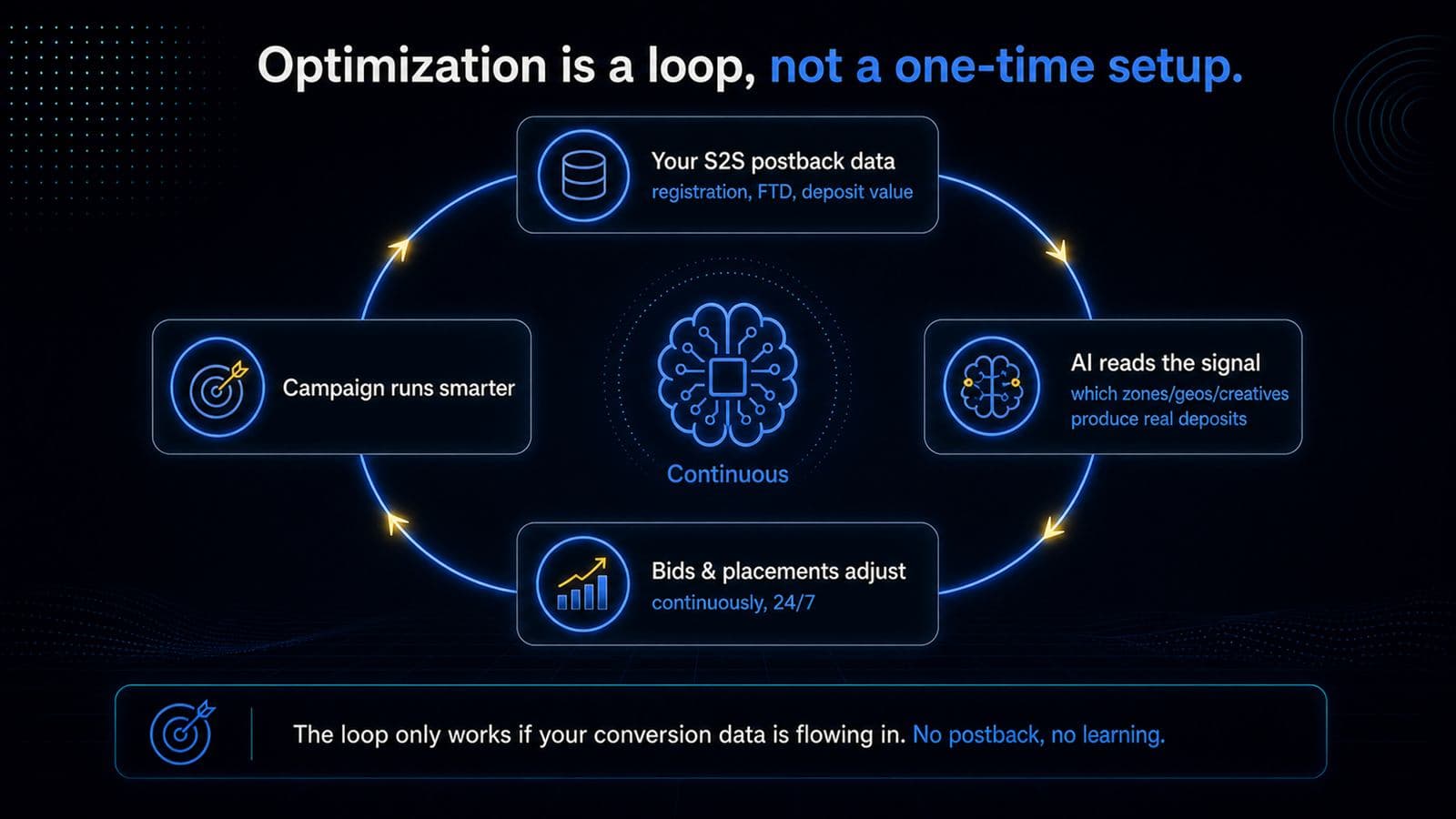
What you're aiming for is a campaign that gets more efficient the longer it runs, instead of one that quietly decays.
How this stacks against other networks
Most networks offer some flavor of automated bidding. The differentiator isn't whether automation exists. It's how much regional context feeds it, how close the conversion feedback loop sits, and whether there's a human anti-fraud layer on top.
- Plenty of large global networks operate at serious scale and offer fast approval and self-serve access. Where Taroviser sets out to stand apart is service depth, price efficiency, SEA-specific market intelligence, and AI optimization tuned to iGaming FTDs specifically rather than to generic global performance.
- Across the wider competitive set, advertisers often report – in public reviews and community threads – friction around things like support responsiveness, limited regional granularity, or optimization that chases clicks over downstream conversions. Those networks may well dispute that characterization, and experiences differ. The honest takeaway is simple: generic optimization and iGaming-specialized, SEA-informed optimization are not the same product.
Taroviser's position is plain enough. iGaming-specialized, ad formats that are easy to approve, 24/7 support, continuous AI optimization, and leading local intelligence specialised in Asia/SEA, with no platform fees or monthly minimums.
Practical guardrails for advertisers
A few things that consistently separate advertisers who win with AI optimization from the ones who don't:
- Pass real conversion data back. Optimization without FTD postback is optimization toward the wrong target. Wire S2S from day one.
- Give the model room to learn before you judge it. The first hours are signal collection. Killing a campaign at hour six is judging a model on noise.
- Keep compliance non-negotiable. Responsible gambling, age-gating, and geo-gating aren't optimization variables. They're constraints the optimization has to respect, and we treat them as fixed.
- Optimize the funnel too. The fastest CPA win is often a better landing page, not a better bid model.
FAQ
Q: How does AI optimization actually lower my CPA?
By continuously moving budget away from sources, geos, and dayparts that produce clicks-without-deposits and toward the ones producing FTDs, at a frequency and breadth no manual operator can match. The savings come from cutting dead spend, not from cutting quality.
Q: Do I need to share my conversion data? Is that safe?
Sharing FTD events via S2S postback is what makes optimization target deposits instead of clicks. You control what's passed. The tighter the conversion feedback loop, the faster and more accurately CPA stabilizes.
Q: How long before optimization shows results?
There's no universal number. It depends on volume, geos, and offer fit. The principle holds across campaigns: the model needs enough deposit signal to learn before it can reallocate with confidence. Judge it on a meaningful sample, not the first few hours.
Q: Why does Asia/SEA focus matter for my campaign?
Conversion patterns in SEA markets move on local rhythms – calendars, paydays, competitive promo waves. Optimization informed by deep regional intelligence spends fewer dollars learning a market from scratch, so efficient reach turns up faster.
Q: Is the optimization fully automated, or are humans involved?
Both. The model handles high-frequency tuning 24/7. Human analysts own strategy, fraud review, and compliance judgment. That pairing is deliberate – automation for speed, humans for context.
Q: Which ad formats does this work across?
Push, in-page push, popunder, native, and interstitial. The bid logic is calibrated per format because each converts on a different curve, and CPM/CPC/CPA models are tuned toward FTD efficiency rather than raw clicks.
Start optimizing toward deposits, not clicks
If your campaigns are decaying faster than you can retune them by hand, that's not a discipline problem. It's a bandwidth problem, and it's exactly what continuous, AI-assisted optimization solves. Pair it with deep Asia/SEA market intelligence, a tight FTD feedback loop, and human-led anti-fraud review, and that's how iGaming advertisers turn spend into depositors at a cost that holds up under scrutiny.
No platform fee. No monthly minimum. Easy-to-approve formats across 200+ geos, with 24/7 support and optimization that keeps working while you sleep.
Talk to a Taroviser specialist or open a self-serve account to launch your first AI-optimized campaign. Bring your offer and your FTD postback. We'll handle the tuning.
Related on Taroviser
Related guides
- iGaming Campaign Optimization: The Performance Playbook for Casino and Betting Ads
- iGaming Ad Creative Optimization: Creatives That Convert to FTD
- Pre-Lander and Landing Page Optimization for Casino and Betting Offers
- Traffic Source and Zone Optimization for iGaming: Whitelists, Blacklists
- A/B Testing iGaming Ad Campaigns: Test Creatives, Geos and Bids
- How to Run Casino Push Notification Campaigns That Convert
Traffic & ad formats
Ready to launch?
Put these tactics to work with premium iGaming traffic on Taroviser.
Start advertising