
How to Buy Casino Traffic That Converts: CPM vs CPC vs CPA
Buying casino traffic profitably comes down to one question: does the cost of acquiring a depositing player stay below their value? The pricing model you choose – CPM, SmartCPM, CPC, SmartCPC or CPA – determines who carries the risk of getting that answer wrong, and picking the wrong one for your stage of funnel maturity is how buyers quietly burn budget. This guide breaks down when to use each, how to pair pricing with format and geo, how to structure a first test budget, and why every one of those decisions should be judged on cost-per-FTD rather than clicks.
A quick note before we start. This is written for advertisers and media buyers, the people buying traffic to acquire depositing players. It is not player-facing, and nothing here is advice on how to gamble. Run every campaign inside the rules: respect age-gating, geo-restrictions, and responsible gambling requirements in each market you touch, and only buy where your offer is licensed.
The five pricing models
Taroviser bills casino traffic on five models, and the split that matters is not really CPM versus CPC versus CPA – it is who carries the risk of a click or an impression not turning into a depositor. Here is what each one actually does.
- CPM (cost per mille): you pay per 1,000 impressions. You carry all the risk, but you also keep all the upside when creatives and landers perform. Best for high-volume formats like popunder traffic where you want cheap reach to gather data fast.
- SmartCPM: the same per-impression billing, but the platform adjusts your bid impression by impression, within limits you set, to win the inventory most likely to perform. It spares you the manual bid-babysitting that plain CPM demands once your targeting and creatives have stabilised.
- CPC (cost per click): you pay per click to your landing page. Risk shifts partly to the network – you only pay for engaged users, not for impressions that go nowhere. Great for push and native, where the click is a meaningful signal of intent.
- SmartCPC: CPC billing with automated per-click bidding, so the platform leans your spend toward the sources and zones that convert rather than the ones that merely get tapped. Reach for it when you have a working CPC campaign and want to stop tuning bids by hand.
- CPA (CPA Goal 2.0): you pay against a defined action – registration or first deposit – and the network's AI optimises delivery toward that goal. Lowest risk to you, but you give up some margin and the model needs conversion volume to learn before it performs. It is a scaling tool, not a discovery tool.
How each model shifts risk
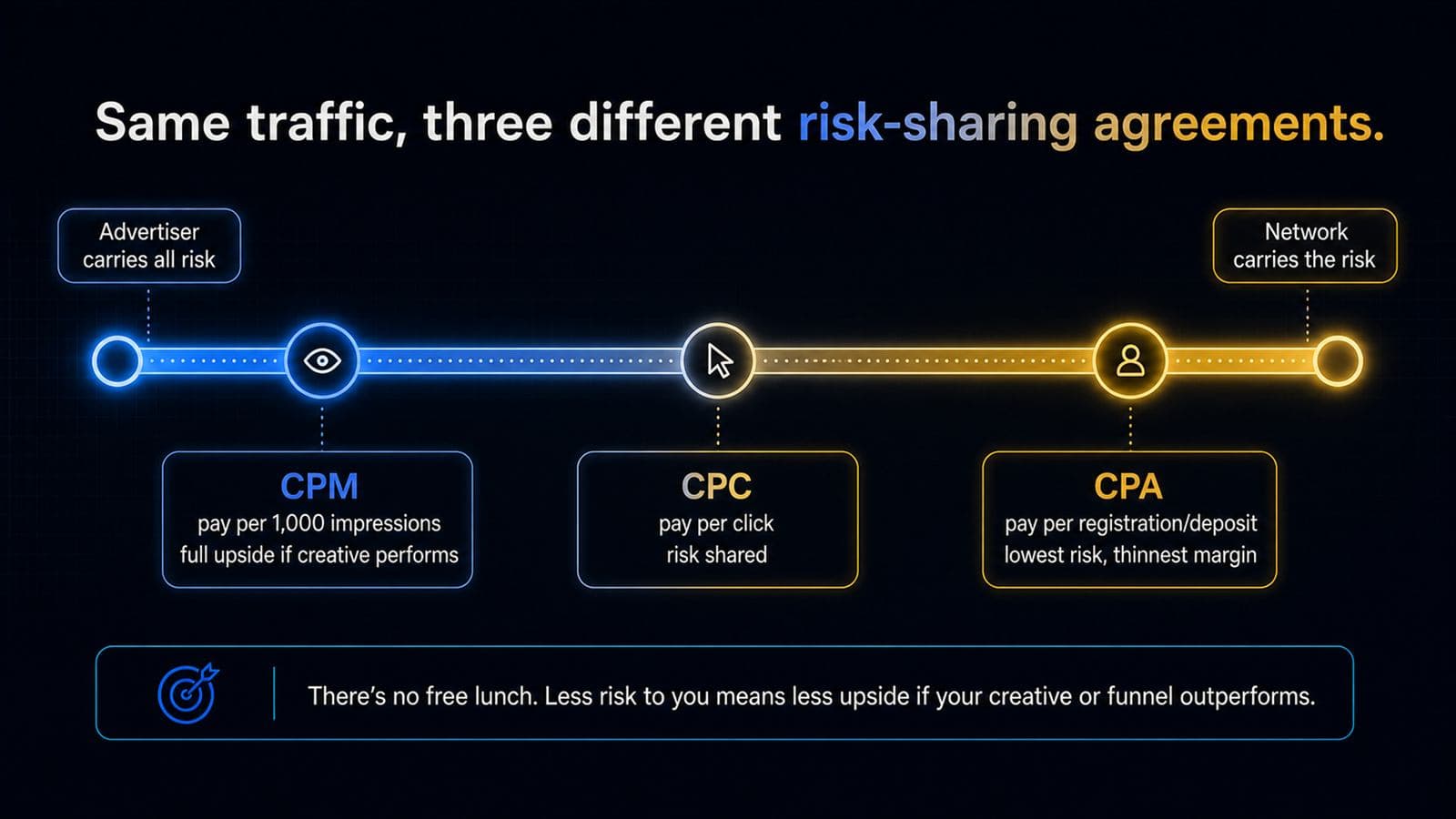
Read the five models as a single spectrum. On the CPM end, the advertiser carries every bit of the risk: you pay for the impression whether or not it produces a click, a registration or a deposit, and in exchange you see the rawest, cheapest data and keep all the upside when your funnel converts. Move toward CPC and the network starts sharing the load – you stop paying for impressions that never engage. Reach CPA and the network carries most of the delivery risk, because you only pay when the action you defined actually happens.
Nothing is free on that spectrum. Every step that offloads risk onto the network is paid for in margin or in a learning requirement. CPA looks safest because spend follows depositors, but it cannot steer toward a first deposit until it has seen enough first deposits to learn the pattern, and that learning is fed entirely by the conversion data you send back. Point CPA at a cold, unproven segment and it has nothing to optimise on. That is the single most common way buyers misfire: reaching for the lowest-risk model before they have generated the data it needs to work.
Pick the model by funnel maturity and goal
The cleanest way to choose is to ask where your funnel is on its learning curve, not which model sounds cheapest. A brand-new offer, a fresh GEO or an untested creative has no conversion history, so it belongs on CPM or CPC, where you are paying to generate the data. A segment you have already proven, one that is posting registrations and deposits at a cost you can live with, belongs on CPA, where you are paying to scale what the data already told you. SmartCPM and SmartCPC sit in the middle: use them once a CPM or CPC campaign is stable and you want the platform to keep tuning bids while you focus on creative and offers.
The reliable path is to start broad and tighten:
- Test on CPM or CPC across 2–3 GEOs to find which countries, devices and creatives convert. Keep the variables few enough that you can read the result.
- Cut ruthlessly. Kill GEO and creative combinations that don't produce registrations within your sample window, before they eat the budget the winners need.
- Hand winners to SmartCPM or SmartCPC, then CPA. Let automated bidding press the advantage on a proven segment, and once it has enough deposit volume, move it to a CPA goal so spend follows depositors automatically.
For the wider view of how a cost-per-action network is structured underneath this workflow, our explainer on how CPA networks work in iGaming shows why the conversion feedback loop is the whole game.
Pair pricing with format and geo
A pricing model is only half a decision. The other half is the format it rides on and the market it runs in. Taroviser sells five formats – Push, In-page Push, Popunder, Interstitial and Native – and each pairs naturally with a different pricing posture. Popunder gives you cheap, high-volume reach, which is exactly what CPM discovery wants. Push and native produce a cleaner click signal, so they sit well on CPC and SmartCPC. Interstitial commands full attention at a break point, which rewards tight targeting rather than broad CPM spray. Match the format to the job the pricing model is doing, and the two reinforce each other instead of fighting.
Geo is the third leg. Casino demand and payout economics vary widely by market. Tier-1 markets (Canada, Germany, New Zealand, Finland) carry higher player value but more competition; emerging markets (Brazil, India, Mexico) offer cheaper traffic and fast-growing demand. Taroviser reaches 200+ GEOs with particularly deep inventory across Asia and Southeast Asia, so the practical move is to start where your offer is licensed, your payment rails work, and the traffic is deep enough to gather data quickly. Our online casino vertical page lists the GEOs that consistently perform, and our guide to choosing an iGaming traffic provider covers the wider selection criteria.
Structure a test budget
A test budget exists to buy one thing: enough conversion data to tell winners from losers with confidence. Structure it so no single unproven variable can drain it. In practice that means splitting a fixed discovery budget across 2–3 GEOs on CPM or CPC, capping spend per GEO and per creative so a bad combination self-limits, and refusing to scale anything until it has cleared a real sample window. First deposits lag clicks, sometimes by days, so give each segment long enough to let those deposits land before you judge it.
The economics are friendlier here than on most networks. There is no platform fee and no monthly minimum, so your discovery budget goes to media rather than overhead, and reported costs run about 30 to 50 percent lower than many alternatives, which stretches the same test dollars further. The minimum deposit is 50 USD and approval typically completes in around two hours, so a controlled test can be live the same day. Anchor the whole exercise to a target cost-per-FTD: for most casino offers on quality traffic, a workable range is roughly 25 to 75 USD per first deposit, tightening or loosening by GEO and player value. If your funnel is weak or the offer is mismatched, that figure can balloon to 100 to 200 USD or worse, which is a signal to fix the funnel, not to keep pouring budget into it. Our breakdown of how to lower your cost per FTD walks through the levers that pull that number down.
Measure to cost-per-FTD, not clicks
A campaign can look profitable on paper and lose money after costs. Always model the net result with real fees baked in – a tight win-rate target that ignores costs is how media buyers fool themselves. The way to see it honestly is S2S postback: wire your platform to fire the registration and first-deposit events server-to-server with the click ID attached, and your cost-per-registration and cost-per-FTD reflect real deposits rather than browser-side guesses, even when those deposits lag the original click by days.
That same postback feed is what powers the AI optimisation on CPA and the Smart bidding models. Feed it clean conversion data and delivery steers toward depositing players; feed it clicks and it steers toward clicks. Multi-layer anti-fraud on the traffic side keeps that signal honest by filtering the invalid taps that would otherwise poison the read. For the full framework on which numbers decide profitability and how they chain together, our guide to iGaming ad performance metrics lays out cost-per-FTD and the surrounding metrics in depth. The short version: track cost-per-registration and cost-per-FTD, never CTR alone.
The format gets you reach; the pricing model decides who eats the risk while you learn. Use CPM/CPC to discover, Smart bidding to press winners, CPA to scale.
Bringing it together
Discover on CPM or CPC, cut fast, hand the survivors to Smart bidding and then CPA, and keep your eyes on net cost per deposit the whole way. Pair each pricing model with a format and a geo that fit the job it is doing, size your test budget to buy data rather than hope, and let S2S postback and AI optimisation do their work on a clean signal. That discipline is what separates profitable casino buying from guesswork. Browse traffic by format, compare pricing models, or open an account to get started.
FAQ
Should I buy casino traffic on CPM, CPC or CPA?
It depends on how much conversion data you already have. Use CPM or CPC to discover which GEOs, devices and creatives convert, because those models let you gather data while you carry the learning risk. Once a segment has enough deposit data, move it to CPA so spend follows depositors automatically. Taroviser supports CPM, SmartCPM, CPC, SmartCPC and CPA (CPA Goal 2.0) so you can run this discover-then-scale path inside one account.
What is the difference between CPM and SmartCPM, or CPC and SmartCPC?
The Smart variants are automated bidding on top of the same billing unit. Plain CPM and CPC bill per 1,000 impressions or per click at the price you set, and you tune bids by hand. SmartCPM and SmartCPC let the platform adjust your bid per impression or click within your limits to win the inventory most likely to perform, which spares you manual bid-babysitting once your creatives and targeting are stable.
What is CPA Goal 2.0 and when should I use it?
CPA Goal 2.0 optimises delivery toward a defined action such as registration or first deposit, and it only works once the AI has learned which users convert. Taroviser's continuous optimisation tunes delivery toward the FTD, but it needs your advertiser conversion data fed back via S2S postback to do so. Use it to scale a segment you have already proven on CPM or CPC, not to discover a cold one.
What is a realistic cost per first deposit for casino traffic?
Treat a cost-per-FTD in the 25 to 75 USD range as a workable target for most casino offers on quality traffic, tightening or loosening by GEO and player value. A weak funnel, a poorly matched offer or an unlicensed GEO can push that to 100 to 200 USD or worse, which is a signal to fix the funnel rather than to keep buying. Judge every campaign on this number, not on clicks.
Which formats and GEOs can I buy casino traffic on?
Taroviser offers five ad formats: Push, In-page Push, Popunder, Interstitial and Native, so you can match the format to your strategy, such as popunder for high-volume CPM testing or push and native for CPC. Inventory spans 200+ GEOs with particularly deep reach across Asia and Southeast Asia, alongside Tier-1 and emerging markets. Start where your offer is licensed and your payment rails work.
What does it cost to get started with Taroviser?
The minimum deposit is 50 USD, with no platform fee and no monthly minimum, so your budget goes to media rather than overhead. Reported costs run about 30 to 50 percent lower than many alternatives, account approval is typically completed in around two hours, and you can run self-serve or work with a managed team. Multi-layer anti-fraud helps protect your spend as you scale.
Related on Taroviser
Related guides
- Evadav Alternative for iGaming Advertisers
- Galaksion Alternative for iGaming Advertisers: How to Choose and Test One
- HilltopAds Alternative for iGaming Advertisers
- Mondiad Alternative for iGaming Advertisers
- TrafficStars Alternative for iGaming Advertisers
- Buy Casino & Betting Traffic in Brazil & LATAM: The 2025 Advertiser Playbook
Traffic & ad formats
Ready to launch?
Put these tactics to work with premium iGaming traffic on Taroviser.
Start advertising