
iGaming Traffic Provider: How to Buy Traffic That Actually Converts
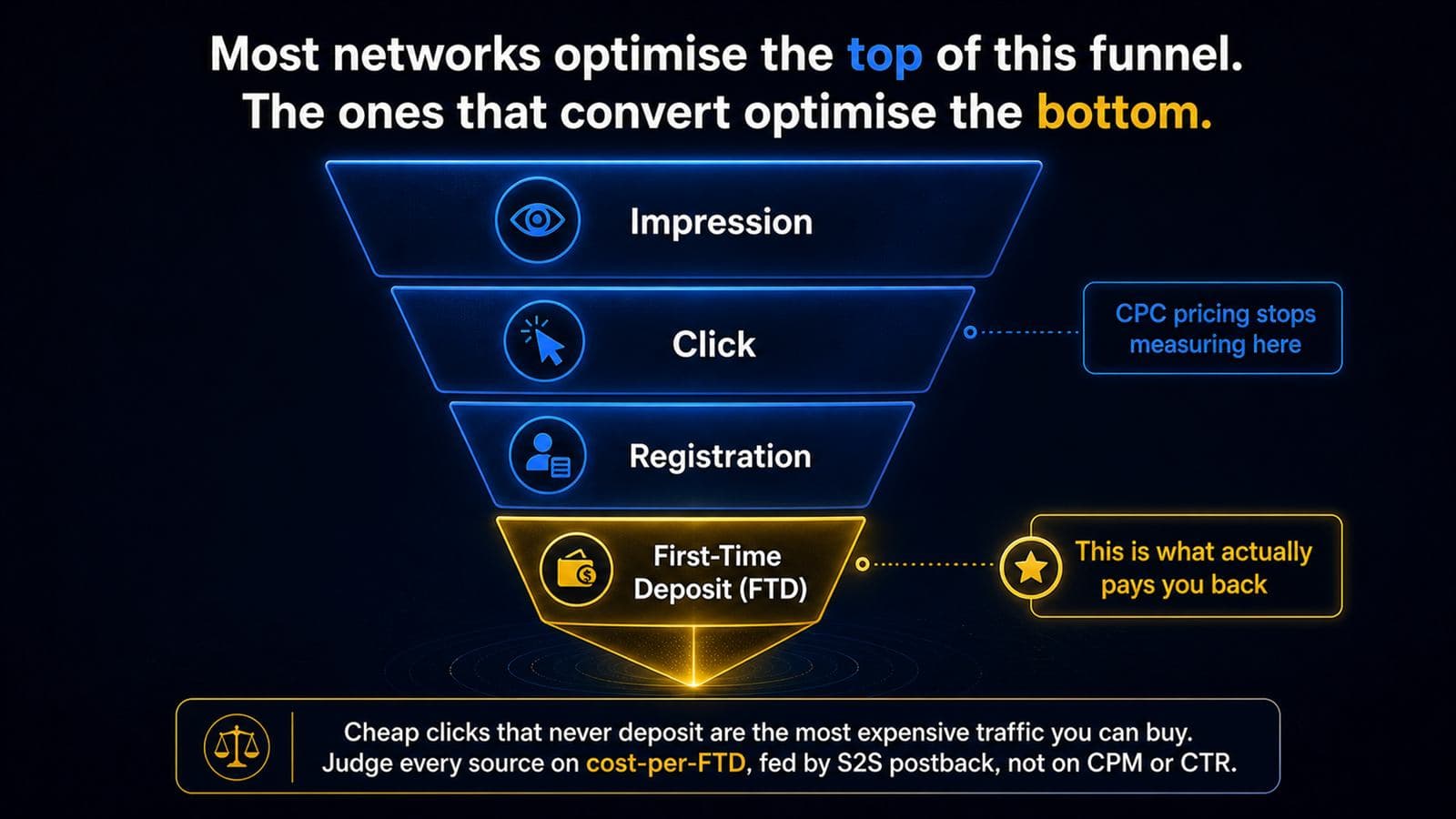
An iGaming traffic provider is an ad network that sells traffic specifically to gambling advertisers, and buying traffic that converts means judging every source on one number: cost-per-FTD, not cost-per-click. This guide covers what actually separates a converting traffic source from a cheap one, where the volume really sits (mobile over desktop, and the real Android-versus-iOS tradeoff), and how to evaluate a provider before you commit budget.
Traffic Is Not a Commodity in iGaming
Generic ad networks sell impressions. An iGaming traffic provider has to sell something more specific: opted-in supply that a casino or sportsbook creative is actually allowed to run on, filtered for the fraud patterns that concentrate in gambling verticals, and priced in a way that lets you optimise toward a first-time deposit instead of a click. Buy traffic that ignores any one of those three things and the CPM looks fine right up until you check cost-per-FTD.
That is the real difference between a traffic provider and a traffic source. A provider gives you the levers to make cheap traffic converting traffic: format choice, device and OS targeting, geo depth, and anti-fraud layered on top of the raw supply.
Desktop vs Mobile: Where iGaming Volume Actually Lives
Mobile carries the bulk of iGaming volume today. Casino and sportsbook audiences are mobile-first almost everywhere, which is why push notifications, in-page push and popunder – all mobile-native formats – tend to be the workhorses for prospecting and re-engagement. Desktop volume is smaller, but it has not gone away: higher-stakes sportsbook offers and live-casino products still pull meaningful desktop traffic, particularly in Tier-1 markets where desktop session times run longer.
The practical read for a media plan: lead with mobile for volume and cost efficiency, and keep a desktop lane open specifically for verticals where the average deposit is large enough to justify the higher desktop CPM.
Android vs iOS: The Tradeoff Advertisers Underestimate
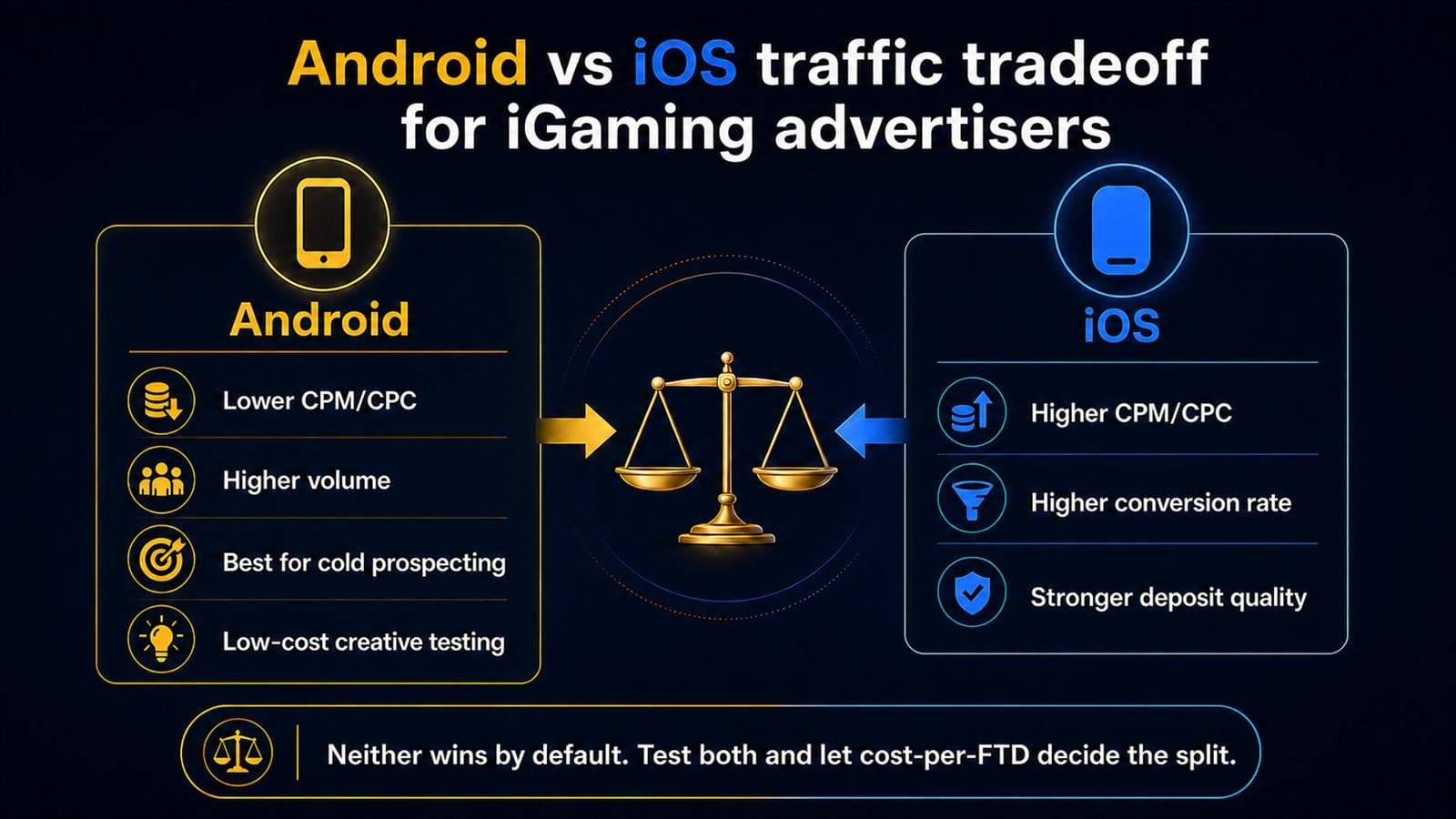
Within mobile, Android and iOS behave differently enough that treating them as one audience wastes budget. Android inventory is typically cheaper on both CPM and CPC, and there is simply more of it, which makes Android the natural choice for cold prospecting and testing new creative angles at low cost. iOS costs more per impression and per click, but iOS users tend to convert at a higher rate and carry better deposit quality once they do – a smaller, pricier audience that pays back more per acquired player.
Neither is universally right. The advertisers who get this correct do not pick a device by CPM alone; they run both, feed conversion data back through S2S postback, and let cost-per-FTD decide the split. In practice that often means Android for volume and initial creative testing, then iOS layered in once a funnel is proven and the higher entry cost is justified by the deposit quality on the other end.
What Actually Makes Traffic Convert
Four things determine whether traffic converts, more than any single pricing model does.
- Format fit. Push and in-page push carry prospecting and re-engagement, popunder delivers volume for aggressive tests, native and interstitial suit brand-forward and content-led funnels. The wrong format for the job wastes spend regardless of how cheap the traffic is.
- Geo and device targeting. iGaming performance swings hard by market and by device – the granular controls (geo, device, OS, browser, language, connection type, frequency capping, dayparting) are what let you stop paying for impressions that were never going to convert in the first place.
- Anti-fraud filtering. Gambling offers attract a disproportionate share of bot and invalid traffic. Human-analyst anti-fraud review layered on top of automated IVT filtering keeps spend away from sources that never had a real depositor behind them.
- Optimisation toward the FTD. Once conversion data flows back through S2S postback, continuous AI optimisation can steer bids, placements and creatives toward the sources that actually produce deposits, not just clicks.
How to Evaluate an iGaming Traffic Provider
Score any candidate on the same criteria before moving budget: genuine iGaming specialisation rather than gambling tolerated alongside every other vertical, fast and predictable ad approval, real geo depth in the markets your licence covers, the ad formats your funnel actually needs, FTD-aware optimisation, human-analyst anti-fraud, and transparent pricing with no platform fee or hidden minimum. For a full side-by-side comparison across ten platforms on exactly these axes, see our ranked guide to the best iGaming ad networks of 2026.
FAQ
What is an iGaming traffic provider?
An iGaming traffic provider is a self-serve ad network and DSP that sells online traffic specifically to gambling advertisers such as online casinos, sportsbooks and poker rooms. Unlike a generic ad network, it accepts gambling creatives, understands first-time-deposit economics, and offers formats, targeting and anti-fraud built for the vertical rather than bolted onto a general-purpose platform. Taroviser runs five formats – Push Notification Ads, In-page Push, Popunder, Interstitial and Native – across 200+ geos with deep reach in Asia and Southeast Asia.
How do I buy iGaming traffic?
You open a self-serve account, fund it, pick a format and geo, wire S2S postback so registrations and first-time deposits track back server-to-server, then launch. With Taroviser the minimum deposit is 50 USD, there is no platform fee and no monthly minimum, and campaign approval typically clears in about two hours. You can run everything self-serve or lean on the managed team, and the rule that matters is to judge every source on cost-per-FTD rather than clicks.
What makes iGaming traffic convert?
Four things do more than any single pricing model: format fit for the job, granular geo, device and OS targeting, multi-layer anti-fraud (IVT and bot filtering, zone scoring and human review), and optimisation toward the first-time deposit. Once conversion data flows back through S2S postback, AI optimisation can steer bids, placements and creatives toward cost-per-FTD instead of cheap clicks that never deposit.
How much does iGaming traffic cost?
It depends on format, geo and pricing model, so there is no single number. Taroviser offers CPM, CPC, CPA (CPA Goal 2.0), SmartCPM and SmartCPC, with flexible bidding that often runs around 30–50% lower cost, and it does not publish fixed rate cards because rates move by market and format. The honest way to plan is by cost-per-FTD: a workable range is roughly 25 to 75 USD per first-time deposit, while a weak funnel can push that to 100–200 USD. You can start testing from the 50 USD minimum deposit with no platform fee.
What is the difference between an iGaming traffic provider and an ad network?
An iGaming traffic provider is a specialised ad network – the difference is focus, not category. A generic ad network tolerates gambling alongside every other vertical, while an iGaming traffic provider is built around it, with gambling-friendly formats, FTD-aware optimisation, vertical-specific anti-fraud and geo depth in the markets that matter. Taroviser is a self-serve ad network and DSP specialised in iGaming rather than a generalist platform that happens to allow it.
How do I choose a reliable iGaming traffic provider?
Score candidates on genuine iGaming specialisation, fast and predictable approvals, real geo depth in your licensed markets, the ad formats your funnel actually needs, optimisation aware of the first-time deposit, multi-layer anti-fraud with human review, S2S postback for register and FTD events, and transparent pricing with no platform fee or hidden minimum. Then prove it with a small test – Taroviser clears approval in about two hours and the 50 USD minimum lets you validate cost-per-FTD on your own offer before you scale.
Where Taroviser Fits
Taroviser is built as an iGaming-specialised traffic provider rather than a generalist platform that happens to allow gambling. It runs its five core ad formats self-serve – push notification ads, in-page push, popunder, interstitial and native – with banner and Telegram placements set up through the Taroviser team, across 200+ geos with deep reach in Asia and Southeast Asia. Targeting reaches down to geo, device, OS, browser, language and connection type, so the Android-versus-iOS split above is something you can actually act on inside a single account rather than juggling multiple platforms. Pricing spans CPM, SmartCPM, CPC, SmartCPC and CPA, S2S postback tracking feeds continuous AI optimisation toward the first-time deposit using your own conversion data, and human-analyst anti-fraud sits on top of automated filtering. The minimum deposit is 50 USD, there is no platform fee and no monthly minimum, and campaign approval typically clears in under two hours – enough to test a format and device combination cheaply before you scale it.
The takeaway holds regardless of which provider you choose: judge every traffic source by what it costs to acquire a real depositor, not by what it costs to acquire a click, and the device and format decisions above stop being guesswork and start being a testable plan.
Related on Taroviser
Related guides
- Telegram Ads for iGaming: How to Advertise on Telegram (Cost, Formats, Setup)
- iGaming Ad Network Vietnam: Buy Casino & Betting Traffic That Converts
- iGaming Ad Network Thailand: Buy Casino & Betting Traffic That Converts
- iGaming Ad Network Philippines: Buy Casino & Betting Traffic That Converts
- Casino Advertising in 2026: How to Advertise an Online Casino
- Sportsbook Advertising in 2026: How to Advertise a Sportsbook and Betting Offers
Traffic & ad formats
Ready to launch?
Put these tactics to work with premium iGaming traffic on Taroviser.
Start advertising