
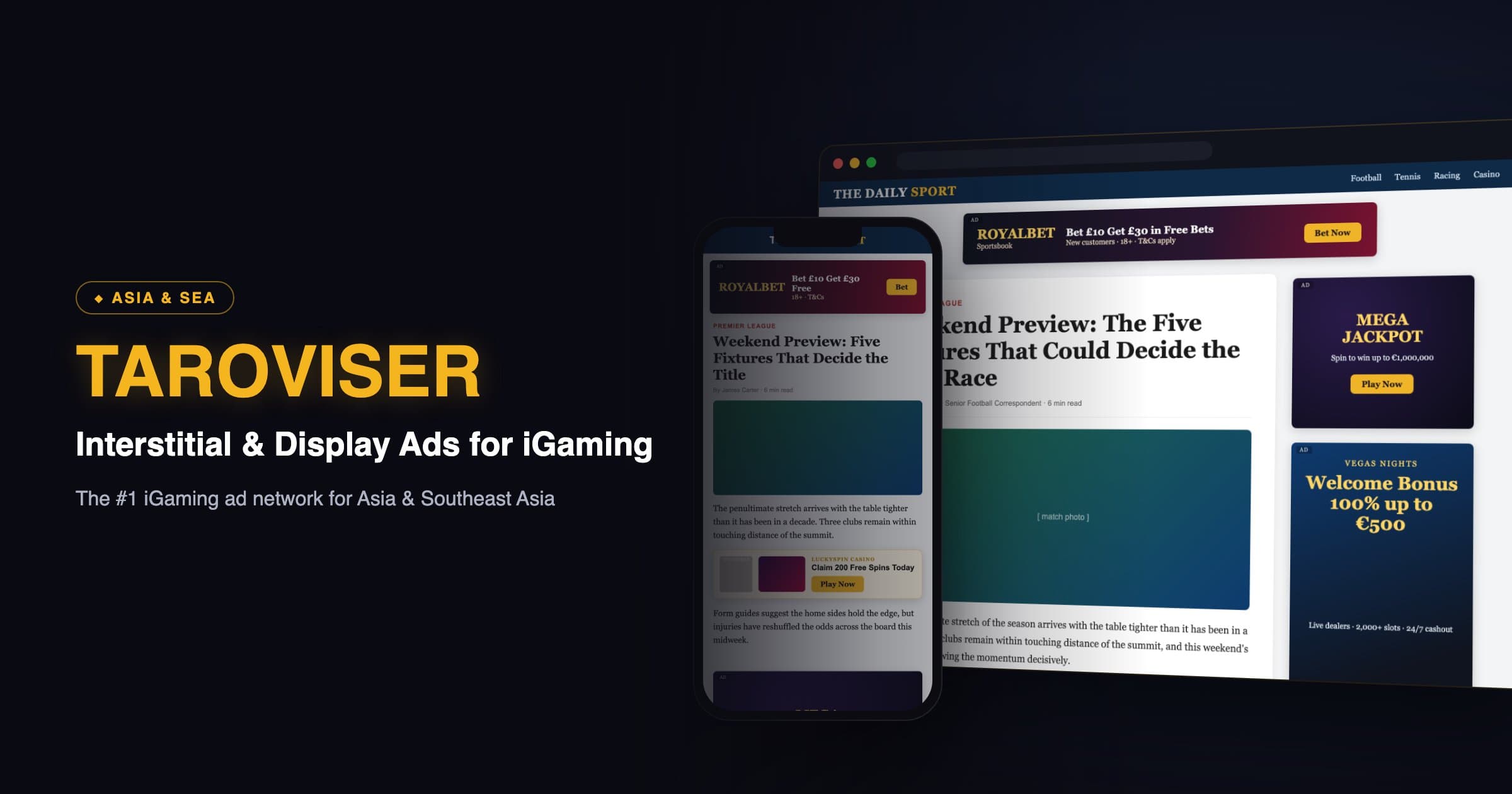
Interstitial & Display Ads for iGaming: When They Beat Push and Pop
Ask ten iGaming media buyers what their workhorse format is, and most will say push or pop. Fair enough. Those formats scale fast, they're cheap on a CPM basis, and they've carried a lot of FTD volume across SEA and the wider Asia market for years.
But "cheapest CPM" and "lowest cost-per-FTD" are not the same number. I've watched campaigns where push delivered a flood of clicks and a trickle of deposits, while a well-placed interstitial on the same offer quietly outperformed on the only metric that pays the bills. So this piece isn't an argument that display beats push. It's an argument that format is a decision, not a default – and that interstitial and banner inventory wins specific battles you might be conceding by habit.
Let's get into where, why, and how.
The Four-Format Lineup, Quickly
Before we pit anything against anything, a fast map of what's actually on the table. Taroviser runs four core formats, and each behaves differently in the funnel:
- Push & in-page push – notification-style ads. High reach, works off opt-in lists (push) or runs without a subscription on the page itself (in-page push). Strong for re-engagement and volume.
- Popunder – opens behind the active window. Huge scale, low cost-per-impression, blunt instrument. Great for casting a wide net.
- Native – blends into content. Higher intent, better for warming cold audiences before the offer hits.
- Banner (display) – the classic IAB units. Sits in-view on the page. Predictable, brand-safe, and – this is the part people forget – measurable on viewability.
"Interstitial" sits a half-step apart. It's a full-screen unit that appears at a natural transition – between pages, between game levels, on app launch. Technically it's a display format, but it behaves more like a hard interrupt than a banner. That distinction matters a lot for when it works.
So when we say "display," we mean two things with different personalities: the always-on banner and the high-impact interstitial. Treat them separately.
Why Push and Pop Became the Default (and Why That's a Trap)
There's a reason these formats dominate. Push lists are cheap to scale, pop inventory is effectively unlimited, and both report clicks that look healthy in a dashboard. For a new advertiser testing an offer in, say, Brazil or the Philippines, they're a sensible first move. Low barrier, fast data.
The trap is what happens after the test. Buyers anchor on the format that gave them their first FTD and stop testing. Then a few things creep in:
- Click inflation. Pop and push generate a lot of accidental and low-intent interaction. The click-through number is flattering. The deposit number is honest.
- List fatigue. Push subscriber lists decay. The same audience sees the same casino offer repeatedly, and response curves bend down over weeks.
- Format blindness. Heavy users mentally filter pops and notifications. The ad serves, the impression counts, the human never registers it.
None of that means push and pop are bad. It means they have a job, and you've probably been asking them to do every job. Which brings us to the formats you might be under-using.
When Interstitial Beats Push and Pop
Interstitial wins when attention is the bottleneck, not reach. Here's where I've seen it earn its placement.
1. App and game-transition moments
The single best interstitial slot in iGaming-adjacent traffic is the natural break – end of a level in a casual game, a page transition in a content app, the load screen between sections. The user is already pausing. A full-screen offer at that exact moment gets genuine attention instead of competing for a sliver of screen.
Push interrupts whatever the user is doing, which often means it's resented. The interstitial fills a gap the user already accepted. Same interruption, very different reception.
2. High-value offers that need room to breathe
A push notification gives you a title, a short line, and an icon. That's it. Try selling a 200% welcome match plus 100 free spins in 30 characters. You can't – so you over-promise and under-deliver, and the FTD rate suffers because expectations and reality diverge before the deposit page even loads.
An interstitial gives you the whole screen. Real offer terms, a clear hero image, a CTA the eye lands on. For complex or premium offers, that real estate converts the right users instead of a larger pile of mismatched ones.
3. Markets where push lists are saturated
In several mature SEA geos, the same push subscribers have seen rotating casino offers for years. The list still delivers impressions; it just doesn't deliver fresh attention. Display and interstitial inventory reaches users outside the push ecosystem – people browsing content, using apps, who never opted into a notification list. Different pool, fresher response.
4. When you actually need to measure viewability
This is the quiet superpower of display. With pop, "was it seen?" is a philosophical question. With a banner or interstitial, viewability is a measurable standard – the IAB threshold of 50% of pixels in view for at least one second (two seconds for video). You can hold inventory to that bar. You can't really do that with a unit that opens behind the window.
For an advertiser optimizing toward cost-per-FTD, a viewable impression you can verify is worth more than three impressions you can't.
When Banner Display Earns Its Place
Interstitial is the high-impact play. The plain banner is the steady one, and it wins on different terms:
- Retargeting and frequency. A user who clicked your offer yesterday but didn't deposit is a warm lead. A banner that follows them across content keeps the brand present without the resentment a repeat push triggers. Display does ambient pressure well.
- Brand-safe placements. Banners run on content sites with clear context. For advertisers who care about where the logo appears – and in a regulated vertical, you should – that visibility is a feature, not a cost.
- Funnel stacking. Native warms the cold user, banner keeps them warm, interstitial or push closes. Display is the connective tissue between the loud formats.
The mistake is judging a banner on click-through. Banners aren't click machines; they're presence machines. Measure them on assisted conversions and on the lift they give your closing formats, not on raw CTR.
The Honest Comparison
No format is best at everything. Here's the rough shape of how they trade off – directional, not gospel, because the real numbers move by offer and geo.
| Dimension | Push / In-page | Popunder | Native | Banner | Interstitial |
|---|---|---|---|---|---|
| Raw scale | High | Very high | Medium | High | Medium |
| Cost per impression | Low | Very low | Medium | Low–med | Medium |
| Attention quality | Medium | Low | High | Medium | Very high |
| Viewability measurable | Partial | Poor | Good | Strong | Strong |
| Best funnel stage | Re-engage / volume | Top, wide net | Warm cold users | Retarget / presence | Close high-value |
| Creative room | Tiny | Minimal | Moderate | Moderate | Full screen |
Read that table as a roster, not a ranking. The winning campaign usually runs several of these at once, each doing the job it's built for. The losing campaign picks one and forces it everywhere.
Viewability: The Metric That Separates Display From Pop
If you take one technical idea from this piece, take this one. Viewability is the bridge between "the ad served" and "a human had the chance to act on it."
The industry standard treats a display impression as viewable when at least half its pixels are on screen for one second or more. That sounds modest, but it's a real filter. A pop that opens behind the active tab can technically log an impression while scoring zero on this standard. A banner in the content well, or a full-screen interstitial at a page break, clears it easily.
Why does an advertiser optimizing for FTDs care? Because viewable impressions are the only ones with a shot at converting. When you can measure viewability per placement, you can cut the inventory that serves but never shows, and shift spend toward inventory that actually reaches eyeballs. That single move often does more for cost-per-FTD than any creative tweak.
A few practical viewability habits:
- Set a viewability floor per placement and prune what falls under it.
- Watch viewable-CTR, not raw CTR – clicks over viewable impressions tell you about real engagement.
- For interstitials, track completion and dismiss timing. A unit dismissed in under a second wasn't really seen, viewability log or not.
How Taroviser Picks the Format For You
Here's where the format conversation stops being theoretical. Running five formats across 200+ geos by hand is a losing game – too many combinations, too many shifting response curves, and the optimal mix in Vietnam at 9pm is not the optimal mix in Peru at noon.
So we don't do it by hand. Taroviser's AI optimization continuously reallocates toward whatever's actually producing FTDs at the lowest cost for your offer and your geos. The model watches the live data and leans into the format that's converting – push when lists are fresh, interstitial when attention is scarce, banner when retargeting carries the weight. You're not locked into one bet.
A few things stack on top of that:
- Cost-per-FTD as the optimization target. Not clicks, not raw CPM – deposits. The system optimizes toward the number that matters to your P&L.
- Local market intelligence across SEA and the wider Asia region, so format choices are informed by how each market actually behaves, not by a global average that fits nobody.
- Human analyst anti-fraud review layered over the automation, because a model can be gamed and a person checking the patterns catches what slips through.
- S2S postback tracking, so attribution flows back cleanly and the optimization runs on real conversion signal, not guesswork.
- No platform fee, no minimum spend, and creatives that clear review quickly – so testing a new format is cheap and fast, not a budget event.
Pricing sits roughly 30–50% under what the larger networks quote for comparable service. Which means you can afford to run the full format roster and let the data – not your habits – decide the winner.
A Quick Word on Compliance
This vertical is regulated, and the smart play treats that as a constraint to design around, not ignore. Display and interstitial creative should carry responsible-gambling messaging, respect age-gating, and run only in markets where the offer is permitted. Taroviser's targeting honors geo-gating, and campaigns are built for the markets where they're allowed to operate. Full-screen interstitials in particular get more scrutiny – more reason to keep creative clean, accurate, and compliant from the first impression.
FAQ
Are interstitial ads more expensive than push?
On a cost-per-impression basis, usually yes – they're a higher-impact unit. But the metric that matters is cost-per-FTD, and interstitial often wins there for high-value offers because it converts the right users instead of a larger volume of low-intent clicks. Test both against deposits, not clicks.
Is display advertising dead for iGaming?
No. It's been declared dead for a decade and keeps converting. Banner and interstitial inventory wins on viewability, retargeting, and reaching audiences outside saturated push lists. It's a different job than push and pop, not a worse one.
What's the difference between a banner and an interstitial?
A banner is a fixed unit that sits in-view on a page alongside content. An interstitial is a full-screen ad that appears at a natural transition – between pages, levels, or on app launch. Banners do ambient presence and retargeting; interstitials do high-impact closing.
How do I know if my display ads are actually being seen?
Viewability tracking. The industry standard counts an impression as viewable when at least 50% of its pixels are on screen for one second or more. With S2S postback and per-placement viewability data, you can prune inventory that serves but never shows.
Which format should I start with on a new iGaming offer?
There's no single right answer – it depends on geo, offer value, and audience. That's the point of running several formats and letting AI optimization reallocate toward whatever produces FTDs cheapest for your specific setup, rather than defaulting to one.
Can I run interstitial and display in any market?
Only where the offer is permitted. Geo-gating, age-gating, and responsible-gambling messaging are non-negotiable in regulated markets. Taroviser builds campaigns to run in the markets where they're allowed and honors those constraints by default.
Stop Defaulting. Start Testing.
Push and pop earned their place. They just shouldn't own every line of your media plan by default. Interstitial closes high-value offers when attention is scarce. Banner carries retargeting and presence. And viewability is the metric that finally tells you which impressions were real.
Run the full roster. Let cost-per-FTD pick the winner. Taroviser gives you all four formats, AI that reallocates toward the cheapest FTDs across 200+ geos, no platform fee, and no minimum to get started. Spin up a test, watch the deposit data, and let the format that actually performs earn the budget.
Related on Taroviser
Related guides
- iGaming Traffic in Indonesia: A Compliance-First Advertiser's Guide
- iGaming Traffic in Malaysia: Advertiser Guide to a Restrictive Market
- iGaming Traffic in Singapore: Advertiser Guide to a High-Value Market
- iGaming Traffic in Cambodia: Advertiser Guide to a Complex Market
- iGaming Traffic in Myanmar: Advertiser Guide to an Emerging Market
- Do Fullpage Interstitial Ads Increase iGaming Conversions? What It Does
Traffic & ad formats
Ready to launch?
Put these tactics to work with premium iGaming traffic on Taroviser.
Start advertising