
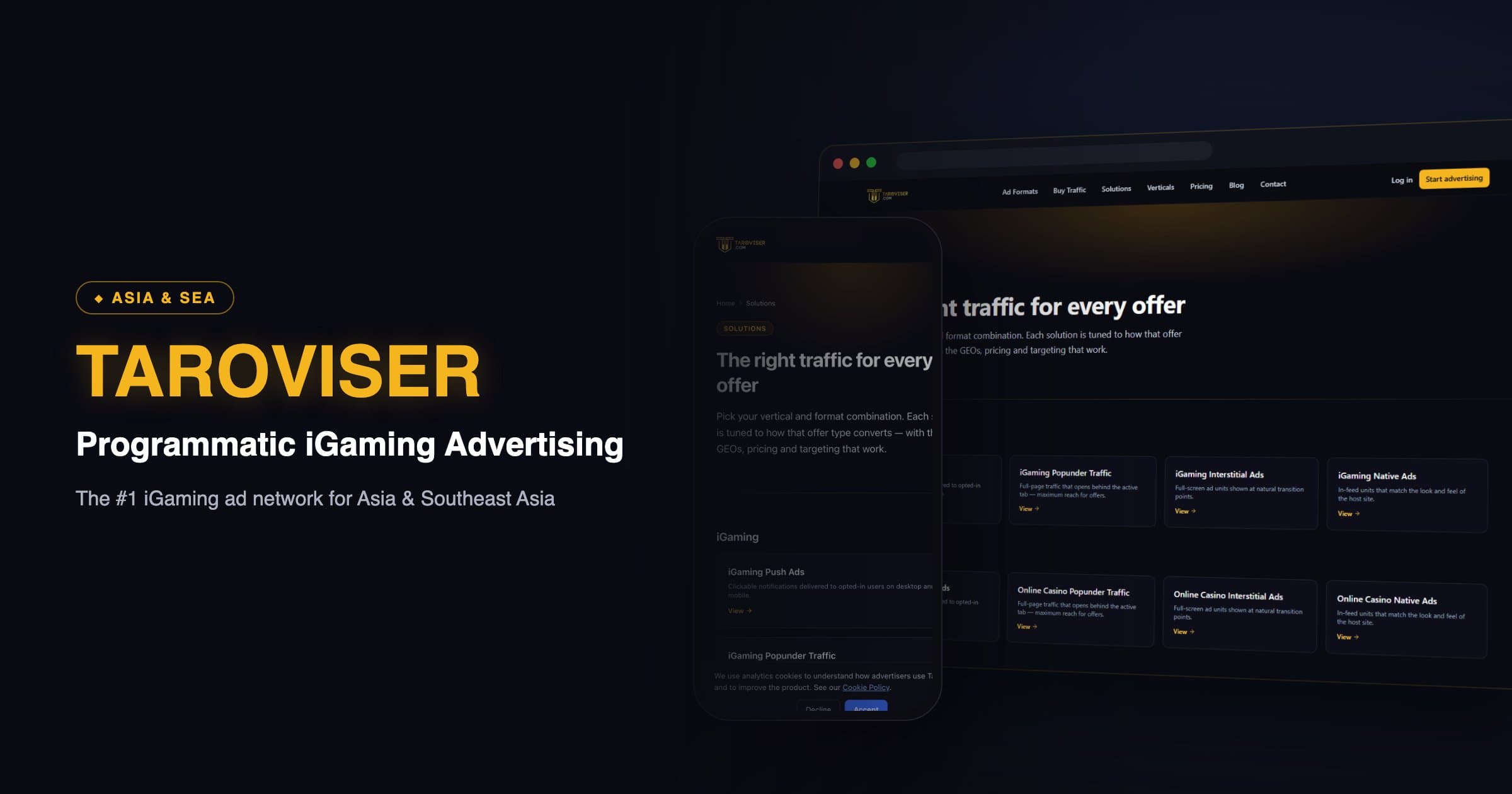
Programmatic iGaming Advertising: DSP, RTB and Self-Serve Explained
So you've built a great casino or sportsbook product, and now you need players. You open Google Ads. Account suspended. You try Meta. Rejected again. Welcome to iGaming marketing, where the two biggest ad platforms on the planet treat you like you're radioactive.
That's the wall most gambling advertisers hit on day one. And it's exactly why programmatic advertising stopped being a buzzword for this industry and became the default path to scale.
Let me walk through what programmatic actually means for an iGaming advertiser, how the plumbing works (DSP, RTB, the whole alphabet soup), and why a self-serve iGaming DSP beats the mainstream platforms that won't take your money anyway.
The Google and Meta problem nobody warns you about
Here's the short version. Google's gambling and games policy requires certification, restricts ad formats, and limits where you can even run. Meta's stance is similar, and enforcement is aggressive. Both platforms apply their own interpretations on top of local law, so even a fully licensed operator in a regulated market can get bounced.
I've seen perfectly compliant brands burn weeks trying to get a single campaign approved, only to watch it get pulled mid-flight. The frustrating part isn't the rejection. It's the unpredictability. You can't build a media plan on a platform that might disappear your account on a Tuesday.
The deeper issue: Google and Meta are walled gardens. They decide what's allowed inside their walls, and iGaming sits permanently in the gray zone. So advertisers go where the inventory is open, the rules are clearer, and the buying is built for verticals like this one. That's the open programmatic ecosystem.
What "programmatic" actually means
Strip away the jargon and programmatic just means buying ad impressions through software instead of emailing a salesperson and negotiating a fixed deal. An algorithm decides, in real time, which impressions to bid on, how much to pay, and where to place them.
For iGaming, this matters more than for most verticals. Player value swings wildly by geo, device, time of day, and traffic source. A manual insertion order can't keep up with that. Software can.
There are a few moving parts worth knowing:
- Inventory – the actual ad slots: a push notification on a sports-news site, a popunder on a streaming portal, a native unit in a content feed, a banner above the fold.
- Demand – you, the advertiser, wanting to fill those slots with your offer.
- The exchange – the marketplace that connects supply and demand and runs the auction.
- The DSP – the cockpit you sit in to buy programmatically.
Those last two are where most of the confusion lives, so let's pull them apart.
RTB: the auction that happens in 100 milliseconds
RTB stands for real-time bidding. Every time a user loads a page or app with an available ad slot, an auction fires. Publishers offer the impression, advertisers bid, the highest relevant bid wins, and the ad renders. All of it happens in the time it takes the page to load, roughly 100 milliseconds.
Picture a user in the Philippines opening a sports app at 9pm. That single impression triggers an auction. Your DSP looks at the signals (geo: PH, device: Android, time: prime evening, context: sports), checks your targeting and bid rules, and decides in a blink whether to bid and how much.
Why this beats fixed buys for iGaming:
- You only pay for impressions that match your criteria.
- You bid more for a Tier-1 geo at peak hours and less for low-value traffic, automatically.
- You can shift budget across geos and formats the moment performance data comes in.
RTB is the engine. It's the thing that turns "buy ads" into "buy the right impression, at the right price, for the right player, right now."
DSP: your cockpit for buying
A DSP, or demand-side platform, is the software you use to access that auction. It's where you set targeting, upload creatives, define bids, manage budgets, and read performance. One login, many inventory sources.
A general-purpose DSP treats every advertiser the same: a retail brand, a mobile game, a casino, all flowing through identical tooling. An iGaming-specialized DSP is built around how gambling acquisition actually works. The difference shows up in the details.
| Generic DSP | iGaming-specialized DSP | |
|---|---|---|
| Inventory | Broad, vertical-agnostic | Tuned for gambling-friendly placements |
| Targeting | Standard geo/device | 200+ geos with local market context |
| Optimization goal | Clicks, installs | Cost-per-FTD, depositing players |
| Compliance tooling | Generic | Age-gating, geo-gating, responsible-gambling support |
| Support | Tiered, often delayed | 24/7, with human analysts |
That cost-per-FTD line is the one that matters most. FTD means first-time deposit, the moment a click becomes a paying player. Optimizing toward clicks or installs is a vanity exercise in iGaming. The only number that pays your salary is depositing players at a cost that makes sense against lifetime value.
Self-serve vs managed: pick your altitude
Programmatic platforms generally give you two ways to run.
Self-serve means you're in the driver's seat. You build campaigns, set bids, choose formats and geos, and adjust on the fly. You see everything, you control everything. Teams that already know their numbers tend to love this. No middleman, no waiting on a rep to push a change you could make yourself in 30 seconds.
Managed means a team runs it with you. You bring the offer and the targets; they bring the setup, the optimization, and the market knowledge. This suits brands entering a new geo, testing a new format, or running lean without a dedicated media buyer.
The honest answer is most serious advertisers want both, and they want to move between them. Start managed in an unfamiliar market, learn the local dynamics, then take the wheel in self-serve once you've got a read on what converts. A platform that forces you to pick one and stick with it is fighting against how acquisition teams actually operate.
Taroviser runs both side by side. Spin up your own campaigns in the self-serve console, or lean on the managed team and AI optimization when you want a hand. Switch as your needs change.
The four formats that carry iGaming
Format choice isn't cosmetic. Each one fits a different intent and budget, and the smart play is to test across several rather than betting everything on one.
- Push notifications – opt-in messages that land on a user's device. High visibility, strong for re-engagement and promo pushes. Works because it reaches users outside the browser.
- In-page push – push-style units rendered inside a webpage, so they reach users who never subscribed to notifications. Wider reach, banner-like delivery, push-like feel.
- Popunder – a full-page unit that loads behind the active window. High impact, low CPM, big volume. Blunt but effective for top-of-funnel reach and aggressive geos.
- Native – ads that match the look of the surrounding content. Lower fatigue, better for warming up cold audiences before the hard CTA.
- Banner – the classic display unit. Reliable, cheap to produce, useful for retargeting and brand presence.
A typical SEA campaign might run popunder for raw volume, in-page push for reach, and native to soften the first touch, all measured against the same cost-per-FTD target. The point isn't one magic format. It's the mix, tuned per geo.
How AI optimization changes the math
Here's where modern programmatic earns its keep. Manual bidding across 200+ geos and four formats is more variables than any human can juggle. AI optimization handles the grind: it watches which placements deliver depositing players, shifts budget toward them, and pulls back on the ones that only deliver clicks.
In practice that means your campaign gets sharper while you sleep. The model spots that a particular geo-format pairing is producing FTDs at a good cost and leans in. It notices another that's burning spend on empty clicks and throttles it. You set the cost-per-FTD goal; the system chases it.
Pair that with human analysts watching for fraud and anomalies, and you get the best of both: machine speed on optimization, human judgment on quality. That combination is hard to replicate with a generic platform that treats your casino offer like a shoe ad.
Tracking: why S2S postback is non-negotiable
You can't optimize toward FTDs if you can't measure FTDs. This is where server-to-server (S2S) postback comes in.
Pixel tracking fires from the browser and breaks easily, blocked by ad blockers, lost on redirects, unreliable on mobile. S2S postback works differently: your server tells the platform's server when a real event happens (registration, first deposit, whatever you define). It's resilient, accurate, and it ties spend directly to revenue events.
For an FTD-optimized campaign, postback isn't a nice-to-have. It's the feedback loop the whole system runs on. No postback, no real optimization, just guessing with a fancy dashboard.
What to look for in an iGaming DSP
If you're evaluating platforms, here's a practical checklist drawn from what actually moves the needle:
- Vertical focus – built for iGaming, not retrofitted for it.
- Geo depth – broad coverage (200+ geos) with real local market intelligence, not just a dropdown.
- Cost-per-FTD optimization – the platform should chase depositing players, not clicks.
- Format range – push, in-page push, popunder, native, banner, so you can build a real mix.
- Pricing models – CPM, CPC, and CPA-FTD, so you can buy the way that fits each campaign's risk profile.
- No platform fee, no minimum – you shouldn't pay a tax to access inventory, or be locked out by a giant deposit.
- S2S postback – proper measurement, baked in.
- Compliance tooling – age-gating, geo-gating, and responsible-gambling support as standard.
- Support that answers – 24/7, ideally with human analysts, not a ticket queue.
Run any platform against that list and the gaps show up fast.
FAQ
Q: Can I really not advertise iGaming on Google or Meta at all?
A: It's not a flat ban everywhere, but it's heavily restricted. Both require certification, limit formats and geos, and enforce aggressively, even against licensed operators in regulated markets. Approvals are slow and accounts get pulled unpredictably, which makes them unreliable as a primary channel. Most advertisers use the open programmatic ecosystem instead.
Q: What's the difference between a DSP and an ad network?
A: A DSP is software you use to buy impressions programmatically across many inventory sources via real-time auctions, with granular targeting and bidding control. A traditional ad network packages and resells inventory, often with less transparency and less real-time control. Many modern platforms blend both, giving you network-scale inventory through a DSP-style interface.
Q: Should I start with self-serve or managed?
A: Depends on your team and the market. If you've got in-house media buyers who know your numbers, self-serve gives you full control and speed. If you're entering an unfamiliar geo or running lean, managed lets you lean on local expertise and AI optimization first. The strongest setups let you use both and move between them.
Q: What does cost-per-FTD optimization actually mean?
A: FTD is a first-time deposit, the point a user becomes a paying player. Cost-per-FTD optimization means the platform measures and bids toward acquiring depositing players at a target cost, rather than chasing clicks or installs that may never convert. It's the metric that ties ad spend to actual revenue.
Q: Why do I need S2S postback instead of a tracking pixel?
A: Pixels fire in the browser and break easily, blocked, lost on redirects, unreliable on mobile. Server-to-server postback sends conversion events server-to-server, so it's far more accurate and resilient. For FTD-optimized campaigns it's the feedback loop the optimization depends on.
Q: How many geos and formats should I test at launch?
A: There's no fixed rule, but don't put everything on one format or one geo. A common approach is to run two or three formats (say popunder for volume, in-page push for reach, native to warm audiences) across a small cluster of target geos, all measured against the same cost-per-FTD goal, then scale what works.
Ready to buy programmatically without the platform headaches?
If Google and Meta keep slamming the door, stop knocking. Taroviser is a self-serve and managed iGaming DSP built for advertisers like you: 200+ geos with local market intelligence, optimization toward cost-per-FTD, five core formats (push, in-page push, popunder, interstitial, native), CPM/CPC/CPA-FTD pricing, S2S postback, and AI optimization backed by human analysts watching for fraud. No platform fee. No minimum. Easy approvals.
Spin up a campaign in self-serve, or let the managed team run it with you. Either way, you're finally buying the way iGaming actually works.
Related on Taroviser
Related guides
- iGaming Traffic in Indonesia: A Compliance-First Advertiser's Guide
- iGaming Traffic in Malaysia: Advertiser Guide to a Restrictive Market
- iGaming Traffic in Singapore: Advertiser Guide to a High-Value Market
- iGaming Traffic in Cambodia: Advertiser Guide to a Complex Market
- iGaming Traffic in Myanmar: Advertiser Guide to an Emerging Market
- Do Fullpage Interstitial Ads Increase iGaming Conversions? What It Does
Traffic & ad formats
Ready to launch?
Put these tactics to work with premium iGaming traffic on Taroviser.
Start advertising