
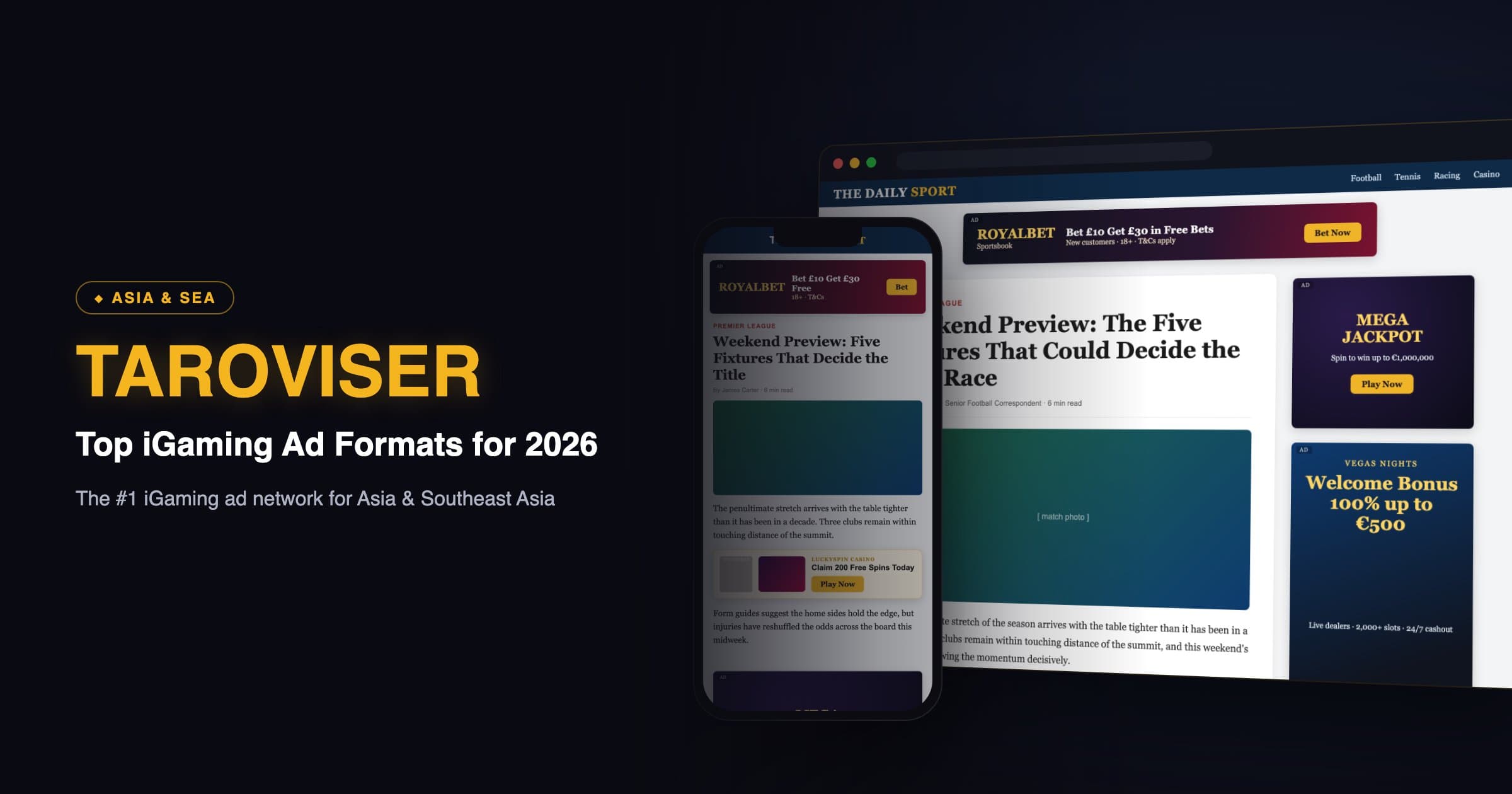
Top iGaming Ad Formats for 2026: When to Use What for Casino & Betting Campaigns
If you run casino or sportsbook acquisition, you already know the format you pick decides half the campaign before the first impression ever fires. The creative matters. The geo matters. But the wrapper around that creative is what determines whether you're paying for a curious tap or a deposit that actually clears.
I've watched advertisers burn budget on the wrong container for a perfectly good offer. A slick native unit dropped into a popunder-style buy. A push campaign aimed at a market where push subscription density is thin. The offer wasn't broken. The format was.
So this is a working breakdown of the seven formats that matter for iGaming heading into 2026 – push, in-page push, popunder, native, banner, interstitial, and Telegram – and the actual decision logic for matching each one to a casino or betting goal. No format is "best." Each has a job.
The 2026 backdrop: why format choice got harder
A few shifts are worth naming before we get into the units themselves.
Browser-level changes keep nibbling at classic web push. Subscription prompts face more friction, and some environments throttle delivery. That hasn't killed push – far from it – but it's pushed smart buyers toward in-page push, which sidesteps the subscription step entirely.
Mobile is where most iGaming traffic lives now, especially across Asia and Southeast Asia. Formats that respect a small screen and a data-conscious user win. Formats that fight the device lose.
And measurement got stricter. With S2S postback the norm, advertisers can finally see which format drives a first-time deposit, not just a click. That changes the math on everything below. A format with a "low" CTR can still be your cheapest cost-per-FTD channel.
Push notifications: the workhorse for retargeting and re-engagement
Classic web push lands as a system-style notification on a user who opted in. It feels native to the device, it arrives outside the browsing session, and it pulls people back.
For iGaming, push earns its keep in a few specific spots:
- Re-engagement and retention angles. "Your bonus is waiting" style messaging works because the user already chose to hear from that source.
- Time-sensitive offers. A weekend reload, a tournament starting, a match about to kick off – push delivers it to the lock screen.
- High-volume prospecting in markets with deep subscriber bases. Where push lists are large, the CPM stays low and the reach is enormous.
The trade-off: subscriber quality varies, and a user three months into a subscription behaves nothing like a fresh one. You also can't fully control the moment of delivery the way you can with a session-based unit.
Push is rarely your single best cost-per-FTD channel on cold traffic. It's a volume-and-retention play. Use it to scale and to win people back.
In-page push: push behavior without the subscription wall
In-page push looks like a push notification but renders as a banner element inside the page during an active session. No subscription, no opt-in prompt. It reaches users who'd never appear in a classic push list – including iOS web traffic, which classic push largely can't touch.
This is the format that's been quietly taking share, and for 2026 it's one of the first places I'd test a new casino offer.
Where it fits:
- Cold prospecting where you want push-style creative but broader, fresher reach.
- iOS and Safari-heavy geos, where classic push coverage is weak.
- Markets with shallow push subscriber bases – in-page doesn't depend on an existing list, so a newer geo isn't a dealbreaker.
The catch is that in-page push lives inside the session, so it competes with whatever the user came to do. Frequency capping matters more here. Hammer someone with five in-page units in one visit and you'll train them to ignore the format. But for matching push economics with reach that classic push can't deliver, in-page is hard to beat right now.
Popunder: brute-force reach and the funnel entry point
A popunder opens a new tab or window behind the active one. The user sees it when they close or switch. It's the least subtle format here, and that's exactly the point.
For iGaming, popunder does two things well:
- Massive, cheap reach. When you need volume at the top of the funnel – a landing page, a quiz, a pre-lander that warms the user before the offer – popunder delivers impressions at a price almost nothing else matches.
- Full-page real estate. You get the whole screen. A well-built pre-lander can do real qualification work before sending traffic to the casino itself.
The honest downside: intent is lower and the experience is interruptive. Raw popunder traffic on a direct offer rarely converts well. The advertisers who win with it pair it with a strong pre-lander and lean on S2S data to cut the placements that don't produce deposits. Treated as a funnel-entry tool rather than a closer, popunder is one of the most cost-efficient ways to feed the top of a casino funnel.
Native: the credibility format for higher-value players
Native ads match the look and feel of the content around them – recommendation widgets, in-feed units, content blocks. The user reads them more like editorial than advertising.
For iGaming, native is the format for warming skeptical or higher-value audiences:
- Content-led acquisition. "Why this sportsbook changed how I bet on the league" as an advertorial pulls in users who'd scroll past a flashing banner.
- Higher-LTV player segments. People who research before they deposit respond to a softer, story-first approach.
- Brand and trust building, especially for an operator trying to establish itself in a competitive market.
Native usually costs more per click than popunder or push, and it demands real creative work – a weak advertorial is just an expensive banner. But the players it brings tend to qualify better. When your KPI is FTD quality rather than raw volume, native deserves a serious slice of the test budget.
Banner / display: the always-on supporting cast
Banners are the oldest format here and people love to call them dead. They aren't. They're just misunderstood.
Display banners – standard IAB sizes across web and mobile – work best as a support layer, not a lead actor:
- Retargeting. Keep your brand in front of users who visited but didn't deposit. Banners do this cheaply and at scale.
- Brand reinforcement alongside a push or native push during a heavier campaign push.
- Specific high-intent placements, like sports-content sites for a betting offer, where context does the heavy lifting.
On their own, cold banners drive low engagement for iGaming. Used as the connective tissue of a multi-format campaign – the format that keeps you visible between the moments other units do the converting – they're efficient and worth the line item.
Interstitial: full-screen attention at the right moment
An interstitial takes over the full screen at a natural transition point – between pages, between levels, between content steps. It's high-impact by design, and on mobile it commands attention almost nothing else can match.
For iGaming:
- Mobile-first geos where most traffic is on a phone and screen real estate is everything.
- High-impact offer launches – a new operator entering a market, a big welcome bonus, a flagship promotion.
- App-style and gaming environments where the transition-point placement feels natural rather than jarring.
Because it's interruptive, frequency discipline is non-negotiable. Show it at the wrong moment or too often and you bruise the user experience. But for sheer attention per impression on mobile, interstitial is one of the strongest units going into 2026.
Telegram ads: the channel-native frontier
Telegram has become a serious surface for iGaming, particularly across Asia and Southeast Asia where the messenger is woven into daily life. Ads inside channels – and the broader Telegram ad ecosystem – put your offer where engaged, community-driven audiences already gather.
Where it earns a slot:
- Community-heavy markets where users follow betting and gaming channels by choice.
- Engaged, opt-in-style audiences who already lean into this content.
- Bot-driven funnels and direct response, where the messenger's interactivity can carry a user further than a standard ad click.
It's a newer surface, so targeting and scale differ from web inventory, and you'll want to test before you commit budget. But for the right geos – and SEA is squarely one of them – Telegram reaches engaged audiences in a context that feels native rather than interruptive.
Matching format to goal: a quick reference
No format wins every objective. Here's the logic I'd apply, format against goal:
| Goal | First choice | Strong support |
|---|---|---|
| Cheap top-funnel volume | Popunder | In-page push |
| Cold prospecting, broad reach | In-page push | Popunder |
| Re-engagement / retention | Push | Banner (retargeting) |
| Higher-LTV / quality FTDs | Native | Interstitial |
| Mobile-first impact | Interstitial | In-page push |
| Brand / trust building | Native | Banner |
| Community-driven SEA markets | Telegram | In-page push |
| Time-sensitive offers | Push | Interstitial |
The strongest casino and betting campaigns rarely ride one format. They stack: popunder or in-page to fill the funnel, native to warm the skeptics, push and banner to retain and retarget, interstitial or Telegram for impact in the right geo. The skill is in the mix – and in reading the postback data to keep rebalancing toward whatever produces the cheapest qualified deposit.
How Taroviser fits
Taroviser carries all of these formats – push and in-page push, popunder, interstitial and native – under one roof, built specifically for iGaming advertisers across 200+ geos with a focus on Asia and Southeast Asia. So you're not stitching together separate buys across separate platforms to run a multi-format campaign.
The part that does the heavy lifting day to day is the optimization layer. Taroviser's AI works against your advertiser data and steers spend toward the format-and-placement combinations producing the best cost-per-FTD, not just the most clicks. That's the metric that actually matters, and it's the one the system is tuned around. Pair that with 24/7 support and human-analyst anti-fraud review, and the format mix keeps adjusting toward what's converting while you sleep.
A few practical points worth knowing:
- CPM, CPC, and CPA-FTD pricing models, so you can buy the way each format and goal demands.
- S2S postback so every format reports against real deposits, not vanity clicks.
- No platform fee and no minimum, with an approval process built to get iGaming creatives live without the usual friction.
- Self-serve or managed, depending on how hands-on you want to be – and Taroviser typically runs 30-50% cheaper than comparable buys.
FAQ
Which ad format is best for casino campaigns in 2026?
There's no single best format – it depends on your goal. For cheap top-funnel volume, popunder and in-page push lead. For higher-quality first-time deposits, native and interstitial tend to bring better-qualified players. Most strong campaigns blend several formats and rebalance using postback data.
What's the difference between push and in-page push?
Classic push is a system-style notification sent to users who opted into a subscription; it arrives outside the browsing session. In-page push renders inside an active page during a session with no subscription required, so it reaches broader, fresher audiences – including iOS web traffic that classic push can't.
Is popunder still effective for iGaming in 2026?
Yes, as a funnel-entry tool. Popunder delivers huge, cheap reach and full-page real estate that's ideal for pre-landers and qualification steps. It rarely converts well sent straight to a direct offer, so pair it with a strong pre-lander and trim weak placements using S2S data.
Why use native ads if they cost more per click?
Because the players they bring tend to qualify better. Native's content-led, editorial feel warms skeptical and higher-LTV users who'd ignore a banner. When your KPI is deposit quality rather than raw click volume, the higher click cost often produces a lower cost-per-FTD.
Are Telegram ads worth it for betting offers?
In the right markets, yes – especially across Asia and Southeast Asia, where Telegram is part of daily life and communities gather around gaming and betting channels. It's a newer surface, so test targeting and scale before committing larger budget.
How do I measure which format actually drives deposits?
Use S2S postback tracking, which ties each format and placement back to first-time deposits rather than clicks. That lets you compare cost-per-FTD across formats directly and shift budget toward the units producing real, qualified players.
Run a smarter multi-format campaign
Stop guessing which format fits which offer. Taroviser gives you push, in-page push, popunder, interstitial and native across 200+ geos – with AI that optimizes the mix toward your real cost-per-FTD, human-analyst anti-fraud, and 24/7 support. No platform fee, no minimum, fast approvals. Launch self-serve or let the managed team build the format stack for you.
Related on Taroviser
Related guides
- iGaming Traffic in Indonesia: A Compliance-First Advertiser's Guide
- iGaming Traffic in Malaysia: Advertiser Guide to a Restrictive Market
- iGaming Traffic in Singapore: Advertiser Guide to a High-Value Market
- iGaming Traffic in Cambodia: Advertiser Guide to a Complex Market
- iGaming Traffic in Myanmar: Advertiser Guide to an Emerging Market
- Do Fullpage Interstitial Ads Increase iGaming Conversions? What It Does
Traffic & ad formats
Ready to launch?
Put these tactics to work with premium iGaming traffic on Taroviser.
Start advertising