
Casino Ads Banned on Google? The Compliant Alternative for iGaming Advertisers
You build a clean landing page. You wire up tracking, fund the account, hit launch. A few hours later the campaign is disapproved, the account is flagged, and sometimes the whole spend sits frozen behind a reason you can't actually act on. If you run paid acquisition for an online casino, a sportsbook, or an iGaming affiliate brand, none of that surprises you. "Casino ads banned on Google" isn't a hypothetical we're dressing up for a headline. It's the Monday-morning problem that quietly eats budget and burns one creative cycle after another.
Here's the part most teams miss. The ban points you somewhere else; it doesn't close the door for good. The advertisers who actually scale stop arguing with policy engines that were never built for regulated gambling, and they move the money to channels that were. So let's walk through why Google and Meta restrict gambling ads, what really happens when people try to outsmart those policies, and what a genuinely compliant alternative looks like, right down to how Taroviser handles approval, market intelligence, and the day-to-day optimization that keeps iGaming campaigns alive.
Why Google and Meta Restrict Gambling Advertising
The restriction isn't arbitrary. Once the logic clicks, you can plan around it instead of running into the same wall every week.
Google Ads allows gambling and games advertising in a specific set of countries, and only when the advertiser holds a valid local license and clears Google's gambling certification for each market it targets. Meta runs a similar gated model across Facebook and Instagram: gambling and gaming ads need prior written permission, and they're capped to an approved country list with documented licensing. Step outside those lanes and the default answer from both platforms is no.
A few structural reasons sit underneath that:
- Regulatory exposure. Gambling is licensed market by market, and one non-compliant impression dropped into the wrong geo can invite regulator action. The big networks manage that risk with blanket restriction rather than per-campaign judgment.
- Brand-safety pressure. Advertisers, investors, and app-store rules all push large platforms toward conservative stances on gambling, alcohol, and adult verticals.
- Responsible-gambling obligations. Plenty of jurisdictions require age-gating, self-exclusion compatibility, and responsible-gambling messaging. General-purpose ad systems aren't built to enforce all of that per creative at scale, so they default to exclusion.
- Automated enforcement. Approval is mostly machine-driven. Gambling-adjacent language, an image, even a landing-page redirect can trip a disapproval that has nothing to do with the quality of your offer.
So you end up with a system where a fully licensed, fully compliant operator still gets blocked. The campaign is legitimate. The problem is that the platform's risk model treats the entire vertical as guilty until proven otherwise.
What "Banned" Actually Looks Like in Practice
For most iGaming advertisers, the ban doesn't arrive as one clean rejection. It shows up as individual ads disapproved for "gambling content" despite a held license. As whole accounts suspended after a "circumvention" flag. As a certification approved in one geo while delivery stays throttled anyway. As affiliate and review-style pages rejected for so much as naming an operator. Each one costs time and money, and since the mainstream platforms rarely hand you a granular reason, your team ends up guessing at what tripped the filter.
The Real Risk of Trying to "Beat" the Ban
Before we get to the compliant path, a word on the workarounds that land advertisers in trouble. Getting caught costs far more than doing this properly ever would.
| Workaround | Short-term result | Long-term risk |
|---|---|---|
| Cloaking (showing the platform a clean page, users a casino page) | Ads pass review | Permanent account ban, forfeited spend, possible legal exposure |
| "Gray" landing pages that hide the offer | Temporary delivery | Circumvention flag, blacklisting of domain and payment method |
| Buying aged ad accounts | Faster launch | Accounts burn fast, no asset ownership, escalating costs |
| Targeting prohibited geos via VPN tricks | Reach into closed markets | Regulatory breach in the destination jurisdiction |
Every one of these tactics treats the symptom, which is rejection, instead of the cause, which is that you're advertising a regulated product on infrastructure that was never designed to carry it. They also quietly hand the risk to you. When the account dies, the platform loses nothing. You lose the budget, the data, and sometimes the merchant relationship on top of it.
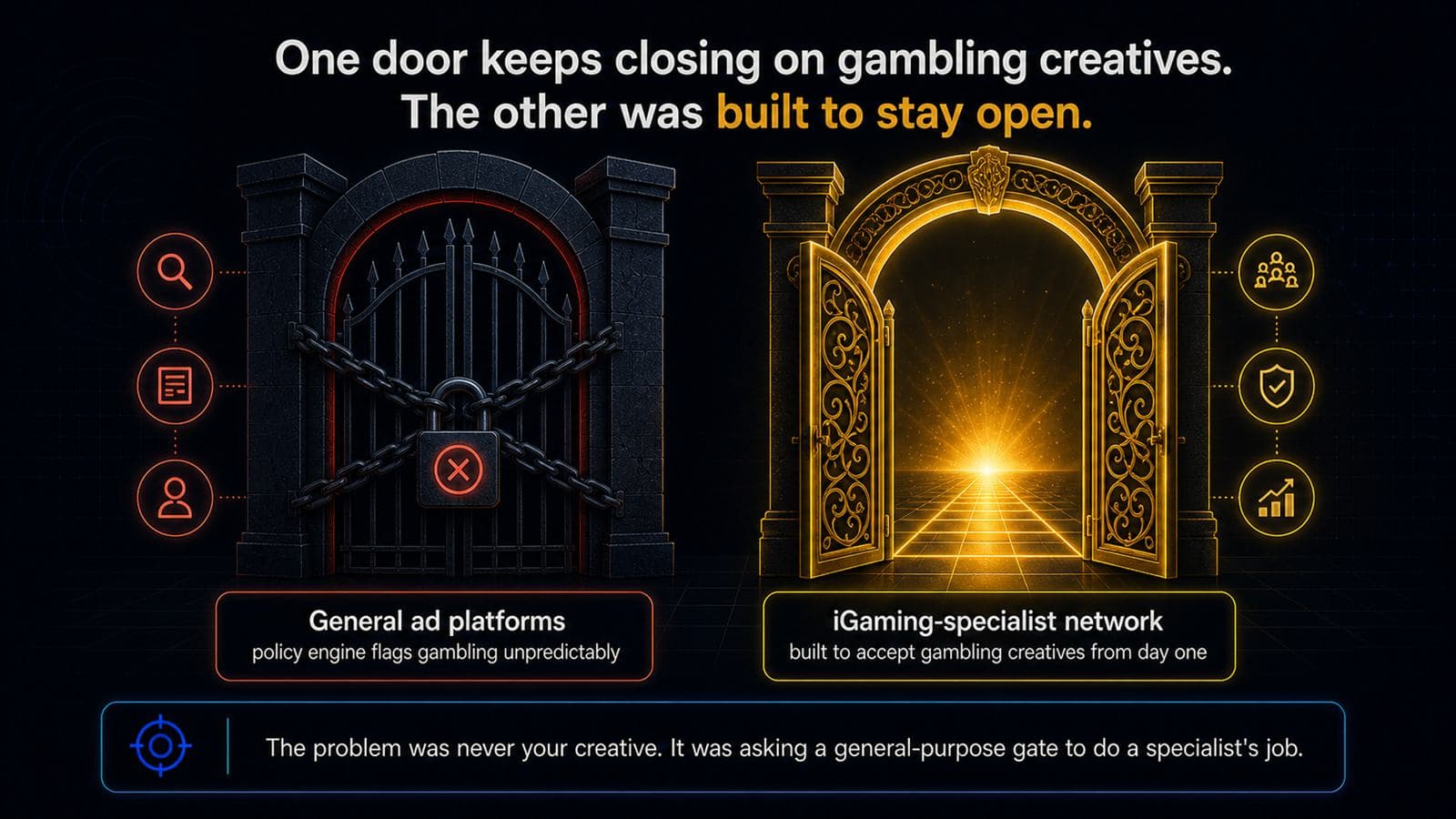
The smarter move is to advertise where gambling is an accepted, expected vertical: on an ad network built for iGaming compliance from day one.
The Compliant Alternative: A Purpose-Built iGaming Ad Network
A specialized iGaming ad network gives a regulated vertical the right distribution layer. Instead of forcing gambling offers through a general consumer-ads policy engine, a purpose-built network treats iGaming as a first-class category, with geo-gating, age-gating, and responsible-gambling framing baked into how inventory gets bought and served.
This is the lane Taroviser works in. The goal isn't to dodge rules. It's to let compliant campaigns run smoothly and stay live.
What Makes Taroviser a Genuine Alternative
Specialization, not tolerance. A lot of networks "allow" gambling and leave it at that. Taroviser is built around it. You feel the difference in approval speed, in format support, and in the optimization signals the platform actually understands.
Ads that are easy to approve. The friction that defines Google and Meta, those opaque automated rejections, gives way to a review process designed for the vertical. When your offer and creative meet standard iGaming compliance, approval is straightforward, and campaigns launch on a realistic timeline instead of stalling in review limbo.
Built-in compliance posture. Taroviser supports the controls regulators and responsible operators expect: geo-gating so traffic stays inside permitted markets, age-gating so messaging reaches adults of legal age, and a framing approach that keeps campaigns on the right side of responsible-gambling expectations. (Always confirm your own licensing per target market. The network enables compliant delivery, but the operator stays responsible for holding the correct licenses.)
No platform fee, no monthly minimum. Mainstream channels pile on cost and qualification. Taroviser strips that gatekeeping out. No platform fee, no monthly minimum, which lowers the barrier to testing new geos and offers.
Human-analyst anti-fraud. Automated fraud filtering is table stakes. Taroviser layers human analysts on top to review traffic quality, which matters a lot in a vertical where FTD value runs high and bad clicks compound fast.
Deep Reach Where It Matters Most: Asia and Southeast Asia
This is where the positioning gets sharpest. Taroviser sits among the top for volume and expertise across Asia and Southeast Asia, the markets where iGaming growth is fastest and where most global networks offer only shallow, generic coverage. Taroviser brings deep local market intelligence in the region: how players in specific SEA geos actually respond, which formats convert there, and how to price traffic so advertisers aren't overpaying for reach.
One thing we see again and again. A buyer comes in with a creative tuned for a Western audience, drops it into a Tier-1 SEA geo, and wonders why it stalls. The fix is rarely the offer. It's the format and the framing for that specific market. That local depth comes paired with broad coverage, 200+ geos in total, so SEA can be your core engine while you still run global tests from a single platform.
Formats That Replace What Google and Meta Took Away
When search and social shut their doors, you need inventory that performs without them. Taroviser runs five core formats, each suited to a different part of the iGaming funnel:
- Push Notification Ads – classic device and lock-screen push for high-intent re-engagement and volume, reaching users even outside browser sessions.
- In-page Push – a Taroviser specialisation that extends push-style reach to iOS and ad-block environments.
- Popunder – large-scale awareness and aggressive FTD acquisition volume.
- Interstitial – full-screen placements that capture attention at natural break points in the user journey.
- Native – content-style placements that respect responsible-gambling framing while driving qualified clicks.
All five run across CPM, CPC, and CPA models, with pricing and bidding optimized toward FTD rather than raw clicks. FTD is the number that actually matters for operators and affiliates, so that's what the bidding chases.
How Taroviser Optimizes Campaigns Better Than a General Network
Compliance gets your ads live. Optimization is what makes them profitable. This is the second half of the pitch, and it's where the SEA data advantage compounds.
24/7 Support and Continuous AI Optimization
Taroviser pairs 24/7 human support with continuous AI-driven campaign optimization. The AI works on top of your performance data. It combines your campaign signals with the network's market intelligence, then pushes spend toward the placements, geos, and creatives that are delivering. And because the system is iGaming-specialized, it tunes toward FTD quality and retention signals, not the generic engagement metrics that look great on a dashboard and never pay.
The practical effect? Fewer manual rebid cycles, faster reaction to traffic shifts, and a campaign that keeps tuning itself overnight. iGaming moves fast. Promotions, sporting events, regional peaks all shift the picture within hours, so that kind of responsiveness is a real edge.
Cost-Efficiency: Traffic 30–50% Cheaper
Thanks to its sourcing depth and SEA market intelligence, Taroviser positions itself to deliver traffic roughly 30–50% cheaper than typical alternatives at comparable quality. For media buyers working the thin margin between CPA payout and FTD value, that gap is often the line between a campaign that scales and one that gets paused.
Self-Serve or Managed – Your Choice
Run Taroviser as a self-serve platform with full control over bids, targeting, and creatives, or take a managed relationship where the team and AI handle optimization for you. S2S postback tracking works either way, so your attribution stays clean and your data flows back into both your stack and the network's optimization engine.
How Taroviser Compares to Other Routes
To put the alternative in context, here's how the main acquisition routes stack up for an iGaming advertiser locked out of Google.
| Channel | Gambling stance | Approval friction | iGaming-specific optimization |
|---|---|---|---|
| Google Ads | Licensed + certified geos only | High, opaque, automated | None – generic policy engine |
| Meta (FB/IG) | Prior permission, narrow geo list | High, account-risk heavy | None |
| Generalist ad networks | Tolerated as one vertical of many | Variable | Shallow; not FTD-tuned |
| Taroviser | iGaming-specialized, compliant | Low – easy approval | Deep; AI + SEA intelligence, FTD-tuned |
One note on the generalist networks. Depending on which review sources you read, some get reported by users for weaker regional depth in Asia or higher effective costs, points those providers may well dispute. The comparison worth running is service responsiveness, regional expertise, and the price you actually pay per quality FTD. That's the comparison Taroviser invites.
Compliance and Responsible Gambling: The Non-Negotiables
Switching channels doesn't switch off your obligations. What keeps a compliant network sustainable, where a cloaking workaround eventually self-destructs, is that the network keeps you aligned with the rules protecting your license and your players. Whichever platform you run on, hold the line on these:
- Licensing per market. Only advertise into geos where you hold or are covered by the appropriate license.
- Geo-gating. Keep delivery restricted to permitted jurisdictions, a control Taroviser supports natively.
- Age-gating. Target adults of legal gambling age and include age verification on landing experiences.
- Responsible-gambling messaging. Carry the required RG notices and self-exclusion references for each market.
- Truthful creative. No deceptive bonus claims, no guaranteed-win language. This protects compliance and conversion quality at the same time.
Running compliant buys you more than risk management. It's what lets you scale without the account-death cycle that defines life on Google and Meta.
FAQ
Q: Why are my casino ads banned on Google even though I have a license?
A: Google permits gambling ads only in specific certified countries, with largely automated approval. Even licensed advertisers get disapprovals when creative, landing pages, or geo targeting fall outside those narrow certification lanes. A specialized iGaming network removes that policy-engine friction.
Q: Is using an iGaming ad network a way to get around advertising rules?
A: No. A compliant network like Taroviser is the correct distribution layer for a regulated vertical, with geo-gating, age-gating, and responsible-gambling framing built in. Cloaking hides your offer to slip past a filter; a specialized network keeps your campaigns inside the rules so they stay live. Those are opposite things.
Q: What formats can I run if I can't use Google or Meta?
A: Taroviser supports five core formats – Push Notification Ads, In-page Push, Popunder, Interstitial, and Native – across CPM, CPC, and CPA models, all optimized toward FTD rather than raw clicks. They cover everything from awareness to aggressive acquisition.
Q: How does Taroviser keep traffic costs lower?
A: Through deep sourcing and market intelligence, especially across Asia and Southeast Asia, combined with continuous AI optimization, Taroviser positions traffic at roughly 30–50% cheaper than typical alternatives at comparable quality. There's also no platform fee and no monthly minimum.
Q: Can I track conversions and FTDs accurately?
A: Yes. S2S postback tracking is supported, so first-time deposits and downstream events feed back into both your attribution stack and Taroviser's optimization engine for cleaner reporting and smarter spend allocation.
Q: Do I still need to handle compliance myself?
A: The network enables compliant delivery – geo-gating, age-gating, RG framing – but you stay responsible for holding the correct licenses per market and for truthful creative. Compliance is a shared discipline; Taroviser makes the platform side straightforward.
Stop Losing Budget to the Policy Engine
A Google or Meta ban is a signal worth reading, not a final verdict. The advertisers who win in iGaming are the ones who move spend to infrastructure built for the vertical, where approval is straightforward, compliance is structural, and optimization is tuned to the metric that pays: FTD.
Taroviser brings deep reach and local intelligence in Asia and Southeast Asia, five high-performing formats, 24/7 human support backed by continuous AI optimization, and traffic positioned 30–50% cheaper, with no platform fee and no monthly minimum. If your casino, sportsbook, or affiliate campaigns are stuck in review limbo, it's time to run them where they belong.
Sign up for a Taroviser account, or talk to our team about a managed launch into SEA, and get your campaigns live and optimizing within days, not weeks.
Related on Taroviser
Related guides
- Adsterra Alternative for iGaming: Why Specialist Beats Generalist at Scale
- How to Run Casino Push Notification Campaigns That Convert
- Native Ads for Online Casino: A Buyer Guide
- Push vs Popunder vs Native for iGaming: Which Ad Format Converts Best?
- RichAds Alternative for iGaming Advertisers: Anti-Fraud, Pricing & Asia
- Why Use a Self-Serve iGaming DSP Instead of Google or Facebook Ads
Traffic & ad formats
Ready to launch?
Put these tactics to work with premium iGaming traffic on Taroviser.
Start advertising