
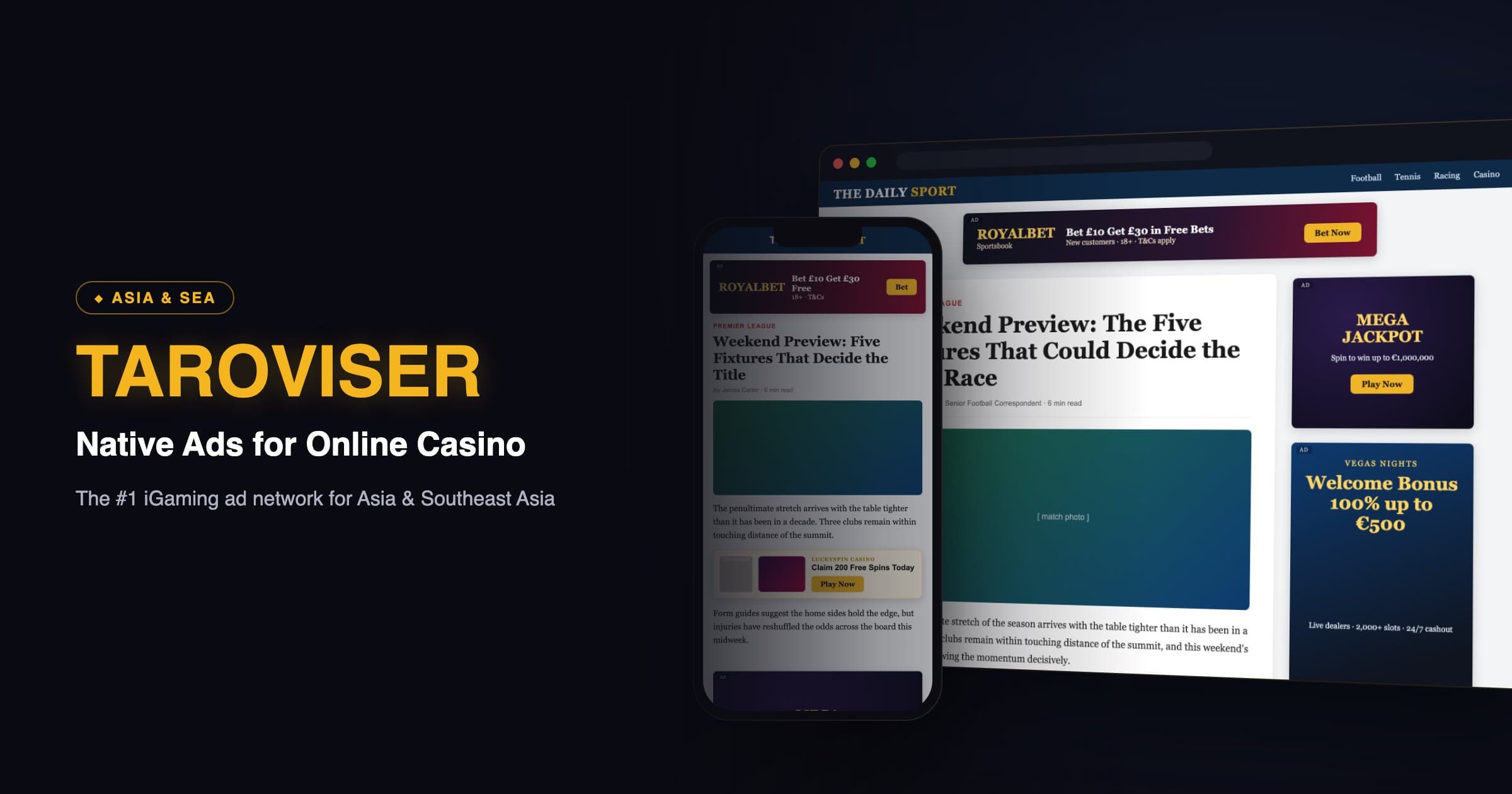
Native Ads for Online Casino: A Buyer Guide
Buy iGaming traffic long enough and you learn the problem with most formats fast. They shout. Banners get ignored, aggressive pops get blocked, and by the time the user lands on your offer they are already annoyed. The advertisers we talk to every week – operators, affiliates, agencies, media buyers – keep describing the same thing. Clicks cost too much, the ones that arrive bounce, and cost-per-FTD never settles into a number you can plan around.
Native is the format most likely to fix that, and I want to be clear it only works if you run it right. There is no magic button here. It is a discipline: you match the look and intent of the content around the ad, you respect the geo and where the player sits on the awareness curve, and you keep feeding real conversion data into an optimization loop. This guide is for the buyer who already gets CPA and FTD economics and wants an honest read on how native fits an online casino media plan – and where Taroviser fits in.
What "Native" Actually Means for a Casino Advertiser
Native advertising is paid placement built to match the form and function of the platform it sits on. So instead of a flashing 300x250, your offer shows up as a recommended-content widget, an in-feed unit, or a content card that reads like the article around it. The user processes it as information first and advertising second.
For a casino advertiser, that gap matters more than it does in almost any other vertical. Three reasons:
- Trust is the conversion bottleneck. A first-time depositor is handing over money and payment details. Anything that smells like a cheap pop or a scammy banner kills that intent on the spot.
- Compliance demands restraint. In a regulated and semi-regulated landscape, screaming player-facing copy is both a policy risk and a trust killer. Native rewards the calmer, editorial tone you should be writing in anyway.
- The pre-click frame sets the post-click outcome. A native unit that mirrors the destination produces a warmer click, and warmer clicks deposit more often.
Across the major native ecosystems you will run into four practical sub-formats: in-feed / content recommendation, native push and in-page push (push-style delivery wearing native creative), native banners that adapt to the host design, and, more and more, video-native units. Taroviser runs Push Notification Ads, In-page Push, Popunder, Interstitial, and Native on one S2S-postback-enabled platform, so you can test native against your existing pop and push mix without re-plumbing your tracking.
Why Native Drives Higher Conversion Rates
There is no single reason native CRs tend to beat interruptive formats for casino. It is a stack of effects that compound.
1. Self-qualified clicks
A native unit reads like content, so the people who click have already shown some intent toward the topic. They are not thumb-slips on a misplaced banner. You get fewer clicks, but each one is worth more – which is exactly the trade a CPA buyer wants.
2. Lower banner blindness and ad fatigue
Users have trained themselves to skip the standard display zones. Native lives inside the content stream, so it slips past that blindness and decays more slowly. You still need creative rotation – more on that below – but the starting baseline is healthier.
3. A continuous frame from impression to FTD
When the creative, the pre-lander, and the offer page tell one coherent story, the drop-off between each step shrinks. Native is the format that lets you build that narrative honestly instead of bait-and-switching your way to a deposit page.
4. Cleaner data for optimization
Native traffic behaves more consistently than scraped or incentivized clicks, so the conversion signal is cleaner. That matters because an optimization engine can only learn from a signal it can trust. Which brings us to the next section.
One honest note on numbers. Native CR uplift versus interruptive formats swings wildly by geo, vertical sub-niche, and creative quality. Treat any single benchmark with suspicion and measure it on your offer. The point is structural – native removes friction at the trust layer – not that it hands you a fixed lift.
Creative Best-Practice for Casino Native
Native lives or dies on creative. The format hands you the trust frame; the creative either earns it or wastes it.
Headlines that inform, not scream
Your headline is doing two jobs at once: matching the host content's voice and filtering for intent. Curiosity and specificity beat hype, every time.
- Works: clear, editorial, region-aware, benefit-led without overpromising.
- Avoid: all-caps, fake urgency, and any player-facing reward language that breaks B2B-appropriate compliance framing.
Write five to ten headline variants per campaign. You are not guessing the winner. You are giving the optimization layer something to choose between.
Images that look native, not advertised
The single biggest tell of a "native ad that isn't native" is a glossy, over-produced stock image. Real, slightly imperfect, contextually relevant visuals beat polished render-style creatives more often than not. Match the visual culture of the geo, too – what reads as trustworthy in one SEA market can read as foreign or spammy in the one next door. This is where deep local market intelligence earns its keep.
The pre-lander does the heavy lifting
Send native clicks straight to a deposit page and you waste the trust you just built. A short, honest pre-lander that picks up where the headline left off – context first, then a clear path to the offer – is the highest-ROI asset most casino native buyers under-invest in. I have seen campaigns turn around on the pre-lander alone, with the creative untouched.
Rotate before fatigue, not after
Native decays slower than display. It still decays. Build a rotation cadence and retire units on measured CTR-and-CR decay, not on a gut feeling about which one feels tired. Continuous creative turnover is a campaign-management task, and it is exactly the kind of work Taroviser's 24/7 support and AI optimization are built to carry alongside you.
A quick reference table
| Element | Do | Avoid |
|---|---|---|
| Headline | Editorial, specific, geo-aware | All-caps, fake urgency, player-facing hype |
| Image | Authentic, contextual, locally relevant | Glossy stock, generic renders |
| Pre-lander | Continues the story, sets honest expectations | Direct-to-deposit, bait-and-switch |
| Rotation | Retire on measured CR/CTR decay | "Set and forget" |
| Compliance | Responsible-gambling + age/geo framing | Anything that ignores local rules |
Targeting: Where Native Casino Campaigns Are Won
Creative gets the click. Targeting decides whether that click was worth buying.
Geo first, always
iGaming is a geo game. Allowed markets, payment behavior, language nuance, competitive density – they change everything. Asia and Southeast Asia in particular reward operators who understand local payment rails, device habits, and regulatory framing instead of treating the region as one undifferentiated block. Taroviser's positioning is built right here: the deep local market intelligence and a leading volume position across Asia / SEA, so your geo targeting runs on data, not assumptions.
Device, OS, and connection
Mobile-first is the rule in most SEA markets, but the specifics matter – Android dominance, Wi-Fi versus carrier, OS version spread – and they shape both creative and bid. Tune your native creatives for the dominant device profile in each target geo.
Source and placement quality
Native inventory varies a lot in quality. The lever that protects your spend is human-analyst anti-fraud layered on top of automated filtering, catching the patterns automated systems alone tend to miss. Taroviser combines algorithmic filtering with human review for a simple reason: casino budgets are a high-value fraud target.
Dayparting and frequency
Deposit behavior clusters by hour and day, and the pattern differs by market. Native lets you pour budget into the windows that convert and cap frequency so you are not paying to annoy the same user over and over.
Optimization model
Most native platforms support CPM, CPC, and CPA-style buying. The right starting model depends on your data maturity: run CPC to gather signal fast, then optimize toward CPA/FTD as the conversion data piles up. Taroviser supports CPM/CPC/CPA optimized toward FTD, with S2S postback so your conversion truth flows back into the system in real time.
The Optimization Loop: Where Taroviser Is Different
Here is the part buyers underweight. Native is not a "launch and harvest" format. It is a feedback system. Every impression, click, pre-lander view, and FTD is a data point. The network that closes that loop fastest and smartest is the one that lowers your effective cost per depositor.
Taroviser's approach pairs two things that usually get sold separately:
- 24/7 human support – real people on campaign issues, approvals, and scaling decisions, around the clock, across the time zones that matter for Asian markets.
- Continuous AI optimization – the engine ingests your campaign and conversion data and adjusts toward your KPI continuously, instead of waiting on a weekly manual review.
That combination is what produces the cost-efficiency Taroviser positions on – traffic that comes in materially cheaper, on the order of 30–50% versus comparable buys – without you babysitting every bid.
A few operational details that take friction out of native buying specifically:
- No platform fee and no monthly minimum – test native at a small budget before you commit.
- Ads are easy to approve – less back-and-forth getting compliant casino creatives live.
- 200+ geos and a self-serve plus managed model – run it yourself, or hand the optimization to the managed team and the AI.
- Multi-vertical and iGaming-specialized – the platform is broad, but the casino expertise is deep.
How Taroviser Compares (Honestly)
Buyers always ask how a network stacks up against the alternatives. The honest answer: most large native and multi-format networks can deliver volume. The differences show up in service, price-efficiency, regional depth, and how intelligently the optimization runs.
- Against broad-reach native and multi-format networks, Taroviser's edge sits in service depth, price-efficiency, SEA market intelligence, and AI-driven continuous optimization – many of those are strong, established platforms, and our differentiation lives in those specific service and regional dimensions, not a blanket claim.
- Against other native and multi-format players (Adsterra, RichAds, Galaksion, TrafficStars, HilltopAds, Mondiad, Evadav, Zeropark, for example), buyers in public reviews and reports sometimes flag trade-offs around support responsiveness, regional depth in Asia, or dashboard optimization granularity – points those networks may reasonably contest, so validate against your own test data. Taroviser's deliberate answer to those gaps is 24/7 human support, SEA-first intelligence, and the AI optimization loop described above.
The right move is never to take a network's word for it. Ours included. Run a controlled native test on a real offer, in a real geo, with S2S postback wired, and let the FTD data decide.
FAQ
Q: Is native really better than push or popunder for casino offers?
Not universally. It is better for the trust-sensitive part of the funnel, especially first-time depositors. Plenty of buyers run native, push, and popunder together and let CPA-per-FTD decide the budget split. Taroviser supports Push Notification Ads, In-page Push, Popunder, Interstitial, and Native on one platform with shared tracking, so the test is cheap to run.
Q: How much budget do I need to test native?
Less than most buyers expect. With no platform fee and no monthly minimum, you can start small, gather conversion signal on CPC, and only scale the geos and creatives that prove out on FTD.
Q: How long before native campaigns stabilize?
Depends on volume and how clean your conversion postback is. But the faster your FTD data flows back, the faster the optimization converges. S2S postback plus continuous AI optimization is built specifically to shorten that learning window.
Q: How do you keep native traffic clean for a high-value vertical like casino?
Layered defense: automated filtering plus human-analyst anti-fraud review. Casino budgets attract fraud, so human eyes on the patterns automation misses are part of the standard process.
Q: Which geos work best for casino native?
Asia and Southeast Asia are where Taroviser concentrates depth and volume, with 200+ geos available overall. The best geo for you comes down to your license footprint, payment coverage, and offer – something the managed team helps you map.
Q: Can I run native self-serve, or do I need a managed team?
Both models are available. Experienced buyers often start self-serve and bring in the managed team and AI optimization as they scale.
Ready to Test Native the Right Way?
Native is the format that respects the casino buyer's hardest problem – earning enough trust to turn a click into a first deposit. Run it with honest creative, geo-smart targeting, and a tight optimization loop, and the cost-per-FTD math starts working in your favor.
Taroviser brings the three things that make native pay off at scale: a leading volume position and the deep market intelligence across Asia / SEA, 24/7 support paired with continuous AI optimization, and cost-efficiency that runs materially below comparable buys – with no platform fee, no monthly minimum, and easy approvals.
Sign up for Taroviser, or talk to our team, and launch a controlled native test on your top casino offer this week.
Related on Taroviser
Related guides
- Casino Ads Banned on Google? The Compliant Alternative for iGaming Advertisers
- How to Run Casino Push Notification Campaigns That Convert
- Do Fullpage Interstitial Ads Increase iGaming Conversions? What It Does
- iGaming Ad CTR Benchmarks by Format: How to Read Them Without Fooling Yourself
- Adsterra Alternative for iGaming: Why Specialist Beats Generalist at Scale
- Best Popunder Ad Networks for Gambling Traffic in 2026
Traffic & ad formats
Ready to launch?
Put these tactics to work with premium iGaming traffic on Taroviser.
Start advertising