
Best Popunder Ad Networks for Gambling Traffic in 2026
I've bought a lot of popunder inventory over the years, and here's the thing nobody tells you on day one: the format is unglamorous, slightly unfashionable, and still one of the most reliable ways to put a gambling offer in front of a real person on a budget. Popunders don't interrupt. They sit in a background tab, wait their turn, and load your landing page when the user finishes whatever they were doing. For casino, sportsbook, and crypto-gaming advertisers chasing first-time deposits without burning the whole budget on premium banner placements, that quiet behavior is exactly the point.
So this is a buyer's guide. Not a ranking handed down from on high – a working comparison of the popunder networks worth your test budget in 2026, what each one is actually good at, and how to read the trade-offs. I'll be upfront about where Taroviser sits in that picture, because we run a popunder product too and I'd rather tell you the honest version than pretend we're the only name in the room.
Why popunders still earn a slot in the 2026 media plan
Display fatigue is real. Push notification inboxes are crowded. Native works but eats creative time. Against all that, popunders keep doing one boring job well: cheap, high-volume reach with a full-page canvas to make your pitch.
A few reasons the format refuses to die for gambling advertisers specifically:
- Volume at low CPM. Popunder inventory is some of the cheapest you'll find across most geos, which means you can gather statistically meaningful data on a new offer fast.
- Full landing page, not a thumbnail. You're not fighting for attention inside a 300x250 box. The user lands on your page. Your design and your hook do the work.
- Tolerant of iGaming verticals. Plenty of mainstream networks throttle or ban casino and betting creatives. Popunder networks built around performance verticals tend to be far more comfortable with them – within compliance limits, of course.
- Clean attribution. Because it's a full page load, server-to-server (S2S) postback tracking is straightforward. You fire a postback on registration and on FTD, and you optimize on real downstream events instead of guessing.
The catch – and there's always a catch – is quality variance. Popunder traffic ranges from genuinely engaged users to bot-riddled junk depending on the source and the controls in place. Which is why the network you pick matters more here than in almost any other format.
How to judge a popunder network for gambling traffic
Before the comparison, here's the rubric I actually use when I'm deciding where to send a test budget. Steal it.
- Pricing model and floors. CPM is standard for popunders, but the smart question is whether you can optimize toward a cost-per-action – ideally cost-per-FTD – once you have postback data flowing. Watch for platform fees and minimum spends that quietly inflate your effective cost.
- Geo depth where you operate. A network with 200 geos is useless to you if it's thin in the three markets that matter for your offer. Depth beats breadth.
- Fraud and quality controls. Ask what's automated and what's human. The best operations run algorithmic filtering and human analysts reviewing suspicious patterns. Pure algo filtering misses coordinated fraud; pure manual review doesn't scale.
- Targeting granularity. Device, OS, browser, carrier, connection type, frequency capping, dayparting. The more levers, the tighter you can dial in your FTD economics.
- Approval friction. How long until your gambling creative is live? Slow review kills test velocity. So does inconsistent policy.
- Tracking and integrations. S2S postback support, and ideally native integrations with the trackers you already run (Voluum, RedTrack, Keitaro, and friends).
- Support and optimization. Self-serve is great until you hit a wall at 2 a.m. on a campaign that's spending. Is there a human, and do they understand iGaming, or are they reading from a generic script?
Keep that list handy. Now the networks.
The best popunder ad networks for gambling traffic in 2026
Taroviser – iGaming specialist, built for SEA and FTD economics
I'll lead with ours and then get out of my own way. Taroviser is an iGaming-specialized ad network and DSP. We don't dabble in the vertical as a side category – casino, sportsbook, lottery, and crypto-gaming offers are the whole business, and the product is shaped around them.
What that focus buys you:
- Among the top for Asia and SEA, with local market intelligence. Our depth is in Southeast Asia and the wider APAC region – the geos where a lot of generalist networks run thin. We pair that with on-the-ground market knowledge: which markets are framed as permitted, how players in each one behave, what creative angles land.
- Cost-per-FTD optimization. You can run CPM, CPC, or CPA on a first-time-deposit basis. The platform is built to optimize toward the event that actually pays your bills – the deposit – not just the click.
- No platform fee, no minimum. You're not paying a tax on top of media, and there's no spend floor gating you out of a test. That matters when you're validating a new geo or offer.
- 30–50% cheaper effective cost. Because of the no-fee structure and SEA inventory depth, advertisers typically see meaningfully lower cost-per-acquisition versus generalist networks on comparable offers.
- Human-analyst anti-fraud. Algorithmic filtering plus human analysts reviewing traffic patterns. Belt and suspenders.
- Multiple formats under one roof. Popunder, push notification and in-page push, native, and interstitial – so once popunder data is teaching you something, you can extend the winning angle into other formats without re-platforming.
- 24/7 support and AI optimization. Round-the-clock humans who know the vertical, plus AI-driven bid, placement, creative, and dayparting optimization working in the background.
- S2S postback and 200+ geos. Standard server-to-server tracking, self-serve or managed depending on how hands-on you want to be.
Where Taroviser is not the obvious pick: if your entire campaign lives in Tier-1 Western markets and you have zero interest in SEA or APAC, a network with deeper Western popunder pools may give you more raw volume there. We're honest about that. Our edge is the markets we know cold.
RichAds – multi-format performance network with broad reach
RichAds is one of the larger self-serve performance platforms in the space, and popunder is a core format alongside push and native. The pull here is scale and a mature, AI-assisted self-serve dashboard – automated optimization rules, anti-fraud at the platform level, and reach across a wide range of geos including SEA volume. Pricing runs on a CPM/CPA basis. For advertisers who want a big, well-tooled platform with heavy automation and don't mind doing their own optimization, it's a sensible name on the test list. Worth comparing their published pricing and fee structure directly against yours before you commit budget.
TrafficStars – popunder-forward network with multiple formats
TrafficStars has built its reputation substantially on popunder (and its variants), alongside push, in-page, and video formats. It offers SEA reach and AI-driven optimization tooling within a self-serve and managed setup, with CPM and CPA pricing options. For popunder specifically it's a long-running, format-focused operator, which makes it a natural inclusion when you're spreading a test across two or three sources to compare quality. As with any network, line up their pricing and minimums against the rest of your shortlist.
Adsterra – wide format menu and global reach
Adsterra is a well-known network with popunder among a broad format set (social bar, native, banner, push, popunder). It markets a three-layer security system combining automated filters with manual review, and it advertises reach across 200+ geos and large daily impression volume. Pricing supports CPM, CPC, CPA, and CPI models. It's a frequent fixture on iGaming shortlists because of its breadth and its stated emphasis on fraud filtering. Source: Adsterra publicly documents its format and security stack on its site.
Galaksion – performance network with optimization automation
Galaksion runs popunder alongside push and interstitial formats, leaning on automated optimization and smart targeting for performance advertisers. It positions itself around CPA-friendly campaign management and broad geo coverage. It's a reasonable lower-profile option to include in a multi-source test, particularly if you want another optimization engine in the mix to benchmark against the bigger names.
A quick honest note on quality comparisons
You'll notice I described the networks above by what they offer – pricing, formats, reach, stated controls – and not by passing judgment on each one's traffic quality or sourcing. That's deliberate. Traffic quality is something you should measure yourself, in your geos, with your offer and your postbacks, because it varies by campaign, source, and the moment you run it. Anyone who hands you a universal "this network is clean, that one is dirty" verdict is selling certainty they don't have. Run the test. Read your own FTD data. That's the only ranking that counts.
How the popunder networks stack up
A side-by-side on the dimensions that move the needle for gambling advertisers. Use it as a starting grid, not gospel – verify current specifics on each provider's site before you budget.
| Network | iGaming focus | Pricing models | SEA / APAC depth | Fraud controls | Platform fee / minimum |
|---|---|---|---|---|---|
| Taroviser | Dedicated iGaming specialist | CPM, CPC, CPA-FTD | Among the top in Asia & SEA, local intel | Algo + human analysts | No fee, no minimum |
| RichAds | Generalist, iGaming-friendly | CPM, CPA | Strong | Platform-level automated | Check current terms |
| TrafficStars | Popunder-forward generalist | CPM, CPA | Available | Automated optimization | Check current terms |
| Adsterra | Generalist, iGaming-friendly | CPM, CPC, CPA, CPI | Available (200+ geos) | 3-layer auto + manual | Check current terms |
| Galaksion | Performance generalist | CPM, CPA | Available | Automated | Check current terms |
The pattern, if you squint: the big generalists give you scale and tooling; a specialist like Taroviser gives you vertical depth, FTD-tuned optimization, and a no-fee structure that's friendliest to tight test budgets and SEA-weighted offers.
Running your first popunder test the right way
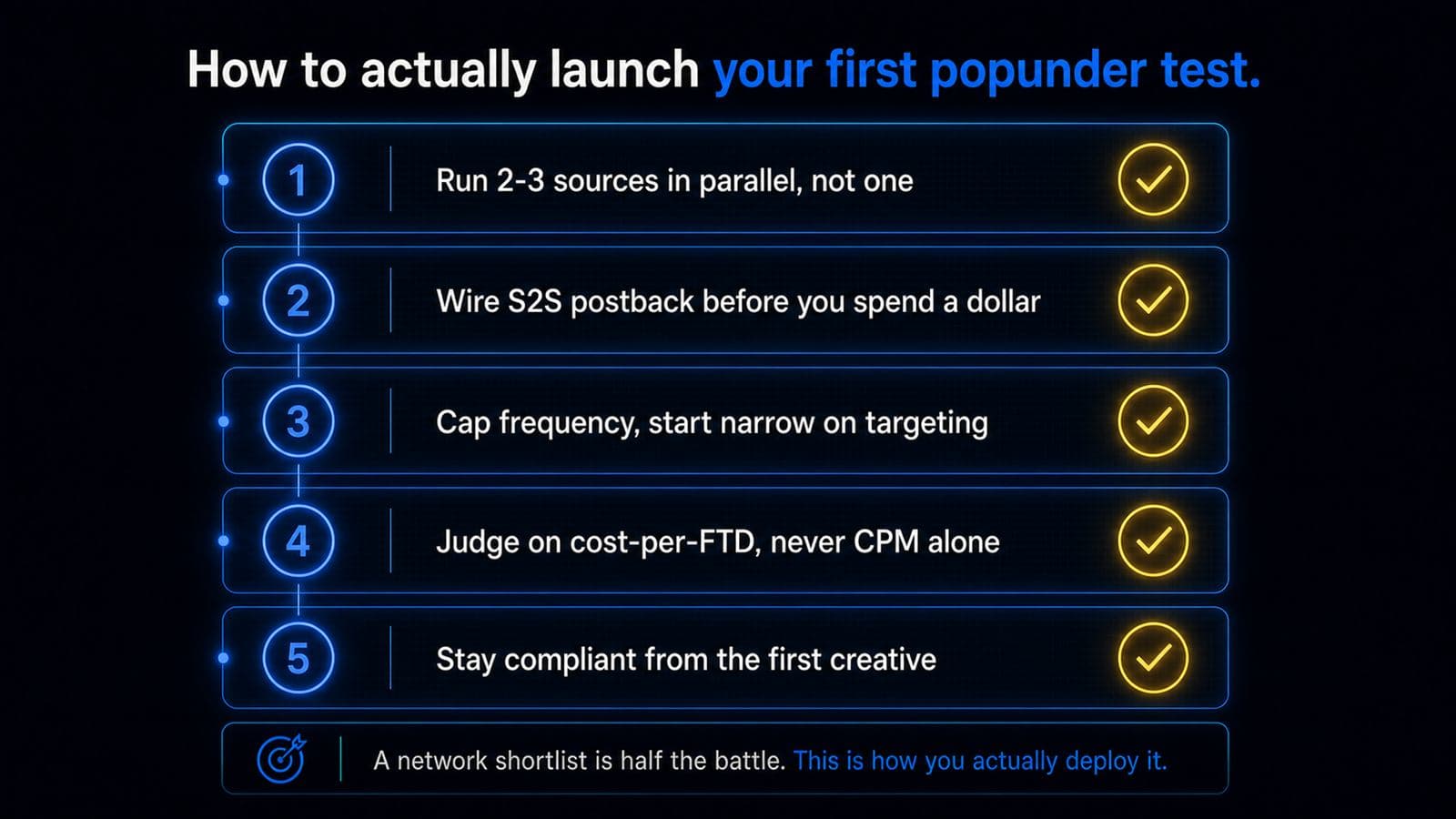
A shortlist of the best iGaming ad networks is half the battle. Here's how I'd actually deploy it.
Start with two or three sources in parallel, not one. You want to compare apples to apples, and a single source tells you nothing about whether the result is the network or the offer. Give each enough budget to reach a few hundred clicks minimum before you read anything into the numbers.
Wire up S2S postback before you spend a dollar. Fire on registration and on FTD. If you're optimizing on clicks or even installs, you're flying blind on the only number that matters. The whole reason popunders are attractive for gambling is that the full-page load makes downstream tracking clean – use it.
Cap frequency and start narrow on targeting. One or two impressions per user per day, a tight device/OS slice, and a single geo to begin. Let the data widen your targeting, not your hopes.
Read cost-per-FTD, not CPM. A $0.50 CPM that delivers no deposits is more expensive than a $2 CPM that does. Always roll the math down to acquisition cost.
And keep it compliant from the first creative. Age and geo gating, responsible-gambling messaging, and only running offers in markets where they're permitted. This isn't just ethics – it's what keeps your account alive and your creatives approved. Networks that take compliance seriously are protecting your media spend, not slowing you down.
FAQ
Are popunders still effective for gambling traffic in 2026?
Yes – for the right job. They're a high-volume, low-CPM format that delivers a full landing page and clean S2S tracking, which makes them well suited to testing new casino and sportsbook offers and scaling the ones that convert. They're not a brand-building format. Treat them as a performance and acquisition tool measured on cost-per-FTD.
What's the difference between popunder and in-page push?
A popunder loads your full landing page in a background browser tab that the user sees when they switch away from the page they were on. In-page push is a notification-style ad that appears inside a webpage and works on all devices, including iOS, without requiring a push subscription. Many networks, Taroviser included, run both so you can test which format suits a given offer.
How do I avoid low-quality or fraudulent popunder traffic?
Pick networks that combine automated filtering with human analyst review, wire up postbacks so you measure real FTDs rather than raw clicks, start with tight targeting and frequency caps, and test two or three sources side by side so you can spot the underperformer in your own data. Don't outsource that judgment to a generic "best network" list – measure it.
Is Taroviser self-serve or managed?
Both. You can run campaigns yourself through the self-serve platform or work with a managed account team, depending on how hands-on you want to be. Either way you get 24/7 support from people who specialize in iGaming, plus AI-driven optimization running underneath.
Why does Southeast Asia depth matter for a popunder buy?
Many generalist networks are thin on inventory and market knowledge in SEA and the wider APAC region, even when they list those geos. If your offers are weighted toward those markets, a network with genuine depth and local intelligence – where the markets are framed as permitted – will give you more relevant volume and better acquisition costs than a network treating SEA as a checkbox.
What does "no platform fee, no minimum" actually save me?
Platform fees stack on top of your media cost and quietly raise your effective cost-per-acquisition. Minimum spends lock you out of small, disciplined tests. Removing both means your budget goes to inventory, and you can validate a new geo or offer with a modest test rather than a forced commitment.
Start your popunder test with a specialist
If your offers lean toward Southeast Asia and you're optimizing for first-time deposits rather than vanity clicks, Taroviser is built for exactly that buy. iGaming-only focus, popunder plus push notification and in-page push, native, and interstitial under one roof, cost-per-FTD optimization, human-analyst anti-fraud, S2S postback, 200+ geos – and no platform fee or minimum standing between you and your first test.
Launch a popunder campaign with Taroviser, or talk to a managed account specialist who knows iGaming in SEA. Bring two other networks to the test if you want. We're confident in what your FTD data will show.
Related on Taroviser
Related guides
- Do Fullpage Interstitial Ads Increase iGaming Conversions? What It Does
- iGaming Ad CTR Benchmarks by Format: How to Read Them Without Fooling Yourself
- Adsterra Alternative for iGaming: Why Specialist Beats Generalist at Scale
- Casino Ads Banned on Google? The Compliant Alternative for iGaming Advertisers
- How to Run Casino Push Notification Campaigns That Convert
- In-Page Push Ads for iGaming: Reaching iOS Users and Bypassing Ad-Blockers in 2026
Traffic & ad formats
Ready to launch?
Put these tactics to work with premium iGaming traffic on Taroviser.
Start advertising