
In-Page Push Ads for iGaming: Reaching iOS Users and Bypassing Ad-Blockers in 2026
Run paid acquisition for an iGaming brand long enough and you keep slamming into the same two walls. Classic push subscriptions never fire on Safari iOS, so a fat slice of high-value mobile traffic is just invisible to your campaigns. Then desktop ad-blocking eats into reach from the other side, quietly inflating your effective CPMs because you are paying to fight over a shrinking pool of users you can actually touch.
In-page push was built for exactly this corner. It looks like a system push notification, but it is not wired to the browser's subscription mechanism at all, and that is the whole reason it keeps working where standard push goes dark. This guide walks through how the format actually functions, why it reaches iOS and ad-blocker users that other formats miss, the specs and targeting that matter to you as an advertiser, and how to run it profitably for gambling and betting offers. Taroviser supports in-page push as one of its core formats, with among the deepest reach across Asia and Southeast Asia and continuous AI optimization layered on top.
What In-Page Push Actually Is (and How It Differs From Classic Push)
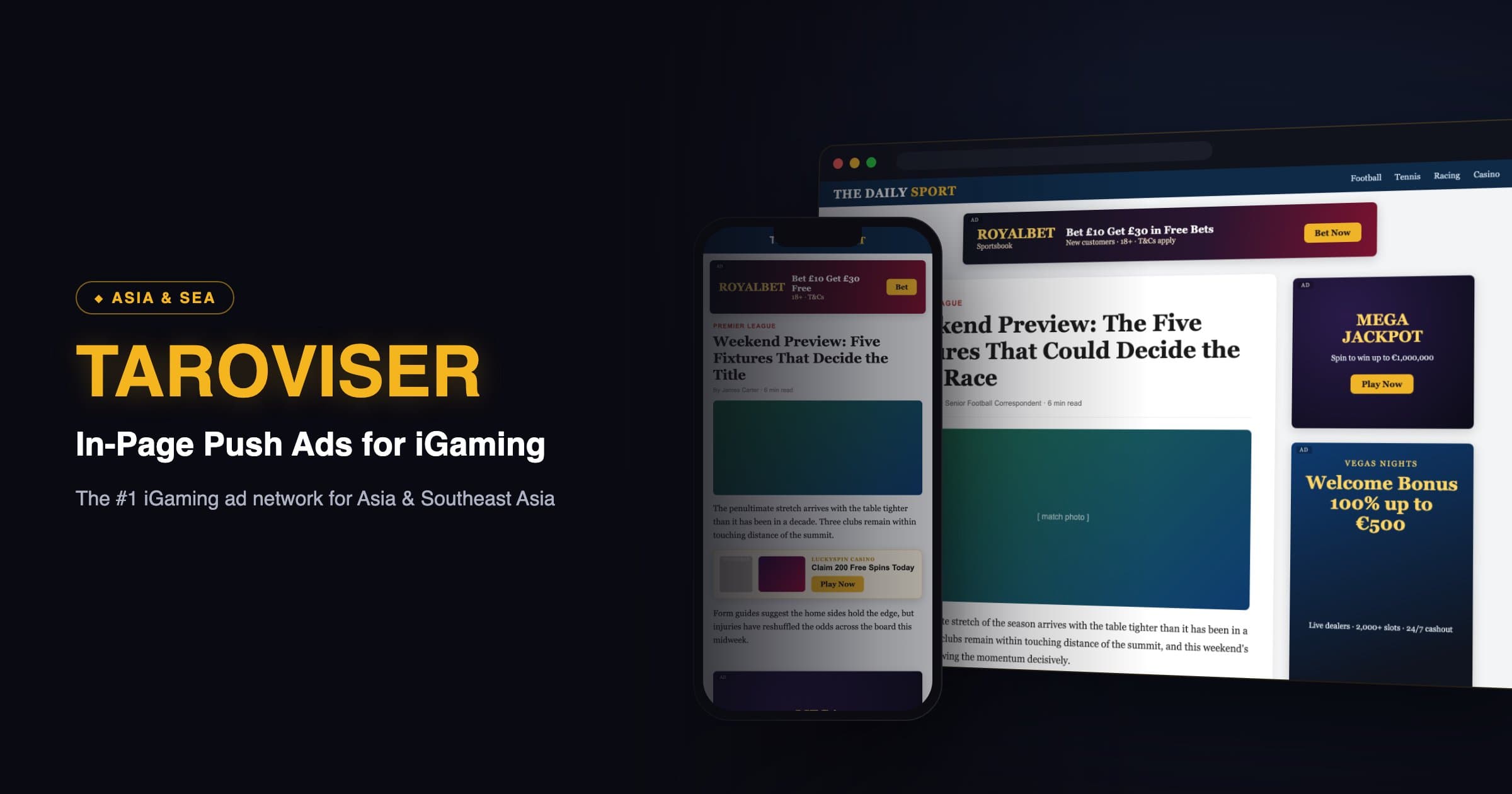
In-page push is an ad unit rendered straight inside a publisher's web page while someone is browsing. It borrows the visual language of a system push notification – small icon, title, a short line of body text, a click-through – but it ships as an on-page creative element, not as a real OS-level or browser-level notification.
That distinction is the whole story. Classic (or "web") push works by asking the user to subscribe to a site's notifications. Once they are subscribed, the publisher can message them later, even after they have left the site. It is great for retargeting an audience you already have, but it comes with two structural limits:
- It needs an explicit opt-in. No subscription, no impression. Building a subscriber base eats time and traffic.
- It depends on the browser supporting the Push API. And that is where iOS has historically been a dead zone for advertisers.
In-page push sidesteps both. There is no subscription gate, so the unit shows to any user loading the page in the targeted inventory. And because it renders as page content rather than a browser notification, it does not care whether the Push API is available or switched on.
| Classic / Web Push | In-Page Push | |
|---|---|---|
| Delivery | Browser/OS notification | On-page creative element |
| Requires opt-in | Yes (subscription) | No |
| Works on iOS / Safari | Limited / historically no | Yes |
| Survives most ad-blockers | Partially | Better (renders in-content) |
| Best for | Retargeting subscribers | Fresh reach + prospecting |
| Audience freshness | Aging subscriber lists | 100% fresh impressions |
The practical read for iGaming media buyers: in-page push hands you a push-style creative experience while behaving like a display placement under the hood. That combination is what unlocks the iOS and ad-blocker audiences.
Why In-Page Push Reaches iOS Users
Safari only added web push support relatively recently, and even then with strings attached. On iPhone, web push generally needs the site added to the Home Screen as a web app before notifications can fire, and the user still has to grant permission. Stack those conditions and standard push reaches a sliver of iOS visitors – nowhere near enough to build real campaign scale.
And iOS users are worth a lot in iGaming. They skew toward higher-spend demographics in many markets, and in several Asian and Southeast Asian geos iPhone share among engaged bettors runs high. Leaving them unreachable through push is a genuine revenue gap, not a rounding error.
In-page push closes that gap because it never touches the notification subscription pipeline:
- The creative is injected into the page DOM as the user browses, so no notification permission is ever requested.
- It renders inside Safari (and Chrome on iOS, which runs on Safari's engine) like any other on-page element.
- No Home Screen web-app step, no opt-in friction.
So an iGaming offer can reach iOS Safari users at scale through in-page push, while the same campaign on classic push would simply never serve to them. If a real chunk of your target market is on iPhone – and across much of Asia it is – this is the line between reaching those users and not.
Why In-Page Push Holds Up Against Ad-Blockers
Ad-blocking is one of the quietest taxes on performance marketing. A big segment of desktop users, plus a growing slice on mobile, run blocking extensions or DNS-level blockers. Standard display and pop formats are favorite targets for filter lists, so a chunk of the impressions you bid on never render at all.
In-page push holds up better, and there are structural reasons why:
- It renders as in-content page elements rather than loading through the most heavily filtered ad-serving patterns, so it does not match many of the signatures blockers key off.
- Delivery is more tightly woven into the page, which makes blunt URL or element blocking less effective without breaking the page itself.
- The format's footprint reads more like first-party content than a classic third-party banner call.
Worth being precise here, because this space is full of overstatement. In-page push is more resistant to ad-blockers, not magically immune. Filter lists evolve, and no format guarantees 100% delivery against every blocker setup. But "more of your paid impressions actually render" is a real, measurable advantage, and at iGaming volumes, clawing back even a single-digit percentage of otherwise-blocked reach compounds fast.
In-Page Push Specs and Creative Anatomy
In-page push is deliberately lightweight, which is part of why it loads fast and converts well on mobile. A typical unit has only a handful of components, and the constraints are tight. Treat them as a discipline, not a limitation.
Core creative elements:
- Icon – a small square image (commonly around 192×192 px). This is your brand cue, and it carries a surprising amount of the click decision.
- Main image / hero (optional, depending on placement) – a wider banner image (often around 360×240 px) for richer placements.
- Title – short, typically around 30 characters. This is the hook.
- Description – short body text, typically around 45 characters.
- Landing URL – your destination, ideally with S2S postback wired in.
> Exact pixel and character limits shift by placement and device. Confirm the current spec sheet with your account manager before you design a batch, and always prepare multiple creative variants for testing.
Creative principles that work for iGaming offers:
- Lead with the value proposition, not the brand name. Reach-side advertiser creatives convert on clarity – what the user gets, framed within the rules of the market you are targeting.
- The icon carries weight. A clean, recognizable icon beats a busy one. Test 2–3 icon directions per campaign.
- Match the creative to the geo and language. This is where local market knowledge earns its keep – a literal translation rarely performs as well as a culturally-tuned message.
- Rotate creatives aggressively. Push-style formats fatigue fast. Plan for fresh variants on a weekly cadence.
- Keep landing pages compliant and fast. Age-gating, responsible-gambling messaging, and geo-appropriate framing are non-negotiable, and a slow LP kills the iOS/mobile advantage you just paid for.
Targeting and Optimization for iGaming Campaigns
The format only pays off if you point it at the right inventory and then let the data steer. For gambling and betting offers, the targeting levers that matter most:
- Geo – down to country and, where supported, region. iGaming performance is intensely geo-specific, especially across Asia and SEA, where regulation, payment rails, and player behavior swing hard from one market to the next.
- Device & OS – split iOS and Android, because creative, bid, and LP behavior differ. This is also where you isolate the iOS reach advantage in-page push gives you.
- Connection type & carrier – relevant for mobile-first markets and certain offer types.
- Browser & language – match creative language to the user, not just the geo.
- Frequency capping – push-style formats reward disciplined caps to protect CTR and avoid burning audiences.
- Day-parting – betting traffic has strong time-of-day patterns; line up spend with when your audience actually converts.
On pricing, in-page push runs well on CPM for pure reach and on CPC/CPA when you want the network optimizing toward your conversion event. For iGaming, the event that matters is usually the FTD (first-time deposit), and the right setup pushes the model to learn toward it instead of toward cheap-but-empty clicks.
This is where Taroviser is built differently. The platform layers continuous AI optimization on top of every campaign, combining your conversion data with network-level signal to steer bids, creatives, and placements toward your best outcomes in real time, rather than leaving you to manually rebalance every few hours. Pair that with 24/7 human support and human-analyst anti-fraud review, and the optimization is both automated and accountable. The goal is simple. Spend lands where it converts, and waste gets squeezed out continuously.
Why Run iGaming In-Page Push Through Taroviser
Plenty of networks offer in-page push as a format. The reasons advertisers concentrate iGaming spend with Taroviser come down to specialization, geography, and economics:
- Asia & Southeast Asia depth. Taroviser carries deep local market intelligence and strong volume across Asia and SEA – the geos where iGaming reach (and iOS share) is hardest to buy well anywhere else.
- iGaming-specialized, not generalist. The platform is built around gambling and betting advertisers, so the targeting, optimization, and compliance defaults are tuned to how these offers actually behave.
- Cost-efficiency. Traffic typically lands 30–50% cheaper than comparable sources, which changes the math on prospecting-heavy formats like in-page push.
- Continuous AI optimization toward FTD and your real KPIs, blending your data with the network's.
- No platform fee, no monthly minimum. You are not paying a tax to access the inventory, and you can start small and scale on results.
- Fast, friendly ad approval across a wide range of verticals, with 200+ geos available.
- Core formats – in-page push, push notification ads (classic push), popunder, interstitial, and native – so you can build a coherent funnel instead of stitching vendors together.
- S2S postback for clean, real-time conversion tracking.
- Both self-serve and managed service, with 24/7 support and human-analyst anti-fraud.
A note on alternatives. Other networks in the same competitive set also offer in-page push at scale. Where Taroviser differentiates is on service depth, pricing, Southeast Asia coverage, and AI-driven optimization – the levers that move iGaming ROI rather than just delivering impressions. Among other competitors, advertiser reviews and industry reports periodically raise questions about how well generalist networks fit tightly-regulated verticals; an iGaming-specialized platform with human anti-fraud review is built to answer exactly that concern. (Operators can of course respond to such reports, so treat them as directional.)
FAQ
Q: Will in-page push really reach my iOS / iPhone audience?
Yes. Because in-page push renders as an on-page element instead of leaning on the browser's notification subscription, it serves to Safari iOS users with no opt-in and no Home Screen web-app install – the conditions that make classic web push almost unreachable on iPhone. For markets with high iPhone share (common across parts of Asia), that is a major reach unlock.
Q: Does in-page push actually bypass ad-blockers, or is that marketing?
More resistant, not immune. The format renders in-content rather than through the most heavily filtered ad-serving patterns, so a larger share of impressions render than with classic display or pops. No format guarantees 100% delivery against every blocker, but recovering otherwise-blocked reach is a real, measurable gain at scale.
Q: What's the difference between in-page push and classic push notifications?
Classic push needs users to subscribe, then messages them later, even off-site – great for retargeting an existing list. In-page push needs no subscription, shows fresh impressions to current page visitors, and works on iOS and against ad-blockers where classic push struggles. They are complementary: prospect with in-page push, retarget with classic.
Q: Which pricing model is best for iGaming in-page push?
Use CPM for raw reach testing, then move toward CPC or CPA once you have data. For most gambling and betting offers, optimizing toward the FTD via S2S postback is the right end state – it lets the AI optimization steer spend toward depositing users instead of cheap clicks.
Q: How fast can I launch, and is there a minimum spend?
Taroviser has no monthly minimum and no platform fee, with fast ad approval, so you can start small and scale on results. Both self-serve and managed options are available, and 24/7 support helps you get the first campaign live quickly.
Q: How do you handle compliance for gambling traffic?
Responsible gambling messaging, age-gating, and geo-gating to permitted markets are baseline requirements. Taroviser's iGaming specialization and human-analyst anti-fraud review are designed around the compliance realities of regulated verticals, and your account team can advise on market-specific framing.
Ready to Reach the Users Other Networks Can't?
If iOS and ad-blocker users are slipping through your current push campaigns, in-page push is the most direct fix – and running it through an iGaming-specialized network with among the deepest Asia/SEA reach is how you turn that reach into FTDs.
Start with Taroviser: no platform fee, no monthly minimum, 200+ geos, 24/7 support, and continuous AI optimization tuned to your conversion goals. Sign up for a self-serve account or talk to our team about a managed in-page push campaign for your offers.
Related on Taroviser
Related guides
- Do Fullpage Interstitial Ads Increase iGaming Conversions? What It Does
- iGaming Ad CTR Benchmarks by Format: How to Read Them Without Fooling Yourself
- Adsterra Alternative for iGaming: Why Specialist Beats Generalist at Scale
- Best Popunder Ad Networks for Gambling Traffic in 2026
- Casino Ads Banned on Google? The Compliant Alternative for iGaming Advertisers
- How to Run Casino Push Notification Campaigns That Convert
Traffic & ad formats
Ready to launch?
Put these tactics to work with premium iGaming traffic on Taroviser.
Start advertising