
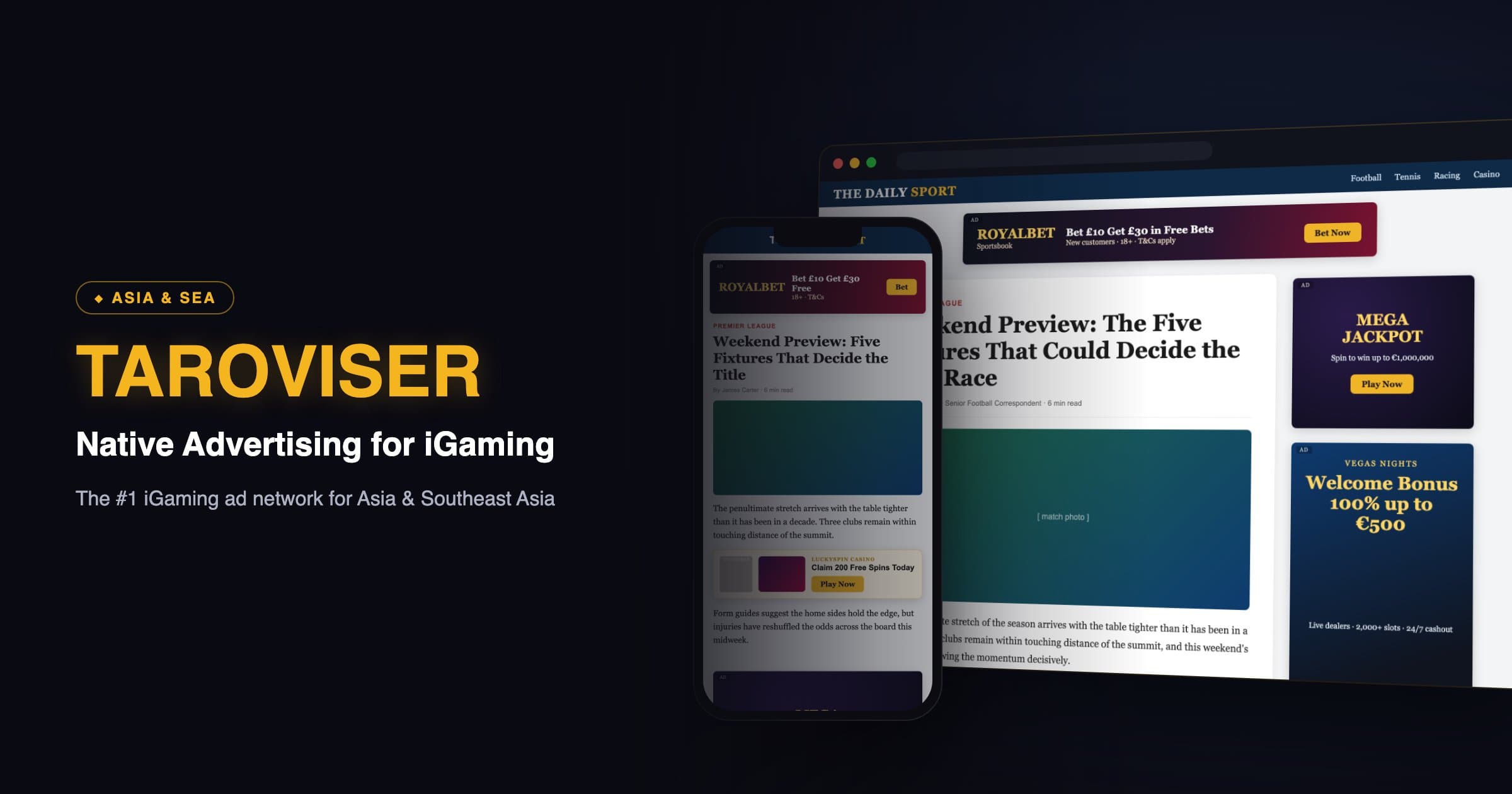
Native Advertising for iGaming: A Complete Guide for Advertisers
Most iGaming acquisition managers learn about native the hard way. They pour budget into push and popunder, see the cost-per-FTD climb every quarter, and only then start asking why their best-converting players never seem to click an ad that looks like an ad.
Native is the answer a lot of them arrive at late. It's the format that doesn't shout. It sits inside the content feed, borrows the look of the page it lives on, and earns the click instead of interrupting for it. For casino and sportsbook brands operating in tighter ad environments – and frankly, most of them are – that difference is the whole game.
This guide is for the buy side. If you're an advertiser, affiliate, or operator trying to figure out where native fits in an iGaming media plan, here's the practical version: what it actually is, why it suits gambling verticals better than people assume, how to build creative and pick placements that don't waste spend, and where a network like Taroviser fits when you're scaling across Asia and SEA.
What Native Advertising Actually Is
Native advertising is paid placement designed to match the form and function of the platform it appears on. A native ad on a news site reads like a recommended article. A native unit in a content feed looks like the next post. The promotional intent is disclosed – there's a "sponsored" or "ad" label – but the visual language belongs to the surrounding content, not to a banner.
That's the core distinction. A banner announces itself. A popunder ambushes. Native blends.
You'll usually see native delivered through content recommendation widgets ("you might also like" blocks under articles), in-feed placements, and search-style or promoted listings. The widget pulls a thumbnail, a headline, and sometimes a short description, then renders it in the host site's template. The reader scans it the way they scan everything else on the page.
A few things follow from that:
- Engagement skews toward intent, not accident. Someone who clicks a native unit chose to, because the headline interested them. That tends to mean a more qualified visitor than a misclick on a full-screen interstitial.
- It scales through programmatic supply. Native inventory is bought across thousands of publishers via DSPs and ad networks, not negotiated site by site.
- Creative carries more weight than placement. With a banner, the design space is fixed. With native, the headline and thumbnail are the campaign. We'll come back to this – it's where most of the wins and losses happen.
One thing native is not: a way to hide what you're selling. Disclosure is mandatory in every serious market, and good native respects that. The trick isn't deception. It's relevance – putting an offer in front of someone in a context where it actually makes sense.
Why Native Fits iGaming
Three reasons, and they reinforce each other.
First, ad-environment friction. iGaming creative gets rejected, throttled, or geo-blocked across a lot of mainstream channels. Native networks that work the vertical understand the category, which means less back-and-forth on approvals and creative that ships instead of sitting in review. At Taroviser we lean into ads-easy-to-approve as a feature, not a footnote – iGaming-specialized review beats generic ad-policy roulette every time.
Second, the funnel math. Casino and betting offers live and die on lifetime value, and LTV starts with intent. A player who arrives via a curiosity-driven native click – "Five things sharp bettors do before kickoff," say – is further along the consideration path than one who tapped a flashing 200% bonus by accident. Higher intent at the top tends to mean better deposit and retention rates downstream, which is exactly what you want when you're optimizing toward cost-per-FTD rather than cost-per-click.
Third, the storytelling room. Gambling is an emotional purchase – the thrill, the near-miss, the comeback. Banners give you a logo and a number. Native gives you a headline and a thumbnail, enough surface to set up a narrative. "I turned a slow Tuesday into a live-betting session" is a native angle. It isn't a banner.
Here's a rough side-by-side of how native stacks against the formats most iGaming buyers already run:
| Format | Interruption level | Intent quality | Creative room | Best use |
|---|---|---|---|---|
| Popunder | High | Low | Minimal | Volume, retargeting, cheap reach |
| Push Notification Ads | Medium | Medium | Short copy + icon | Re-engagement, FTD nudges |
| Banner | Medium | Low–medium | Fixed | Branding, always-on presence |
| Native | Low | Medium–high | Headline + thumbnail + context | Acquisition, intent-led scaling |
None of these is "the best." A real media plan runs several at once. But if your cost-per-FTD is creeping up and your popunder volume is converting worse every month, native is usually the lever you haven't pulled hard enough.
Building Native Creative That Converts
This is where campaigns are won. With native, the creative is the targeting – the headline self-selects who clicks.
The headline does the heavy lifting. You've got roughly a sentence to earn a click from someone who wasn't looking for you. The angles that tend to work in iGaming:
- Curiosity, not claims. "The bankroll rule most casino players ignore" pulls better than "Win big at slots." One implies you'll learn something; the other sounds like every other ad on the page.
- Specificity over hype. "How live betting changed during the second half" beats "Best betting site." Numbers, situations, and concrete nouns read as editorial. Superlatives read as spam.
- Local framing. A headline that nods to a regional sport, league, or game style – a cricket angle in one market, a football one in another – lands far harder than a generic global pitch. More on the geo piece below.
The thumbnail decides whether the headline gets read at all. In a content feed, the image is the first thing the eye lands on. What works:
- Authentic, slightly imperfect imagery over polished stock. A real-looking screen, a stadium crowd, a hand on a phone – these read as content. Glossy renders read as ads.
- High contrast and a clear focal point, because the unit is small and competing with everything else on the page.
- Consistency between thumbnail and headline. Mismatch kills your post-click conversion even when it lifts CTR – and that's the trap. A clickbait combo that doesn't deliver tanks your FTD rate and burns the placement.
The landing page has to keep the promise. Native click intent is fragile. If the headline set up a story and the landing page is a bare deposit form, you've broken the contract and your bounce rate will say so. Match the page to the angle. Carry the headline's language onto the page. Then make the next step obvious.
A discipline worth adopting: run creative in clusters, not singles. Launch four or five headline-thumbnail combinations against the same offer, let them spend a little, kill the bottom half, and iterate on the survivors. Native creative fatigues fast – a winner today is tired in two weeks – so the testing loop never really stops. This is, not incidentally, exactly the kind of grind where AI optimization earns its keep, surfacing the fatigue and the fading combos before your CPA tells you the hard way.
Placement, Bidding, and Optimization
Good creative on bad supply still loses money. Placement is the other half.
Source-level transparency matters more in native than anywhere else. Native inventory varies wildly publisher to publisher – premium news sites on one end, low-quality content farms on the other. The same creative can return a 3% FTD rate on one source and near zero on another. So:
- Run whitelists and blacklists at the source/widget level, not just the category level. Get granular.
- Watch post-click signals, not just CTR. Time on page, pages per session, and deposit rate tell you whether a source sends real humans with intent.
- Be patient with the learning phase. Native algorithms need conversion data to optimize, and FTD is a deep funnel event. Starve the model and it never finds the pocket.
On bidding, most native runs on CPC or CPM, but the metric you actually steer by should be cost-per-FTD. That's the gap a lot of buyers fall into – they optimize CPC because that's what the dashboard shows, and CPC has only a loose relationship with deposits. Bid to the funnel:
- Start broad to gather data, then tighten toward the sources and creatives that produce deposits, not just clicks.
- Use S2S postback to feed real conversion events back into the system. Without server-to-server tracking, you're optimizing blind – the network can't learn what a good click looks like if it never sees the FTD. Taroviser supports S2S postback precisely so the optimization layer trains on deposits, not proxies.
- Set dayparting and frequency caps once you know when your players actually convert. A football market converts on match days; a casino audience has its own rhythm.
The optimization cadence is where AI does the unglamorous work – reallocating budget across hundreds of source-creative pairs faster than a human reviewing spreadsheets, flagging creative fatigue, catching a source whose quality just dropped. The human job shifts to strategy and the calls a model can't make: creative direction, offer selection, and reading market context.
The Geo and Market-Intelligence Layer
Native is contextual by nature, and context is local. This is where most cross-border iGaming campaigns quietly leak money – running a single English creative across fifteen countries and wondering why the cost-per-FTD won't move.
Asia and SEA aren't one market. They're dozens, each with its own dominant sports, payment habits, device mix, language, and rules about what gambling framing is permitted. A headline angle that flies in one country falls flat or gets blocked in the next. Native that works here is native that's been localized – language, sport, cultural reference, and an offer framed for what's actually allowed in that market.
This is the part of the job that doesn't scale on instinct. You need local market intelligence: which leagues matter where, which payment rails build trust, what framing keeps you compliant, where the audiences sit. It's the difference between scaling and burning budget, and it's the reason a generalist network struggles with iGaming in this region. Taroviser is built around top-tier Asia & SEA coverage with 200+ geos and the local read to go with it – managed when you want a team, self-serve when you'd rather drive.
Compliance and Responsible Advertising
Native's biggest strength – looking like content – is also its biggest responsibility. Get it wrong and you have a problem with both regulators and platforms.
The non-negotiables:
- Clear disclosure. Every native unit carries a sponsored/ad label. Blending into the feed is fine. Disguising the commercial intent is not, and it'll cost you the placement.
- Age and geo-gating. Serve only where you're licensed and permitted, and only to adults. This is a hard line, enforced at the targeting layer before a single impression runs.
- Responsible-gambling framing. Don't promise guaranteed wins or chase-your-losses messaging. Stick to entertainment framing, include the required responsible-gambling cues, and keep claims honest. It's the right call ethically – and it's also what keeps your campaigns and your account alive.
Boring? A little. But a compliant native campaign runs uninterrupted, and an uninterrupted campaign is one that gets to optimize long enough to actually find its cost-per-FTD floor.
FAQ
Is native advertising more expensive than push or popunder for iGaming?
On a raw CPC or CPM basis, native often costs more per click. On a cost-per-FTD basis – the number that matters – it frequently comes out ahead, because the intent quality is higher and the players tend to convert and stick. Judge it on deposits, not clicks.
How long before a native iGaming campaign optimizes?
Plan for a learning phase. The algorithm needs conversion volume to find the right sources and creatives, and FTD is a deep funnel event, so it takes longer than a click-optimized campaign. Don't gut a campaign in 48 hours – and feed it S2S conversion data from day one so it has something to learn from.
What creative formats does native support for casino and betting?
The standard unit is a thumbnail plus a headline, sometimes with a short description, rendered in the host site's style. Some inventory supports richer formats, but the headline and image carry the campaign. Run clusters of variations and let the data pick winners.
Can I run native alongside push, popunder, and interstitial?
Yes, and you should. They do different jobs – native for intent-led acquisition, push for re-engagement, popunder for cheap volume, interstitial for high-impact presence. Taroviser runs all five core formats so you can manage the mix in one place.
Do I need server-to-server tracking?
For native, effectively yes. S2S postback feeds real FTD events back to the optimization layer so it learns what a profitable click looks like. Without it you're steering on CTR, which barely correlates with deposits.
Which geos are best for native iGaming campaigns?
It depends entirely on your offer, license footprint, and the local market. Asia and SEA carry strong demand across many markets, part of Taroviser 200+ GEOs of global reach, but each needs localized creative and compliant framing. This is exactly where market intelligence beats guesswork.
Run Native the Way iGaming Actually Works
Native rewards advertisers who treat creative as the campaign, optimize toward deposits instead of clicks, and localize for the market they're actually in. That's a lot of moving parts – and it's the part most generalist networks get wrong with iGaming.
Taroviser is built for this. iGaming-specialized review that gets your ads approved, AI optimization tuned to cost-per-FTD, S2S postback, all four formats under one roof, and top-tier Asia & SEA coverage with the local market intelligence to back it. No platform fee, no minimum – self-serve or managed, your call – with 24/7 support and human-analyst anti-fraud watching the back end.
If your cost-per-FTD has been drifting the wrong way, native is probably the lever you haven't pulled hard enough. Talk to Taroviser and we'll help you pull it.
Related on Taroviser
Related guides
- Do Fullpage Interstitial Ads Increase iGaming Conversions? What It Does
- iGaming Ad CTR Benchmarks by Format: How to Read Them Without Fooling Yourself
- Adsterra Alternative for iGaming: Why Specialist Beats Generalist at Scale
- Best Popunder Ad Networks for Gambling Traffic in 2026
- Casino Ads Banned on Google? The Compliant Alternative for iGaming Advertisers
- How to Run Casino Push Notification Campaigns That Convert
Traffic & ad formats
Ready to launch?
Put these tactics to work with premium iGaming traffic on Taroviser.
Start advertising