
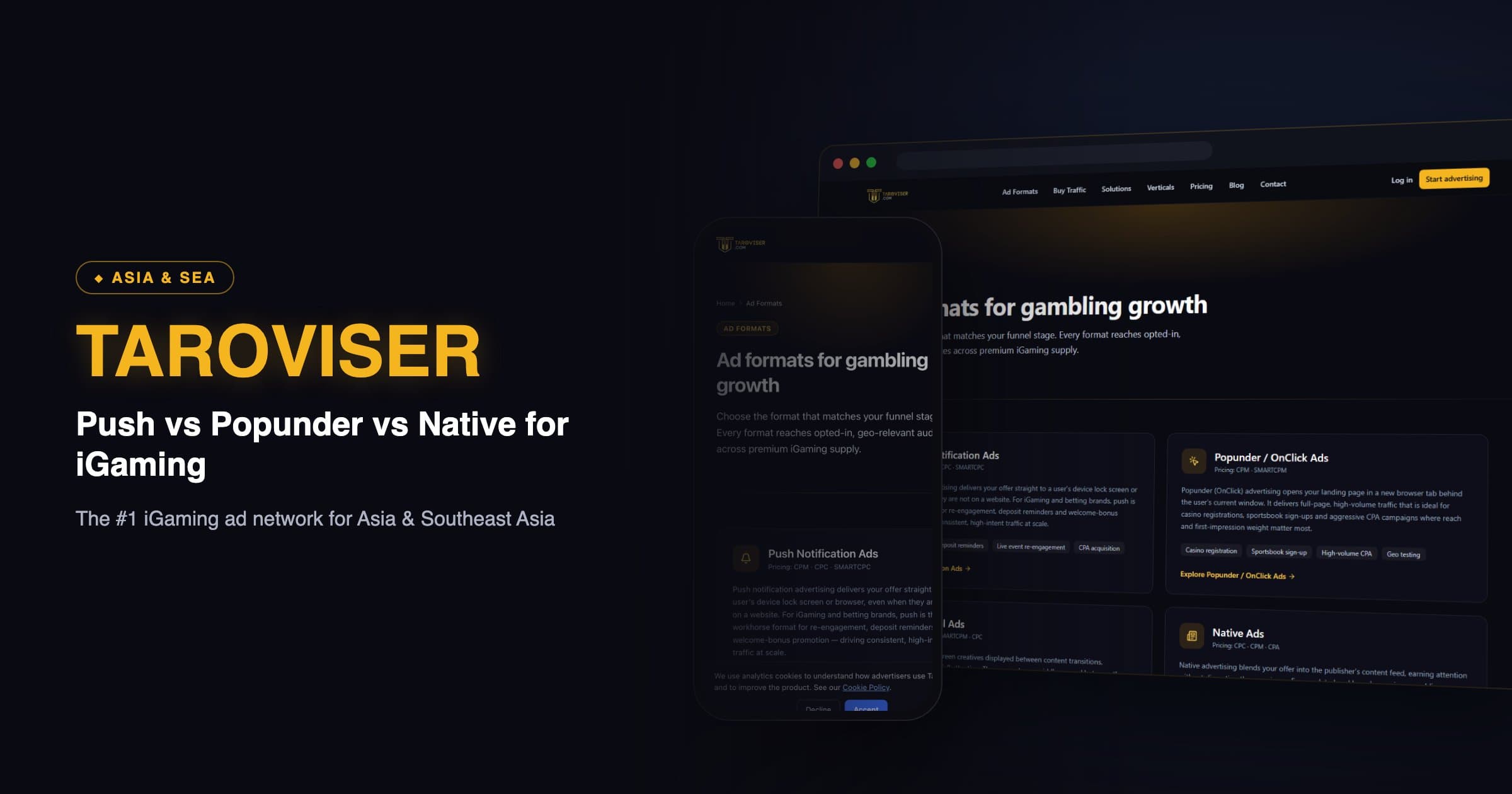
Push vs Popunder vs Native for iGaming: Which Ad Format Converts Best?
You have probably lived this one. Same offer, same geo, same landing page – and one ad format prints FTDs while another quietly eats your budget. Push crushes it in Brazil and flatlines in the Philippines. Popunder volume looks irresistible right up until you check the cost-per-deposit. Native feels "premium," but half the time you cannot tell if it moved real deposits or just the click count.
There is no single best format for iGaming. There is a best format for a specific offer, funnel stage, geo and bid model, and the operators who keep hitting profitable CPA are the ones matching format to intent rather than chasing whatever was hot last quarter. This guide breaks down push, in-page push, popunder and native – with banner for context – on conversion rate, how CPA actually behaves, and real casino and betting use-cases. Then it gets into how to stop guessing and let the data pick.
The four formats at a glance
Quick alignment first on what each format actually is, advertiser-side. All four run on Taroviser as self-serve or managed buys, with CPM, CPC and CPA pricing and S2S postback for clean FTD attribution.
| Format | What it is | Typical intent | Common bid model | Best funnel stage |
|---|---|---|---|---|
| Push | Opt-in notifications to a subscribed device | Re-engagement / warm | CPC, CPA | Mid-funnel, retargeting |
| In-page push | Push-style banners served inside a page (no subscription) | Cold reach at scale | CPC, CPM | Top–mid funnel |
| Popunder | Full-page placement behind the active tab | High-volume cold reach | CPM | Top-funnel volume / direct offers |
| Native | Ad blended into site content (widgets, feeds) | Considered, content-led | CPC, CPM | Mid-funnel, pre-lander led |
| Banner / display | Classic IAB display units | Awareness, branding, RT | CPM, CPC | Awareness + retargeting |
The table is not trying to crown a winner. The point is that these formats sit at different places in the funnel. Comparing a popunder CPA to a push CPA without accounting for intent is like comparing a cold email to a renewal reminder and acting surprised they perform differently.
Conversion rate: what actually drives CR by format
CR for iGaming is never just "format quality." It is a product of traffic intent, how well the creative matches the lander, the geo, and how aggressive the offer is. With that caveat in place, here is how the four tend to behave.
Push notifications
Push reaches someone who already opted in to notifications, so by definition the audience is warmer than a random impression. That matters for iGaming. A "your bonus is waiting" message lands on a device the user actively checks, which is why push tends to show strong click-to-registration ratios once creative and timing are dialed in.
- Strengths: warm-ish audience, high attention, excellent for retargeting and reactivation, cheap to produce creative for.
- Watch-outs: list freshness varies a lot; a stale subscriber pool converts poorly no matter how good the creative is. CR is heavily geo-dependent.
- iGaming fit: sportsbook event reminders, deposit-bonus reactivation, "match starting soon" angles.
In-page push
In-page push runs the same compact, notification-style creative, but inside the page – so it works on every browser and device without a subscription. That opens up far more cold volume than classic push while keeping the punchy, low-friction format. CR usually sits a notch below true push because the audience is colder, but the reachable scale is much larger.
- Strengths: huge reach, works where classic push can't, cheap clicks.
- Watch-outs: colder traffic means the pre-lander does the heavy lifting. A weak lander tanks CR fast.
- iGaming fit: top-of-funnel casino acquisition, broad-geo testing, scaling a proven push angle into colder inventory.
Popunder
Popunder is a volume play. It opens a full-page placement, so the user sees your offer – or better, your pre-lander – with no creative needed. CR per impression runs lower than push because intent is at its lowest here. But the volume and low CPM mean it can deliver a genuinely competitive cost-per-acquisition when the funnel is built for it. That last part is the whole game.
- Strengths: massive scale, lowest entry cost, no creative dependency, fast to test.
- Watch-outs: it needs a strong pre-lander. Without one, the bounce is brutal and CR collapses. Frequency capping and quality controls matter more here than anywhere else.
- iGaming fit: direct-to-offer casino, quiz and spin pre-landers, raw-volume FTD scaling in tier-2 and tier-3 geos.
Native
Native blends into the content stream, so it pulls a more considered click. The user is in reading mode, which suits storytelling angles – "how this strategy works," "why players switched." CR per click can be healthy and quality often skews higher, but you typically pay more per click and you need real creative iteration to win.
- Strengths: higher perceived quality, strong for content and pre-lander funnels, less ad-fatigue, good for stricter compliance framing.
- Watch-outs: higher CPC, creative-hungry, slower to scale than popunder or in-page push.
- iGaming fit: sportsbook content angles, casino "guide-style" pre-landers, geos where heavier framing is required.
> A rough rule of thumb: **push and native win on conversion quality per click; popunder and in-page push win on conversion volume per dollar.** Profit lives wherever those two curves cross for your specific offer.
CPA behaviour: cheap clicks vs cheap deposits
The mistake that kills iGaming campaigns is optimising the wrong number. A low CPC on popunder means nothing if the deposit cost lands above your payout. A high CPC on native is fine if the FTD value justifies it. The format comparison only matters at the cost-per-FTD level – everything above that is vanity.
- Popunder and in-page push usually deliver the lowest CPC/CPM, so that is where you find the cheapest top-of-funnel clicks. But CPA hinges entirely on funnel conversion, because the traffic is cold.
- Push sits in the middle. Clicks cost more than popunder, but warmer intent usually means fewer clicks per deposit, so CPA can be very efficient on the right list.
- Native carries the highest click cost of the four, yet often the steadiest CPA – the users who click are further along in intent and convert to deposit more reliably.
This is exactly why blanket "format X is cheapest" claims fall apart. The cost-efficient choice is the one with the lowest verified CPA after S2S postback, not the lowest click price. Taroviser routinely helps advertisers reach traffic costs 30–50% lower than comparable networks, but the bigger lever is matching format to funnel so those cheaper clicks actually turn into deposits.
When to use which format (decision guide)
Here is the practical mapping most performance teams land on after enough testing.
Choose push when…
- You are retargeting or reactivating existing-ish audiences.
- The angle is time-sensitive – a live event, an expiring bonus.
- You want efficient CPA without building a heavy pre-lander.
Choose in-page push when…
- You need cold scale beyond your push subscriber reach.
- You are testing many angles fast at low click cost.
- You want push-style creative on all devices and browsers.
Choose popunder when…
- You have a strong pre-lander or quiz funnel ready.
- You are scaling raw FTD volume in high-supply geos.
- You want the lowest entry cost to validate an offer quickly.
Choose native when…
- Your funnel is content-led – advertorial, guide, comparison pre-lander.
- The geo or vertical needs softer, considered framing.
- You value traffic quality and lower fatigue over raw speed.
Choose banner/display when…
- You are running branding, awareness, or retargeting layers.
- You want a low-cost always-on presence alongside performance formats.
The most profitable iGaming accounts don't pick one. They run a format stack: in-page push or popunder for cold acquisition, native for considered intent, push for re-engagement, banner for retargeting – then they shift budget toward whichever is producing the cheapest verified FTDs that week, in that geo. The mix is never static.
Geo matters more than format – especially in Asia
A format that wins in one market can fall flat in another, because device mix, browsing behaviour, payment friction and supply quality all shift by region. Asia and Southeast Asia are the clearest example. Mobile-first behaviour, specific local payment flows like e-wallets and bank transfers, and very different supply dynamics mean the "global best practice" often just does not transfer.
This is where local market intelligence earns its keep. Taroviser's strongest position is a leading, specialised network across Asia and Southeast Asia, which means format recommendations there are grounded in what actually converts locally instead of a generic playbook. For SEA casino and betting offers, that local read on which format, geo and bid combinations produce the lowest CPA is often the line between a profitable test and a wasted one.
A note worth stating plainly: whichever format you run, keep compliance front and center – responsible-gambling messaging, age verification, and geo-gating so offers only serve where they are legal. That is not optional polish. It is the cost of staying in business.
Stop guessing: let AI pick the format
Format selection feels like a coin flip because the optimal answer keeps moving – by offer, geo, daypart, supply quality and creative fatigue. No human is re-balancing four formats across 200+ geos in real time, and pretending otherwise just burns spend.
Taroviser's approach is to take that guesswork out:
- AI-driven continuous optimisation combines your campaign data with network-level performance signals to shift budget toward the format and placement producing the best results, and to throttle what isn't.
- All four formats under one roof – push, in-page push, popunder, native, plus banner – so you test the funnel, not the network, and you don't lose attribution by splitting spend across platforms.
- S2S postback plus CPM/CPC/CPA models so optimisation targets real FTDs, not vanity clicks.
- Human analyst anti-fraud layered on top, so cheaper traffic doesn't mean dirtier traffic.
- No platform fee, no monthly minimum, fast approvals, iGaming-specialised – you can test a format hypothesis without onboarding friction.
For advertisers who want hands-on help, the managed service pairs that AI optimisation with 24/7 support and a team that genuinely understands iGaming economics, so the format question gets answered with data instead of opinion. Other multi-format networks also offer broad reach; where Taroviser concentrates is service depth, cost-efficiency, SEA expertise and AI-led optimisation tuned specifically for iGaming CPA.
FAQ
Q: Which format has the highest conversion rate for casino offers?
A: There is no universal winner. Push and native tend to show higher quality conversion per click because intent is warmer, while popunder and in-page push win on volume and low cost. The best CR for a given casino offer depends on geo, pre-lander and bid model – which is why testing across formats beats picking one.
Q: Is popunder still effective for iGaming in 2026?
A: Yes, when it is paired with a strong pre-lander. Popunder is still one of the most cost-efficient ways to scale cold FTD volume because of its low entry cost and huge supply. Without a good funnel, though, cold popunder traffic bounces and CPA suffers.
Q: Push vs in-page push – what's the difference for advertisers?
A: Classic push reaches users who opted in to notifications – warmer, smaller pool. In-page push serves the same creative style inside web pages with no subscription required, so it reaches far more cold traffic on any device. Use push for re-engagement, in-page push for cold scale.
Q: How should I measure which format converts best?
A: Track to the deposit, not the click. Use S2S postback to attribute first-time deposits per format, then compare cost-per-FTD – not CPC or CTR. A "cheap" format with poor deposit conversion ends up more expensive than a pricier format that actually converts.
Q: Can I run all four formats in one place?
A: Yes. Taroviser supports push, in-page push, popunder, interstitial and native on one platform, so you keep clean attribution instead of splitting spend across networks.
Q: Which format is best for sportsbook vs casino?
A: Sportsbook often favours push (event reminders, time-sensitive angles) and native (content and strategy framing). Casino frequently scales well on popunder and in-page push via spin and quiz pre-landers. Most accounts blend formats by funnel stage rather than choosing one.
Get the right format mix – and the data to prove it
You don't need to guess whether push, popunder or native converts best for your offer. You need a network that runs all four formats, attributes results to real FTDs, optimises the mix with AI, and brings deep Asia/SEA market intelligence to the table – at traffic costs 30–50% lower than the field, with no platform fee and no monthly minimum.
Launch a multi-format iGaming campaign with Taroviser. Sign up for self-serve or talk to our team for a managed setup, and let AI-driven optimisation find your cheapest path to FTD across 200+ geos.
→ [Sign up / Contact Taroviser] to start testing push, in-page push, popunder and native today.
Related on Taroviser
Related guides
- Adsterra Alternative for iGaming: Why Specialist Beats Generalist at Scale
- Casino Ads Banned on Google? The Compliant Alternative for iGaming Advertisers
- RichAds Alternative for iGaming Advertisers: Anti-Fraud, Pricing & Asia
- Do Fullpage Interstitial Ads Increase iGaming Conversions? What It Does
- iGaming Ad CTR Benchmarks by Format: How to Read Them Without Fooling Yourself
- Traffic Nomads Alternative for iGaming Advertisers in 2026
Traffic & ad formats
Ready to launch?
Put these tactics to work with premium iGaming traffic on Taroviser.
Start advertising