

CPA vs RevShare vs Hybrid: Which Payout Model for Gambling Traffic?
Pick the wrong payout model and you can run a campaign that looks profitable on the dashboard while quietly bleeding margin every week. I've watched advertisers lock in a fixed CPA on a geo where players deposit three times their first month – and leave most of the lifetime value on the table. The opposite happens too: a media buyer chases RevShare into a low-retention market and waits four months to break even on traffic they paid for upfront.
The payout model isn't a billing detail. It decides who carries the risk, how fast you see your money back, and whether your scaling math holds up once volume climbs. So before we get into format mixes and geo targeting, it's worth being clear-eyed about what CPA, RevShare, and Hybrid actually do to your cash flow and your downside.
Let's break down the three, then talk about when each one earns its keep.
The Three Payout Models, Quickly
At the core, every gambling deal answers one question: what triggers the payment, and to whom?
- CPA (Cost Per Acquisition) – you pay a fixed amount for a defined action. In iGaming that action is almost always the FTD (First-Time Deposit): a player signs up and makes their first real-money deposit. One event, one price.
- RevShare (Revenue Share) – you pay a percentage of the net revenue a player generates over their lifetime. No upfront acquisition fee; you're buying a slice of the ongoing stream instead.
- Hybrid – a blend. A smaller fixed CPA up front to cover acquisition cost, plus a reduced RevShare percentage on the back end. You split the risk and the reward.
That's the skeleton. The interesting part is how each one behaves when real traffic and real player behavior hit it.
CPA-FTD: Predictable Cost, Capped Upside
CPA is the model most performance buyers reach for first, and for good reason. You know your cost per player before the campaign runs. If you're paying $40 per FTD and your internal model says a depositing player is worth $90 in the first 60 days, the math is clean. Spend, count FTDs, scale what works.
A few things make CPA-FTD genuinely strong for gambling traffic:
- Cash-flow clarity. You pay for a result, not a promise. Your CAC is a fixed line item, which makes budgeting and forecasting straightforward.
- Fast feedback loops. An FTD either happens or it doesn't, usually within days of the click. You can kill a losing source, geo, or creative quickly instead of waiting on a revenue curve to develop.
- Easier to scale. When the unit economics are known and positive, scaling is mostly a volume and supply problem, not a guessing game.
The trade-off is the ceiling. With pure CPA you've sold off the upside on your best players. That whale who deposits weekly for eight months? You captured one $40 FTD payment and nothing else. CPA rewards you for acquisition efficiency and punishes you for ignoring retention.
There's also the quality question. Because the payout fires on the first deposit, incentives can skew toward any deposit rather than a player who sticks around. A min-deposit FTD that never deposits again still counts. This is exactly where you want human eyes on the funnel – a campaign manager watching deposit-to-redeposit ratios per source, not just a raw FTD count. We lean on human analysts alongside automated checks for this reason; FTD volume without retention is a vanity metric.
CPA-FTD fits best when you have a strong read on early player value, want predictable acquisition cost, and need to scale fast.
RevShare: Aligned Incentives, Slow Money
RevShare flips the risk. You're not paying to acquire a player; you're agreeing to share in what they actually lose to the operator over time. If a player has a long, active lifetime, RevShare can dramatically outperform a one-time CPA. If they churn after one deposit, you earned almost nothing – but you also paid almost nothing upfront.
The appeal is alignment and long-tail upside:
- No large upfront acquisition cost. Your exposure per player is lower at the moment of acquisition.
- You capture lifetime value. High-retention geos and sticky verticals can pay out for months, well past what any FTD price would have given you.
- Incentives point the same direction. You and the operator both win when players stay engaged and the experience is good.
Now the hard part. RevShare is a patience game, and most media buyers don't have unlimited patience or unlimited working capital.
- Cash flow lags badly. You spend on media now and collect revenue over weeks and months. Scaling RevShare while you wait to get paid can choke a smaller buyer's budget.
- Revenue is variable. Player behavior, operator hold, bonus policy, and even responsible-gambling limits all move your payout. Some of that is outside your control.
- Long-term dependence. Your return rides on the operator's retention and reporting over time. You're trusting a revenue curve you can't fully see.
RevShare rewards advertisers who can float the cash gap, who target retention-heavy markets, and who plan to run the same offers for the long haul.
Hybrid: Splitting the Difference (On Purpose)
Hybrid exists because the two pure models fail in opposite ways. CPA caps your upside; RevShare starves your cash flow. A hybrid deal – say, a reduced FTD payment plus a smaller RevShare percentage – tries to recover acquisition cost early while keeping a stake in lifetime value.
When it's structured well, hybrid gives you:
- Partial cash-flow recovery. The CPA portion offsets media spend up front, so you're not waiting months to see any return at all.
- Retained upside. The RevShare slice means your best players still pay you over time, just at a lower rate than a pure RevShare deal.
- Balanced risk. Neither side carries the full downside. That makes negotiation easier and partnerships more durable.
It's not free, though. Hybrid is more complex to model – you're forecasting two revenue streams with different timing and different volatility. Reporting has to be tight. And because each component is reduced, you won't get the full benefit of either: the CPA is smaller than a pure CPA, the RevShare percentage lower than a pure RevShare. You're buying balance, and balance costs a little of each extreme.
Hybrid tends to be the right call for new geos where you don't yet know lifetime value, for partnerships you want to grow over time, and for buyers who want some upfront recovery without giving up the back end entirely.
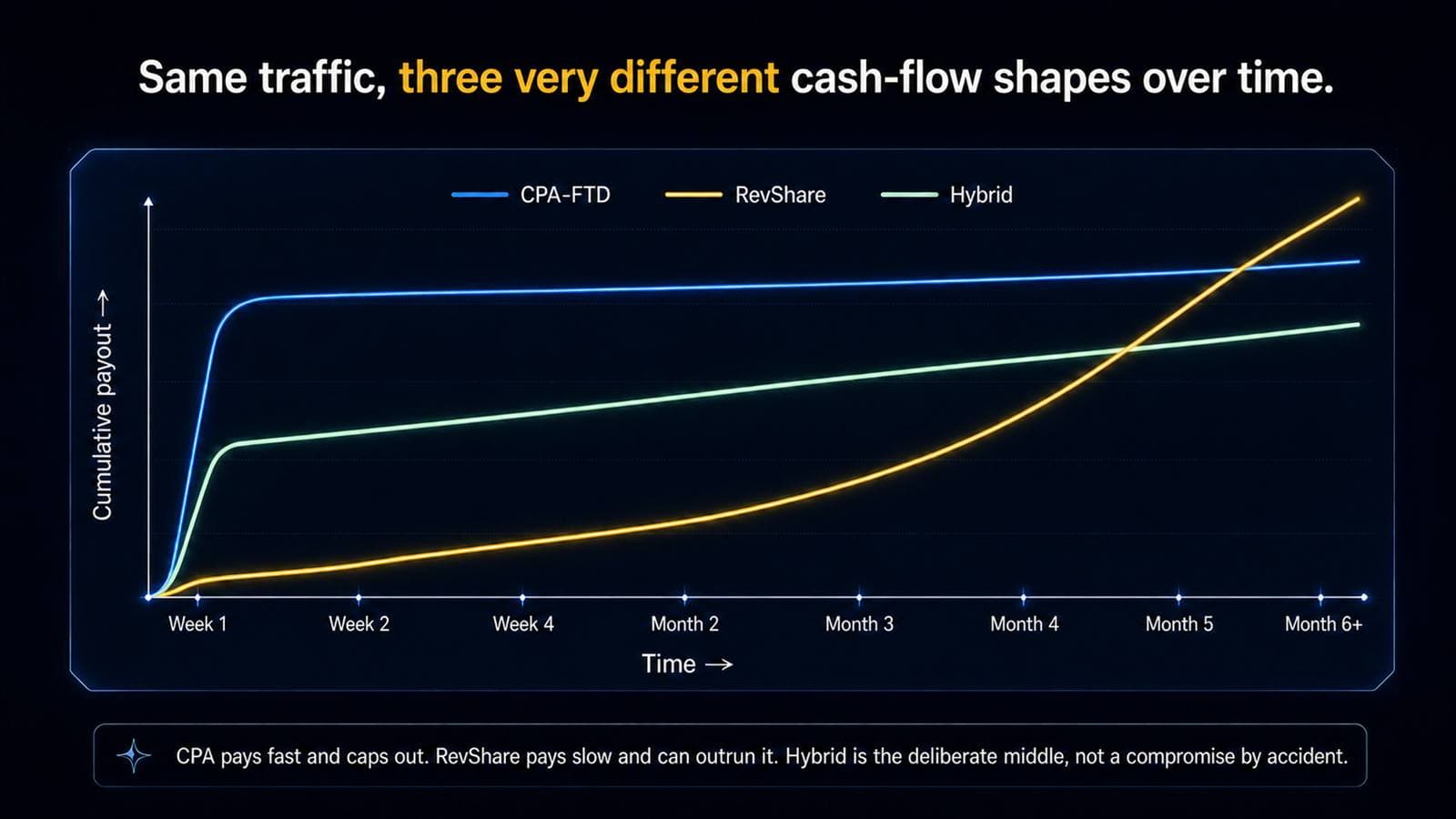
Side-by-Side: How the Three Compare
| Factor | CPA-FTD | RevShare | Hybrid |
|---|---|---|---|
| Upfront cost | Fixed, known | Low / none | Moderate (reduced CPA) |
| Cash-flow speed | Fast | Slow | Medium |
| Lifetime-value capture | None | Full | Partial |
| Risk to advertiser | Acquisition risk | Retention/time risk | Shared |
| Forecasting ease | High | Low | Medium |
| Best for | Fast scaling, known early value | High-retention geos, patient capital | New geos, growing partnerships |
No row makes one model "the winner." They're tools for different jobs.
How to Actually Choose
Strip away the theory and the decision usually comes down to four questions.
1. How well do you know your player value?
If you have solid retention and LTV data for a geo and vertical, CPA-FTD lets you price acquisition with confidence and scale. If you're entering blind – a new market, an untested offer – hybrid de-risks the unknown while you gather data. RevShare is the bet you make when you're confident lifetime value is high but don't want to pay for it upfront.
2. What's your cash position?
This one is underrated. If you can't comfortably float media spend for 30–90 days, RevShare will strangle your scaling no matter how good the players are. CPA and hybrid return capital faster. Match the model to the cash you actually have, not the cash you wish you had.
3. What's the geo telling you?
Retention varies enormously by market. Across our 200+ geos, some Southeast Asian and Asian markets show genuinely sticky deposit behavior, while others are high-churn and reward fast, fixed-cost acquisition. Local market intelligence isn't a luxury here – knowing where players actually stay engaged is what tells you whether RevShare's slow money is worth waiting for.
4. How long is the relationship?
One-off campaign to hit a quarterly number? CPA. A market you intend to own for years? RevShare or hybrid, where time works in your favor.
A practical pattern: start a new geo on CPA-FTD or hybrid to learn the player value fast, then negotiate toward RevShare or a higher RevShare share once your retention data justifies the patience. Let the data move you along the spectrum instead of guessing on day one.
Where Taroviser Fits
We built Taroviser around CPA-FTD because, for most performance advertisers running gambling traffic, predictable acquisition cost is what makes scaling possible. You pay for a depositing player, not a hope. But we don't treat that as the only lever – payout structure should follow your strategy, not box it in, so we work with advertisers on flexible arrangements as their geo and LTV data matures.
A few things that matter regardless of which model you land on:
- Cost-per-FTD optimization. Our AI optimization works toward your effective cost per first-time deposit, combining campaign signals with advertiser-side data so you're scaling efficient FTDs, not just cheap clicks.
- Pricing that protects margin. Competitive rates – advertisers have seen meaningfully lower acquisition costs versus other networks – with no platform fee and no minimum spend to get started.
- Formats that match intent. Push notification ads, in-page push, popunder, interstitial, and native, so you can test how different traffic types convert against your payout model.
- Human + machine quality control. Human analysts on anti-fraud alongside automated checks, plus S2S postback so your FTD and revenue events are tracked cleanly – essential when your payout depends on the integrity of the conversion data.
- Reach and support. 200+ geos, specialised in SEA & Asia, 24/7 support, self-serve or managed.
The point isn't that CPA-FTD beats RevShare. It's that you should run the model your data and cash flow actually support – and have a partner flexible enough to move with you when that changes.
FAQ
Which payout model is best for gambling traffic?
There's no universal best. CPA-FTD wins when you need predictable cost and fast scaling, RevShare wins in high-retention markets if you can wait for the money, and hybrid splits the difference when you're entering new territory. Match the model to your data, your cash position, and your time horizon.
What is an FTD and why is it the standard CPA event?
FTD is a First-Time Deposit – a player who signs up and makes their first real-money deposit. It's the standard CPA trigger because it marks a genuinely converted, paying user rather than a free signup that may never deposit.
Is RevShare always more profitable than CPA over time?
Only when players retain. RevShare can far outperform CPA on long-lifetime players, but it underperforms badly in high-churn geos and ties up cash flow while you wait. Profitability depends entirely on retention in your specific markets.
How does hybrid pricing actually work?
You receive a reduced fixed CPA up front plus a smaller RevShare percentage on ongoing revenue. The CPA portion helps recover acquisition cost early; the RevShare portion keeps you exposed to lifetime value. Each component is smaller than its pure-model equivalent – that's the cost of balance.
Can I switch payout models mid-campaign?
Usually you'd renegotiate per offer or per geo rather than mid-flight, but it's common to start on CPA or hybrid to learn player value, then move toward RevShare once retention data supports it. Flexibility here is worth asking about up front.
Does payout model affect traffic quality I should accept?
It affects what you should watch. On CPA, monitor redeposit and retention behavior so you're not paying for one-and-done deposits. On RevShare, watch lifetime curves and reporting accuracy. Clean S2S postback tracking and human review on conversions matter under every model.
Ready to Price Your Gambling Traffic Right?
Taroviser runs on CPA-FTD with the flexibility to structure deals around your geo and LTV data – no platform fee, no minimum, and AI optimization tuned to your cost per first-time deposit. Spin up a self-serve campaign or talk to a manager about the model that fits your markets. Tell us your geos and we'll help you price them.
Related on Taroviser
Related guides
- Traffic Nomads Alternative for iGaming Advertisers in 2026
- Adsterra Alternative for iGaming: Why Specialist Beats Generalist at Scale
- Best iGaming & Gambling Ad Networks in 2026: 10 Platforms Ranked
- Casino Ads Banned on Google? The Compliant Alternative for iGaming Advertisers
- iGaming Affiliate Network vs Ad Network: Which Should Advertisers Use?
- Push vs Popunder vs Native for iGaming: Which Ad Format Converts Best?
Ready to launch?
Put these tactics to work with premium iGaming traffic on Taroviser.
Start advertising