
iGaming Ad Network Philippines: Buy Casino & Betting Traffic That Converts
The Philippines is the one Southeast Asian iGaming market where English-language creative genuinely works, interstitial placements outperform, and e-wallet cash-in speed decides the funnel – three things that make it a poor fit for a one-size-fits-all regional campaign. This guide breaks down the format mix, payment behaviour and evaluation criteria specific to buying Filipino traffic.
The Philippines iGaming Audience
The Philippines stands out in Southeast Asia for high English literacy and strong engagement with online entertainment, which changes the localization calculus compared to neighbouring markets. Users are comfortable with English-language creative in a way that Vietnamese or Thai audiences are not, though creative that mixes in local phrasing and cultural references still tends to outperform pure English-only copy. The audience is mobile-first and responds well to full-screen, high-impact placements more than some of the region does.
Why the Philippine Market Rewards a Dedicated Playbook
The traits above compound in a way that is easy to underestimate. Because the market is overwhelmingly mobile-first, most of your traffic arrives on a phone, over a mobile connection, on placements that live inside apps and mobile browsers rather than desktop inventory. That shifts weight toward formats built for small screens and short attention windows, and it makes connection type and device targeting more than housekeeping – they decide whether your landing page even finishes loading before the user swipes away. A heavy desktop-style funnel imported from another region tends to bleed users on the first tap.
High English literacy is the second force, and it does more than let you skip a translation step. It widens the pool of creative angles you can test quickly, because you are not waiting on a native copywriter for every variation, and it means proof points, offer terms and calls to action read cleanly without the softening that translation sometimes introduces. The practical move is to treat English as the reliable default and then layer in Filipino phrasing, local references and familiar cash-in language as a performance boost on top, rather than as a prerequisite you cannot launch without.
The third force is genuine, sustained engagement with online entertainment. Filipino users spend real time inside social apps, streaming and mobile content, which is why interruptive-but-relevant placements can earn attention instead of resentment when they land at a natural pause. That same engagement is why a serious campaign here deserves its own plan rather than a regional copy-paste – the market behaves differently enough that a shared Vietnam-Thailand-Philippines template quietly leaves performance on the table. If you are still choosing partners, our note on what separates a real iGaming traffic provider from a generic reseller covers the traits that matter before you ever place a test.
Formats That Convert in the Philippines
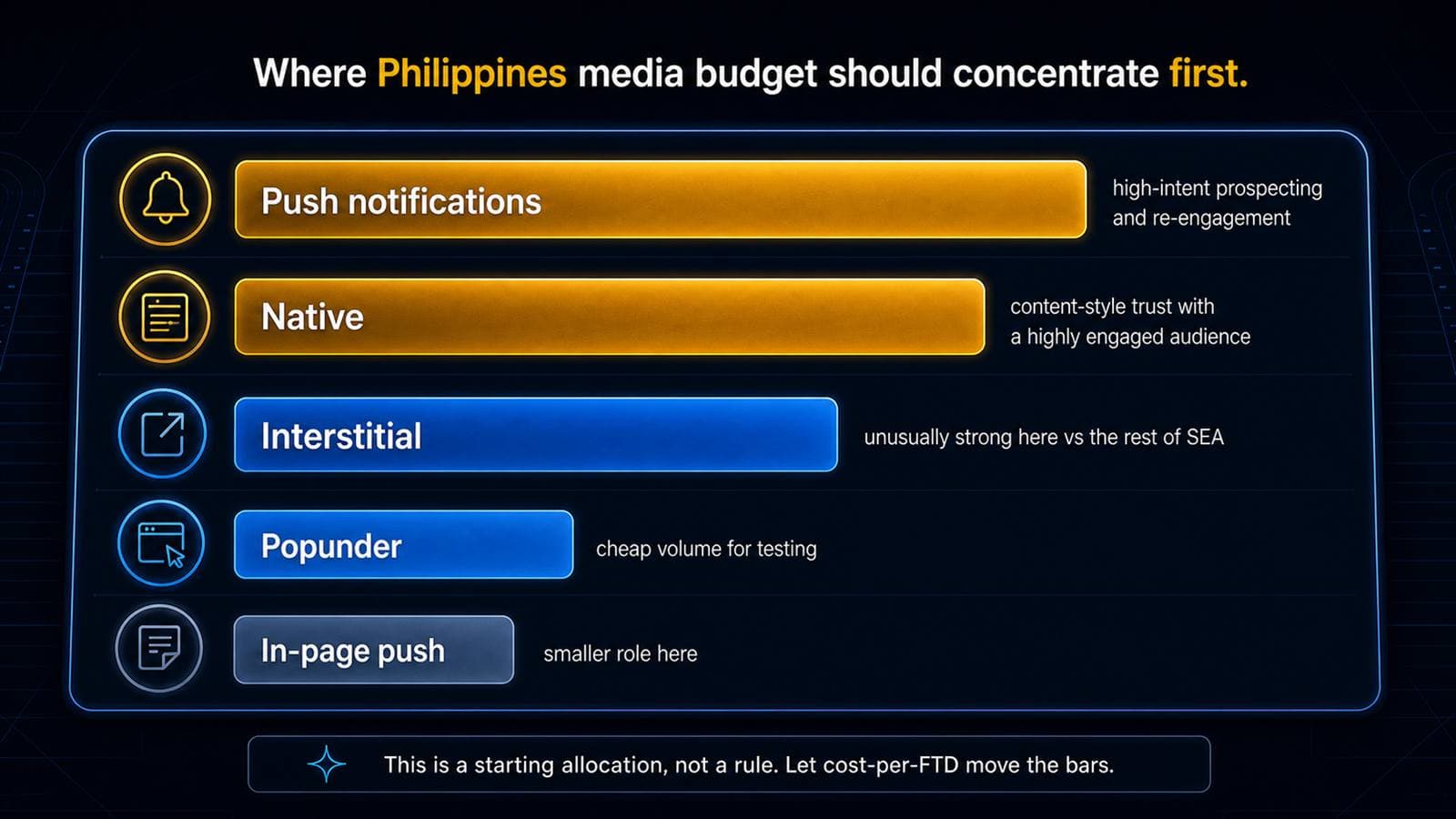
Push notification ads and native placements carry most of the funnel, and the Philippines is notably interstitial-friendly relative to other Southeast Asian markets, so full-screen placements at natural break points in the user journey earn real attention here rather than just interrupting it. Popunder remains the cheap-volume format for testing new creative angles before scaling a proven one into push and native.
Format Depth: Matching Each Placement to the Journey
Treating the five self-serve formats as one bucket is where most Philippine campaigns lose their edge. Each placement occupies a different point in the funnel, and knowing which does what is what lets you spread a fixed budget without burning it on the wrong inventory.
Push notification ads reach a user who already opted in, so they behave like a re-engagement channel – strong for repeat exposure, familiar offers and audiences you have already warmed. In-page push delivers a similar look inside the browsing session itself, which lets you reach users who never subscribed to classic push, widening reach without abandoning the format you know converts. Popunder is your cheap-volume laboratory: it opens behind the page and gives you the raw impression count to test new angles, landing pages and payment flows before you commit spend to pricier inventory. Interstitial is the placement the Philippines rewards more than its neighbours, because a full-screen unit dropped at a natural break – between levels, between articles, between steps – earns real attention here instead of pure annoyance. Native is the trust-builder, blending into the surrounding feed so the message reads as content rather than an obvious ad, which suits longer offers that need a sentence or two to land.
A workable sequence is to prove an angle cheaply on popunder, move the winners into push and in-page push for scaled reach, and reserve interstitial and native for the creatives that have already shown they can carry a full-screen or in-feed moment. Banner and Telegram placements sit outside the self-serve set and are arranged through the managed team when a campaign wants them. Across all of them, targeting down to geo, device, OS, browser, language and connection type is what keeps a Philippine test from spilling into inventory it was never meant for.
E-Wallets and Fast Cash-In Decide the Funnel
E-wallets dominate the Philippine deposit rail, in fast cash-in flows similar in spirit to GCash-style transfers, and Filipino depositors expect that same speed once they reach an offer. A funnel that routes toward a slower or unfamiliar payment method looks fine on click-through rate and quietly loses first-time deposits at the cash-in step. Design the deposit flow around the e-wallets people already use, not around a generic international checkout.
The reason payment behaviour deserves this much attention is that it sits at the exact point where clicks turn into deposits, which is the only step that pays your campaign back. In a market conditioned to near-instant e-wallet transfers, every added tap, redirect or unfamiliar logo in the cash-in flow is a place to hesitate, and hesitation at the deposit step reads in your numbers as a healthy click-through rate paired with a stubbornly high cost-per-FTD. When a Philippine campaign underperforms, the payment rail is one of the first things to inspect, because a fix there often moves cost-per-FTD more than any creative change. The practical test is simple: can a first-time user go from tapping your creative to a funded account using a payment method they already trust, without leaving the flow to figure out how? If the honest answer is no, no amount of format tuning upstream will rescue the economics.
Compliance Framing and a Starter Test Plan
Buy Philippine traffic the way a disciplined advertiser does: with clear geo-gating and permitted-market targeting rather than a broad blast. Keep delivery inside the geos, devices and audiences you intend to serve, keep responsible-gambling messaging present in the creative and landing experience, and treat geo, language and connection targeting as guardrails that keep spend where it belongs. This is an advertiser-facing operational stance, not a legal opinion – confirm what applies to your specific offer and operation before you launch, and lean on layered anti-fraud so a clean-looking campaign is not quietly paying for invalid traffic.
From there, a first Philippine test can stay deliberately small. Pick a single format the market rewards – interstitial or native is the natural starting point here – and run one clear creative angle rather than a scatter of ideas. Wire an S2S postback for both register and first-time-deposit events before spending a peso, so every dollar is attributed to a real deposit rather than a raw click; if postbacks are new to your stack, our guide to S2S postback tracking for iGaming walks through the register and FTD events step by step. Then judge the test on cost-per-FTD, not on click-through rate or cost-per-click, because the deposit is the only signal that maps to revenue. A 50 USD minimum deposit with no platform fee and no monthly minimum keeps that first read cheap, and with approvals typically clearing in about two hours you can be live the same day. As a rough yardstick, a well-built funnel tends to land somewhere in the 25 to 75 USD cost-per-FTD range in this market, while numbers drifting toward 100 to 200 USD usually point at a leaky funnel – often the payment step – rather than bad traffic. Fix the funnel, then scale the winners into push and in-page push.
How to Evaluate an Ad Network for the Philippines
Score a candidate on interstitial and native format depth (not just push and popunder), payment-rail awareness for e-wallet-driven deposits, S2S postback so cost-per-FTD is measurable, human-analyst anti-fraud, and fast approval for gambling creatives. A network that treats the Philippines identically to Vietnam or Thailand on format mix and language is optimizing for the wrong market.
Where Taroviser Fits for the Philippines
In the Philippines, the push, native and interstitial mix above is available inside a single self-serve account running its five core ad formats – push notification ads, in-page push, popunder, interstitial and native – with banner and Telegram placements set up through the Taroviser team, all targetable down to geo, device, OS, browser, language and connection type. The Philippines is part of Taroviser’s broader Asia and Southeast Asia reach spanning 200+ geos. Optimisation runs continuously toward the first-time deposit once S2S postback is wired in, with human-analyst anti-fraud sitting on top of automated filtering, and getting started costs a 50 USD minimum deposit with no platform fee, no monthly minimum, and approval that typically clears in under two hours.
For the wider regional picture across the Philippines, Vietnam and Indonesia, including creative specs and compliance notes, see our Southeast Asia field guide.
Related on Taroviser
Related guides
- iGaming Ad Network Vietnam: Buy Casino & Betting Traffic That Converts
- iGaming Ad Network Thailand: Buy Casino & Betting Traffic That Converts
- iGaming Traffic Provider: How to Buy Traffic That Actually Converts
- Telegram Ads for iGaming: How to Advertise on Telegram (Cost, Formats, Setup)
- Casino Advertising in 2026: How to Advertise an Online Casino
- Sportsbook Advertising in 2026: How to Advertise a Sportsbook and Betting Offers
Traffic & ad formats
Frequently asked questions
What is an iGaming ad network for the Philippines?
For the Philippines, that means a network that sells traffic to casino and betting advertisers with e-wallet-aware funnels and payment-rail targeting built around how Filipino users actually deposit, not a generic international checkout bolted onto local traffic. Gambling creatives are accepted by default, and pricing chases the first-time deposit rather than the click.
Which ad formats work best for the Philippines?
Push notification ads and native placements lead, and the Philippines is unusually interstitial-friendly compared to other Southeast Asian markets, so full-screen placements at natural break points carry real weight here. Popunder adds cheap testing volume for new creative angles.
Does creative need to be in Filipino, or does English work?
English works better in the Philippines than almost anywhere else in Southeast Asia thanks to high English literacy, though creative that mixes in local phrasing and cultural references still tends to outperform pure English-only copy. This is a real difference from Vietnam or Thailand, where local-language creative is closer to mandatory.
What payment behavior should my funnel be designed around in the Philippines?
E-wallets dominate the Philippine deposit rail, in fast cash-in flows similar in spirit to GCash-style transfers, and Filipino depositors expect that speed. A funnel that routes toward a slow or unfamiliar payment method will show reasonable clicks and quietly lose first-time deposits at the cash-in step.
What does it cost to start buying Philippines traffic through Taroviser?
You can begin with a 50 USD minimum deposit and nothing else required – no platform fee, no monthly minimum – which keeps a Philippines-specific format and payment-flow test cheap to run. Approval typically clears in under two hours.
Ready to launch?
Put these tactics to work with premium iGaming traffic on Taroviser.
Start advertising