
iGaming Ad Network Thailand: Buy Casino & Betting Traffic That Converts
Thailand rewards advertisers who treat it as a content-native, Thai-language market first and a Southeast Asia geo second. This guide walks through the format mix that fits that behaviour, the localization decisions that actually move cost-per-FTD, and what to look for in an ad network built for Thailand rather than the region as a whole.
The Thailand iGaming Audience
Thailand is an engaged, mobile-first audience with a strong preference for content that speaks the local language and feels locally made. Users browse feeds and content-style placements heavily, which is part of why native advertising performs well here relative to more interruption-heavy formats. The audience is comfortable transacting on mobile, and a mixed bank-transfer and e-wallet payment landscape sits at the deposit step.
The practical implication: Thailand rewards advertisers who invest in local-language creative and a locally familiar funnel over advertisers who run a regional Southeast Asia campaign with Thailand as an afterthought geo.
Formats That Convert in Thailand
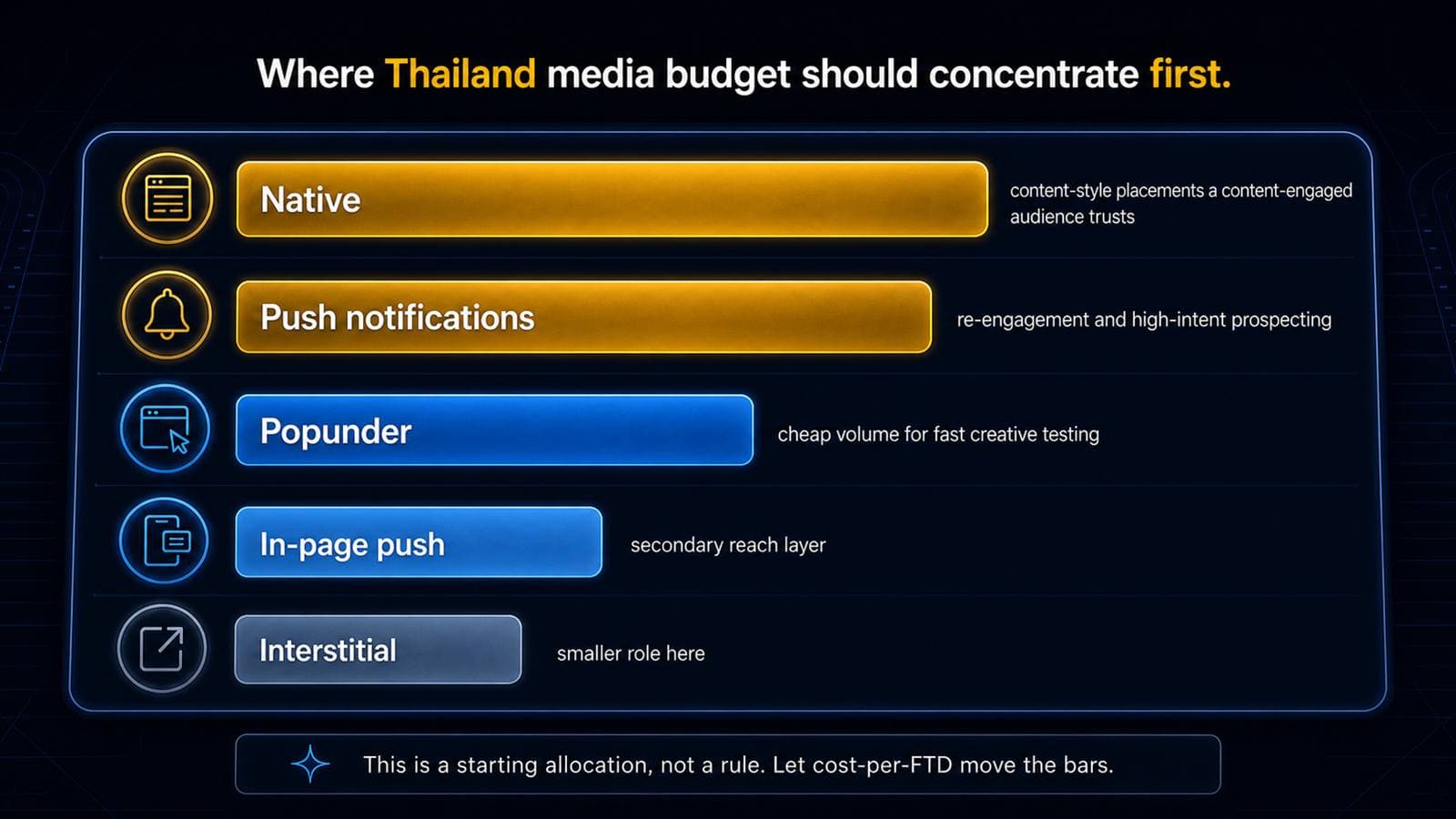
Native earns its keep in Thailand more than in cheaper, volume-first Southeast Asian markets. A more content-engaged audience responds to placements that look like content rather than interruptions, so native creative with a genuinely local angle tends to outperform. Push notification ads handle re-engagement and high-intent prospecting alongside it, and popunder is the format to reach for when a campaign needs cheap volume to test new creative angles fast.
Thai-Language Creative Is Not Optional
Thailand has one of the strongest local-language preferences in the region. Thai-language creative, pre-landers and offer framing consistently outperform English-only campaigns, and the gap is large enough that it should be treated as a baseline requirement rather than a nice-to-have localization step. Pair that with a deposit flow built around the bank-transfer and e-wallet mix Thai users actually use, and the funnel stops leaking first-time deposits at the payment step, the part of the funnel that never shows up in click-through rate.
The Full Format Mix in Practice
Native and push do the heavy lifting, but a Thailand plan uses all five self-serve formats deliberately rather than defaulting to one. Native is the primary converter for a content-engaged, mobile-first audience and should carry Thai-language framing end to end. Push notification ads handle re-engagement and high-intent prospecting, while in-page push is the lighter-touch variant that still reaches users on browsers and devices that suppress classic push, so it is worth running alongside rather than instead of push. Popunder is the cheap-volume workhorse for testing new creative angles before you commit budget to scaling a winner. Interstitial earns its place as a controlled, full-screen test at natural break points, not as an always-on format. Banner and Telegram placements sit outside the self-serve set and are configured through the Taroviser team when a campaign calls for them. The point is to match each format to a job – prospecting, re-engagement, cheap testing, high-impact moments – instead of buying one format and hoping it covers the whole funnel.
Payment Realities at the Deposit Step
Thai depositors move money through a mix of domestic bank transfer and e-wallets, and that mix – not the click – is where a Thailand campaign is won or lost. A deposit funnel that assumes a card-first international checkout will show healthy click-through numbers and then shed first-time deposits the moment a user is asked to pay through a method they do not keep money in. The fix is unglamorous: route the deposit step toward the bank-transfer and e-wallet options Thai users already trust, keep the number of taps between the offer and a completed deposit low, and localize the payment screen in Thai rather than leaving it in English. Because this leak lives below the click, it never shows up in click-through rate and only surfaces in cost-per-FTD, which is the number that actually decides whether a campaign is profitable. If you are buying across the region, the same payment-first discipline applies market by market – our guide to buying casino traffic in Southeast Asia covers how the deposit rails differ between neighbouring geos.
Compliance, Geo-Gating and Responsible Gambling
Thailand has a restrictive gambling environment, and nothing in this guide is a claim about what is or is not legal to run there. Treat regulatory status as a question for qualified local counsel, not for an ad network, and build campaigns so that compliance is enforced at the targeting layer rather than assumed. In practice that means geo-gating traffic to the markets you are actually permitted to target, keeping age-gating and responsible-gambling messaging on landing pages, and confirming that creative claims meet the standards of wherever the traffic is being served. An ad network’s role here is advertiser-facing plumbing – accepting gambling creatives, giving you geo, device and language controls precise enough to enforce your own permitted-market rules, and running anti-fraud so you are not paying for traffic you never wanted. It is not a substitute for legal review. For a wider view of how gambling advertising rules vary by market, see our overview of where gambling advertising is and is not permitted, and treat it as a starting map rather than legal advice.
A Starter Test Plan: Measuring Cost-per-FTD
A first test in Thailand does not need a big budget – it needs tracking wired correctly before a single click is bought. Start by connecting S2S postback for both the registration and the first-time-deposit events, so every dollar is measured against an actual FTD rather than a proxy like clicks or installs. Fund the account at the 50 USD minimum deposit, with no platform fee and no monthly minimum to work around, and split the opening spend across a few formats rather than betting everything on one: Thai-language native and push notification ads as the primary converters, in-page push as a lighter variant, popunder for cheap creative-testing volume, and interstitial reserved for a controlled test at natural break points. Bid on CPM or CPC while you gather data, then hand optimisation to CPA Goal 2.0 – or SmartCPM and SmartCPC – once the postback is returning enough FTDs to steer on.
Read the results in cost-per-FTD, not CTR. A workable Thailand funnel with correct localization tends to land somewhere in the 25 to 75 USD per FTD range; a funnel that is leaking – usually English-only creative, a mismatched payment step, or both – drifts toward 100 to 200 USD and points you straight at what to fix before scaling. Because well-matched self-serve iGaming traffic often runs roughly 30 to 50 percent cheaper than the managed-buy equivalent, the economics of a clean test are forgiving enough to iterate on creative and funnel two or three times before a verdict. Multi-layer anti-fraud runs underneath the whole test so the FTD numbers you are optimising against are real, and campaigns typically clear approval in about two hours, so a full localize-launch-measure loop is a matter of days rather than weeks. For the mechanics of wiring the register and FTD events correctly, see our walkthrough on S2S postback tracking for iGaming.
How to Evaluate an Ad Network for Thailand
Score a candidate on Thai-language targeting and creative support, native ad-format depth, S2S postback so cost-per-FTD is measurable rather than assumed, human-analyst anti-fraud, and approval speed for gambling creatives. A network offering only a broad Southeast Asia buy without language-level targeting will underperform one built to treat Thailand as its own market.
Where Taroviser Fits for Thailand
For Thailand, that means an account that runs its five core ad formats self-serve – push notification ads, in-page push, popunder, interstitial and native – with banner and Telegram placements set up through the Taroviser team, and language-level targeting alongside geo, device, OS, browser and connection type, so a genuinely Thai-language, native-forward campaign is something you configure rather than something you have to request. Reach extends across 200+ geos, with the deeper Asia and Southeast Asia footprint Thailand sits inside. Continuous AI optimisation runs on S2S postback data toward the first-time deposit, backed by human-analyst anti-fraud on top of automated filtering, and a campaign can go live on a 50 USD minimum deposit with no platform fee, no monthly minimum, and approval usually inside two hours.
Related on Taroviser
Related guides
- iGaming Ad Network Vietnam: Buy Casino & Betting Traffic That Converts
- iGaming Ad Network Philippines: Buy Casino & Betting Traffic That Converts
- iGaming Traffic Provider: How to Buy Traffic That Actually Converts
- Telegram Ads for iGaming: How to Advertise on Telegram (Cost, Formats, Setup)
- Casino Advertising in 2026: How to Advertise an Online Casino
- Sportsbook Advertising in 2026: How to Advertise a Sportsbook and Betting Offers
Traffic & ad formats
Frequently asked questions
What is an iGaming ad network for Thailand?
A network built for Thailand specifically sells traffic to casino and betting advertisers with Thai-language targeting and format handling native to that market, not a Southeast Asia buy with Thailand as one line in a country list. Gambling creatives are accepted, language and device targeting go together, and pricing is built to chase the first-time deposit rather than the click.
Which ad formats work best for Thailand?
Native and push notification ads carry most of the weight in Thailand. Native placements suit an engaged, content-aware mobile audience and blend into the feeds Thai users already browse, while push handles high-intent re-engagement and prospecting. Popunder adds cheap testing volume when a campaign needs to scale fast.
Does Thai-language creative actually matter that much?
Yes. Thailand has a strong local-language preference, and Thai-language creative is treated as essential rather than optional in this market. Running English-only creative into Thai traffic is one of the more common ways advertisers quietly inflate their cost-per-FTD without realizing why.
What payment behavior should my funnel be designed around in Thailand?
Thai depositors use a mix of bank transfer and e-wallets, and a deposit funnel localized to that mix lifts first-time deposits noticeably compared to a generic international checkout flow. The lift shows up in cost-per-FTD, not in click-through rate, so it is easy to miss if you are only watching CTR.
What does it cost to start buying Thailand traffic through Taroviser?
Getting started costs a 50 USD minimum deposit, with no platform fee and no monthly minimum standing between you and a real test of the Thai market. Campaign approval typically clears in under two hours.
Ready to launch?
Put these tactics to work with premium iGaming traffic on Taroviser.
Start advertising