
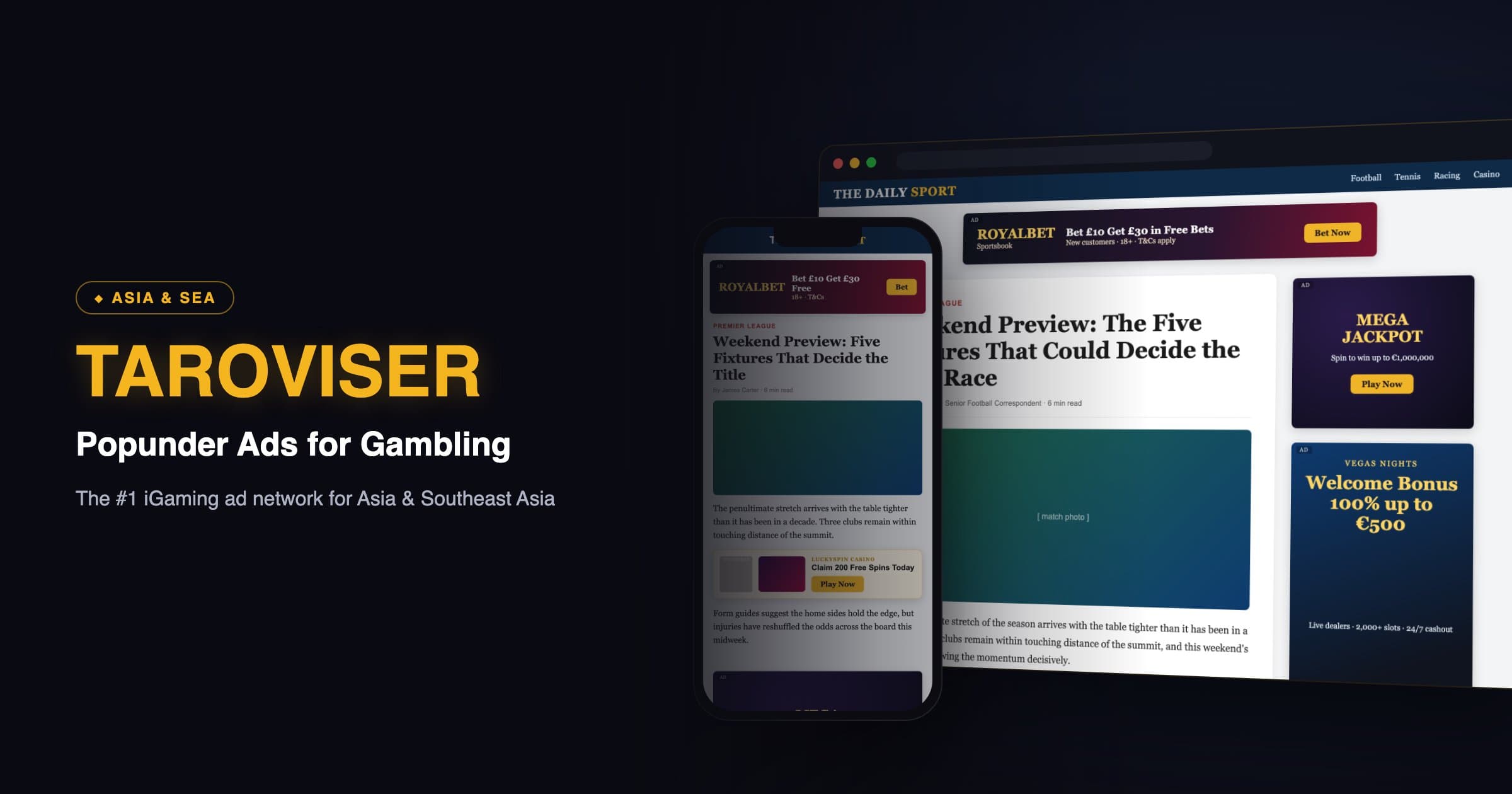
Popunder Ads for Gambling: The Advertiser Playbook
Ask ten iGaming media buyers what they think of popunders and you'll get ten different reactions. Some swear by them. Others wrinkle their nose and mutter something about bots. Both camps are partly right, and that tension is exactly why this format is worth a serious look.
Popunders have been around longer than most ad networks in this space. They survived the death of pop-ups, the rise of native, the whole "is display dead?" panic. They're still here because, run properly, they push enormous volume at a price almost nothing else can touch. Run sloppily, they burn budget on traffic that never had a pulse.
This is the buyer's-eye breakdown. What the format actually is, the geos and verticals where it earns its keep, what you should pay, and the part most guides skip entirely: how to keep your spend honest when fraud is baked into the cheap end of the market.
What a Popunder Actually Is
A popunder opens a new browser tab or window behind the page someone is already looking at. They keep reading, watching, scrolling, whatever. Your landing page is sitting underneath, waiting. They notice it when they close or minimize the active window.
That's the whole mechanic. No overlay, no interruption, no "X" to dismiss before the content loads. The user's session isn't broken, which is the quiet reason the format has outlasted its noisier cousin, the pop-up.
A few things follow from that design, and they matter for how you plan a campaign:
- It's a full-page canvas. You get a whole browser window, not a 300x250 box. Your landing page does the heavy lifting, so creative quality lives or dies on the LP, not on a banner.
- Impressions are cheap and plentiful. Because one page view can trigger one popunder, inventory is huge. CPMs sit at the bottom of the market.
- Attention is delayed, not guaranteed. The user sees your page on their schedule, not yours. Sometimes that's thirty seconds later. Sometimes it's when they close fifteen tabs at end of day.
- Frequency capping is non-negotiable. Show the same person four popunders in an hour and you've made an enemy, not a depositor.
So popunders aren't a branding play and they're not a precision-targeting play. They're a volume-and-price play. You're buying reach at a unit cost that lets you test offers fast and lose cheaply on the ones that flop.
Where Popunders Earn Their Keep in iGaming
Not every offer fits this format. Pushing reach at a rock-bottom price only works when your funnel can convert cold, low-intent visitors quickly. Here's where it tends to pay off.
Casino and slots offers with a strong free-spin hook
Cold popunder traffic responds to instant gratification. A welcome bonus that's visible above the fold, a no-friction registration, a free-spins offer with a number attached, that's the kind of LP that turns a delayed glance into a click. Slow, story-driven landers tend to die here.
High-volume geos where CPMs stay low
Tier-2 and tier-3 markets are popunder country. Latin America, Southeast Asia, parts of Central and Eastern Europe, India. You can buy serious impression counts for a fraction of what tier-1 costs, and many of these markets have growing, mobile-first audiences that respond well to casino and sports offers. Always check the regulatory status of each geo before you scale, because "available inventory" and "permitted to advertise" are not the same thing.
Retargeting and funnel-filling
Popunders are blunt for cold prospecting but useful for keeping an offer in front of an audience you've already touched through push or native. Think of the format as a cheap top-up layer rather than the spearhead of a campaign.
Fast creative and offer testing
Because the entries are cheap, popunders make a decent laboratory. Want to know whether a new casino brand resonates in Brazil before committing real spend to native? Run a controlled popunder test, read the early signals, then move budget to the format that monetizes best. Just don't confuse a cheap click with a quality one, more on that below.
When does the format struggle? Premium tier-1 brand campaigns, anything that needs careful audience curation, and offers with long, education-heavy funnels. If your player needs to read three paragraphs before they get it, a popunder isn't your friend.
What You Should Pay: CPM and the Cost That Actually Matters
Popunders are almost always sold on a CPM basis, cost per thousand impressions. That's the headline number, and it's where the format's reputation for cheapness comes from.
Rough ranges, and treat these as directional rather than gospel because rates move with season, geo, and competition:
| Geo tier | Typical popunder CPM | Notes |
|---|---|---|
| Tier 1 (US, UK, CA, AU, DE) | higher end | More competition, stricter compliance, premium audiences |
| Tier 2 (BR, PL, ZA, parts of SEA) | mid | Strong iGaming demand, growing mobile bases |
| Tier 3 (IN, ID, and similar) | low | Huge volume, cheapest impressions, demands tighter fraud control |
Here's the thing, though. CPM is not the number you should be optimizing against. For a gambling advertiser, the metric that pays your salary is cost per FTD, cost per first-time depositor. A popunder source can show you a gorgeous CPM and still bleed you dry if those impressions never turn into funded accounts.
I've watched buyers chase the lowest CPM on a dashboard, scale the source, and discover three weeks later that their cost per FTD doubled. The cheap traffic was cheap for a reason. The discipline that separates profitable popunder campaigns from money pits is simple to say and hard to do: judge every source on what it costs to acquire a real, depositing player, not on what it costs to serve an impression.
That's why a CPA-FTD pricing model, where you can structure spend around actual depositors rather than raw volume, changes the math in your favor. At Taroviser we run CPM, CPC, and CPA-FTD models on popunder inventory specifically so you can shift the risk onto the metric that matters. Buy impressions when you're testing. Buy depositors when you're scaling.
The Fraud Problem Nobody Wants to Talk About
Let's be honest about the format's weak spot. Because popunder inventory is cheap and abundant, it's also where a lot of low-quality and fraudulent traffic hides. Bot farms, forced redirects, stacked iframes that fire dozens of "impressions" no human ever saw, click spamming designed to poison attribution. The cheaper the unit, the more attractive it is to people gaming the system.
If you've ever run popunders and seen a click-through rate that looked too good to be true, it probably was.
The common types of junk you're up against:
- Bot traffic. Automated scripts generating impressions and clicks with no human behind them. High volume, zero deposits.
- Forced or hijacked redirects. A user gets shoved to your LP by a malicious script rather than a legitimate popunder trigger. Bounces instantly.
- Impression stacking. Multiple ads layered invisibly so one page view bills as many. You pay for views nobody saw.
- Attribution fraud. Click injection and click spamming that steal credit for organic installs or deposits, distorting which source you think is working.
Automated filters catch a chunk of this. IP blacklists, datacenter detection, behavioral scoring, device fingerprinting, they all help and they're table stakes. But fraud evolves faster than any static rule set. Sophisticated operations mimic human patterns well enough to slip past pure machine filtering.
This is where a human-in-the-loop matters. At Taroviser, anti-fraud isn't only an algorithm running in the background. Human analysts review traffic patterns, flag anomalies the automated layer waves through, and shut down suspect sources before they drain your budget. Machines are fast; people catch the clever stuff. You want both.
Two practical habits will protect you regardless of which network you run:
- Wire up S2S postback tracking from day one. Server-to-server postbacks report real conversions, registrations, FTDs, deposits, back to the source without relying on cookies or client-side pixels that fraud can spoof. It's the cleanest way to tie spend to genuine player value. Taroviser supports S2S postback so your optimization runs on verified events, not vanity metrics.
- Optimize on post-deposit behavior, not clicks. A source that delivers cheap clicks but no FTDs is a source to cut. A source that delivers slightly pricier clicks that turn into funded, retained players is a source to scale. Let the deposit data, not the impression count, steer your budget.
Running a Popunder Campaign Without Getting Burned: A Short Checklist
If you take one section into your next campaign, make it this one.
- Start small and segmented. Launch by geo, device, and OS in separate campaigns so you can read signals cleanly. One blended campaign hides the source killing your ROI.
- Cap frequency. One to three impressions per user per day is a sane starting point. Overexposure tanks performance and annoys real prospects.
- Set a clear conversion goal before you spend. Decide whether you're testing for clicks, registrations, or FTDs, and instrument accordingly.
- Whitelist and blacklist relentlessly. Within the first few days you'll see which sources, sites, and zones convert. Cut the dead weight fast and pour budget into the winners.
- Match the LP to the format. Fast-loading, mobile-first, offer above the fold. Popunder visitors arrive cold and impatient.
- Read cost per FTD weekly, at minimum. CPM tells you how cheap the inventory is. Cost per FTD tells you whether you're actually making money.
None of this is glamorous. All of it is the difference between a popunder campaign that prints and one that quietly drains.
How Taroviser Approaches Popunder for iGaming
A quick word on where we fit, because the format is only as good as the network running it.
Taroviser is an iGaming-specialized ad network built for advertisers in Asia and Southeast Asia, with local market intelligence baked into how we plan campaigns across 200+ geos. Popunder sits alongside push, in-page push, native and banner formats, so you're not locked into one channel, you can blend them around how a given market actually behaves.
What we lean on for popunder specifically:
- CPM, CPC, and CPA-FTD models so you can price for testing or for depositors.
- Human-analyst anti-fraud layered over automated filtering, because the clever fraud is the kind machines miss.
- S2S postback tracking so optimization runs on verified conversions.
- AI-driven optimization with 24/7 support to keep campaigns tuned around the clock.
- No platform fee, no minimum spend, and a fast, advertiser-friendly approval process so you can launch and iterate without bureaucracy.
The result, when it works, is a popunder program judged on cost per FTD and protected by people who look at the traffic, not just dashboards that summarize it.
FAQ
Are popunder ads still effective for gambling offers in 2026?
Yes, when used correctly. Popunders remain one of the cheapest ways to reach high-volume audiences in tier-2 and tier-3 geos. The format rewards strong free-spin and welcome-bonus offers with fast landing pages, and it works best as a volume layer judged on cost per FTD rather than a precision branding tool.
What's a good CPM for popunder traffic in iGaming?
It depends heavily on geo and competition, so treat any single number with caution. Tier-1 markets run higher, tier-2 sits mid, and tier-3 is cheapest. The more useful question is your cost per first-time depositor, because a low CPM that never converts is more expensive than a higher CPM that funds real players.
How do I avoid fraudulent popunder traffic?
Combine automated filtering with human review, run S2S postback tracking from launch, optimize on FTDs rather than clicks, and aggressively blacklist sources that deliver impressions or clicks but no deposits. Taroviser pairs automated detection with human analysts who flag anomalies the machines miss.
Popunder vs push notification ads, which should I use?
They solve different jobs. Push and in-page push are opt-in style formats good for re-engagement and retention. Popunders are cold, high-volume reach at the lowest unit cost. Many advertisers run both: popunders to fill the top of the funnel and push to bring audiences back.
Can I pay only for depositors instead of impressions?
With Taroviser, yes. We offer a CPA-FTD model alongside CPM and CPC, so you can structure spend around first-time depositors when you scale and shift the volume risk off your budget.
Which geos work best for gambling popunders?
High-volume tier-2 and tier-3 markets across Southeast Asia, Latin America, India, and parts of Central and Eastern Europe tend to deliver the strongest impression-to-cost ratios. Always confirm the regulatory and advertising status of each market before scaling, since available inventory doesn't mean permitted promotion.
Ready to Run Popunders That Convert?
If you want popunder inventory priced on depositors, protected by human analysts, and tuned by a team that knows Asia and SEA, that's the entire reason Taroviser exists. No platform fee, no minimum, fast approval, and CPM/CPC/CPA-FTD models to match how you actually buy. Reach out and we'll map a popunder plan to your offer and your geos.
Related on Taroviser
Related guides
- Do Fullpage Interstitial Ads Increase iGaming Conversions? What It Does
- iGaming Ad CTR Benchmarks by Format: How to Read Them Without Fooling Yourself
- Adsterra Alternative for iGaming: Why Specialist Beats Generalist at Scale
- Best Popunder Ad Networks for Gambling Traffic in 2026
- Casino Ads Banned on Google? The Compliant Alternative for iGaming Advertisers
- How to Run Casino Push Notification Campaigns That Convert
Traffic & ad formats
Ready to launch?
Put these tactics to work with premium iGaming traffic on Taroviser.
Start advertising